Ann Droid: Review: Series 1 Episodes 3-6
Sue becomes ever more emotionally reliant on her Eldercare robot, but her son Michael’s marriage is at breaking point, and if he moves back home the robot will have to […]



Sue becomes ever more emotionally reliant on her Eldercare robot, but her son Michael’s marriage is at breaking point, and if he moves back home the robot will have to […]
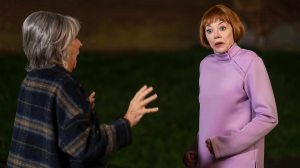 Sue becomes ever more emotionally reliant on her Eldercare robot, but her son Michael’s marriage is at breaking point, and if he moves back home the robot will have to go.
I was invited by Managing Editor, Paul Simpson, to write my first review for Sci-Fi Bulletin almost six years ago this month. It was in the strange nether-limbo between the first and second UK Covid lockdowns. It was a lifesaver of sorts – one that Rishi Sunak’s ‘Eat Out to Help Out’ scheme hadn’t quite managed to crack. No one believed the crisis was over and for screenwriters like myself, pretty much all of my work had ground to a halt, and was only just sputtering back to uncertain life. While many in my trade talked about writing novels or that long deferred spec script, in reality I wasn’t exactly feeling inspired. But if it’s true that the brain is a ‘muscle’ that has to be exercised to stay healthy, then much the same can be said for one’s skill as a writer.
I had done bits and bods of reviewing prior to this – mainly on BBC Radio 4 – but written criticism wasn’t in my skillset, despite having done a module on it as a student at Manchester University in the early 1980s. Indeed, I’d barely ever ventured into pure prose. The dialogue in scripts may have to be beautiful, but let’s face it, the rest of our output is largely in the form of instructions.
As Paul gave my first couple of reviews the thumbs up (despite my hopeless misuse of apostrophes) I realised how much I enjoyed this new discipline, and Sci-Fi Bulletin swiftly became my writing ‘gym’. Even when my work picked up again, I made sure to carve out time for the four hundred (give or take) film, TV and stage reviews, along with the occasional feature and fun pieces penned with my esteemed colleague Nick Joy, that have followed since. Indeed, such was the confidence it gave me in the prose arena – with the help of Paul’s wise, good natured but strict (!) editorial guidance – I did, in the end, write that book.
I know. You’re waiting for me to say something – anything! – about Ann Droid. But for this particular review I ask you to be patient (even more patient than you have been in the past when I’ve rambled on).
Obviously, you can’t move on the internet for reviews – not just for films and shows, but for delivery drivers and the call centre you rang to complain about your central heating insurance – so the reader might be forgiven for wondering why I’m getting so dewy eyed about this. Aren’t reviews just people egotistically just mouthing off about their opinions? Well, yes, but there is – there should be! – more to it than that.
A review, like any writing, needs structure – a beginning, a middle and an end – and hopefully elegance. Like any drama, it should ask a question (e.g. why is this guy twittering on about reviewing and not talking about bloody Ann Droid???) and then take the reader on a journey as it seeks to find some answers. Not just ‘is this show any good?’ – but ‘how and why have the artists executed this project in the way they have’ and ‘where does this work of art (genre entertainment is Art – let’s never pretend it’s anything less) fit into the larger culture and politics that defines us?’ And hopefully, by asking those questions we might just stumble on more fundamental truths about who on earth we are in this ever more unstable and frightening world.
Oh yes, and if you want to have the slightest hope that people will follow you in this cross examination of film and programme making, you need to form a relationship with the reader, keeping them entertained along the way, if you can, with gags, conceits and motifs. Given that so much humour is rooted in others’ misfortune, that tends to mean that the most memorable reviews are the rants and takedowns. But while bad work does need to be called out from time to time – I can’t pretend that aiming one’s satirical guns at a complete turkey isn’t fun to write – ripping a piece of work to shreds shouldn’t give the responsible reviewer any pleasure.
Every time the lights go down in the cinema, or I run a preview of a show on my TV, I want absolutely nothing more than for it to be brilliant. It’s the possibility of joy at the next beautifully crafted genre entertainment that really gets me up in the morning. As a reviewer one can only hope that by celebrating the Good – the Excellent – it might just skew the creative landscape that tiny bit, if only through the power of positive affirmation.
All of which is an extremely long-winded way of saying how thrilled I am that this last review I am penning for Sci-Fi Bulletin can be just one of those celebrations. It would have been an even sadder day than it is to have bowed out trying to find the funny side of mediocrity.
Ann Droid is one of those joyous shows that hits every note with the clarity of a perfectly struck tuning fork. When it needs to be funny it makes you laugh out loud, mainly at Diane Morgan’s droid’s robotic lack of tact. When it needs to be serious, it seems churlish not to shed a tear for Sue’s grief and loneliness, played absolutely for real by Sue Johnston. But these are notes with complex harmonics. With an exquisitely constructed set piece when Sue and Linda visit a tacky funfair clairvoyant, the laughter and the tears come at the same time. In another superbly conceived moment, the robot terrifies a group of children (who insist they want to hear a scary story) with an account of humankind’s self-inflicted path to oblivion. Laugh out loud funny and stomach churningly true at one and the same time.
In genre terms, while one could argue that Ann Droid is nothing more than the odd couple formula comedy dressed up as science fiction, I’d counter that it earns its genre stripes because it poses a more prescient question: What does our developing relationship with Artificial Intelligence tell us about being human?
So, thank you Diane Morgan for letting me say farewell to Sci-Fi Bulletin on such a positive note. I’ll keep on posting reviews and reflections over on my own website www.ninjamarmoset.com or via my Bluesky handle at @smartartz.bsky.social if anyone cares to carry on the journey there, although I can’t guarantee to put all my apostrophe’s [sic] in the right place.
And thank you, Mr Simpson, for giving me permission to explore the ideas gathered over five decades in the creative industries, the ideas closest to my creative heart with only the lightest – but clearest – of editorial touches.
I hope I speak for all my colleagues and all the readers of this great website in sending you our love and wishing you the very best in all that still lies ahead.
Verdict: Which only leaves the small matter of another 9/10 for Ann Droid. If you haven’t caught it already, it really will bring a smile to your summer.
Martin Jameson
 Doctor Who News Star Trek News
