Review: Greenland 2: Migration
Five years after the Clarke impact, Earth is wracked with electromagnetic storms, radiation and tectonic shifts. The survivors at Thule Base are getting by but are short on resources and […]



Five years after the Clarke impact, Earth is wracked with electromagnetic storms, radiation and tectonic shifts. The survivors at Thule Base are getting by but are short on resources and […]
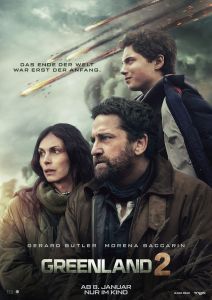 Five years after the Clarke impact, Earth is wracked with electromagnetic storms, radiation and tectonic shifts. The survivors at Thule Base are getting by but are short on resources and long on determination. Until a final catastrophic earthquake forces their hand and sets the Garrity family and their friends on an international journey to the Clarke crater, the last place on Earth said to have a stable climate.
Gerard Butler’s continual refusal to do the obvious thing (or not just the obvious thing) reaches a zenith of sorts here. John Garrity is dying, the radiation the planet is periodically soaked with killing him after so many scavenging trips to the surface. There’s no workaround, no get-out. John dies at the end, and the movie is entirely about what he wants to get done before then.
Oddly, that feels rather muted. While the tsunami-based destruction of Greenland looks and feels dangerous, it hits just a beat too quickly. We’ve just figured out who the Garritys’ new friends are and the life they’re struggling with when it’s turned on its head. It’s crowd-pleasing certainly but it feels oddly rushed.
That sense of rush defines the entire movie. Structurally it’s got similar beats to the original, with the Garritys encountering people in Liverpool, London, at the Channel and in France on their way to the crater. But where the people they meet in the first one feel like the leads of their own story, these people feel like they’re hitting marks. A grumpy soldier in Liverpool, a well-meaning cabbie and the other Greenland survivors we spend time with all feel this way. The most egregious example is the Laurent family, who they meet in France. William Abadie is great as Denis, the family patriarch but he essentially gives his daughter up for adoption to the Garritys inside ten minutes. He has reasons, admittedly, but again, rushed.
 The same is true of some of the plotlines. A lot of society has survived and, in some cases, clearly degraded but there are plenty of people still in the world and we almost never get context for them. A war between the last two cities in France is explained in about as many words as are in this sentence. The military in Liverpool seem clothed, well fed and well resourced five years after the end of the world and their one character trait is Dangerous. I’m not asking for details of how all this works, but I’m asking for a sense of how it could. One of the great strengths of the original was that the evacuation plan seemed well thought out, focused and oddly ruthless. Here the Garritys run towards an unlikely refuge which turns out to be perfect and the end credits roll.
That being said, there’s still a lot to enjoy here. Morena Baccarin is given noticeably more to do and engages with it very well. Sophie Thompson has a great cameo as their London friend Mack and there are moments of alien beauty that mirror the original. The terrifying ladder crawl across a canyon at the bottom of the emptied English Channel is a brilliant white knuckle beat and the offhand ruthlessness with which characters are dispatched is genuinely shocking.
Verdict: There’s a good movie here, but it’s one that would benefit vastly from an extra 20 minutes. As it stands, this feels as much like a set up for a third movie (and one I’d love to see frankly) as it is a sequel. Good, but not as good as the original. 7/10
Alasdair Stuart
 Doctor Who News Star Trek News
