007: Feature: Which Bond is Which?
With the publication of Kim Sherwood’s Hurricane Room this week, bringing her trilogy of OO adventures to a close, Paul Simpson takes a look back at the last quarter century […]



With the publication of Kim Sherwood’s Hurricane Room this week, bringing her trilogy of OO adventures to a close, Paul Simpson takes a look back at the last quarter century […]
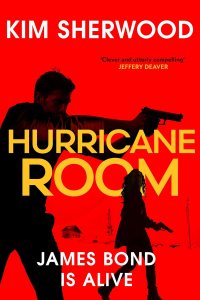 With the publication of Kim Sherwood’s Hurricane Room this week, bringing her trilogy of OO adventures to a close, Paul Simpson takes a look back at the last quarter century of Bond tales – and the multiple continuities that now exist…
It all used to be so simple. You basically knew where you stood with James Bond – it was one of two versions. There was the character created by Ian Fleming who appeared in the books, and there was a screen adaptation of Bond with his own particular traits and foibles, many of which overlapped.
But that’s all changed in the last few years.
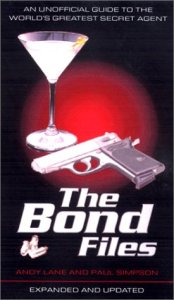 Thirty years or so ago, Andy Lane and I sat down to write The Bond Files, a guide – as far as we could manage it – to every story that had been created for James Bond, from Casino Royale onwards. We pretty quickly realised we had bitten off more than we had expected: sure, there was much more than the Fleming novels and the movies, we’d known that and that was part of the raison d’etre for the book, but we found we needed to cover the daily newspaper strips, the assorted comic books, the radio plays (even then, plural), the computer games… and of course the continuation novels. One of the unique features to the book (and remember this was very much the pre-internet days when such things were far less common than they are now) was a timeline so that you could, should you choose, follow Bond’s life.
Three editions of The Bond Files were published by Virgin, the last in 2002, taking us up to the closing stages of Raymond Benson’s time as chronicler in print, and Pierce Brosnan’s final movie (although our early information on that proved to be a bit far off the mark). But we’d tracked down the comics, I had gone to the Colindale Library to read every one of the Bond strips that appeared over here, we’d bought a load of Swedish comics that had new stories. It was as good as we could make it.
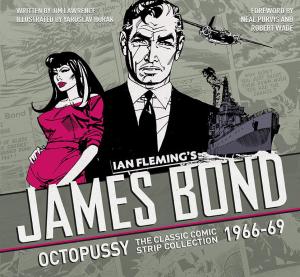 There were certain fundamentals at that stage: Bond in print was pretty self-consistent. OK, John Gardner and Benson made a few changes to what had come before, but squinting a bit, you could make pretty much everything from Fleming’s Casino Royale to Benson’s The Man with the Red Tattoo tie together. Even Gardner’s and Benson’s novelisations of Licence to Kill and the entire Brosnan period could be made to fit. (Christopher Wood’s James Bond and Moonraker, nope, no way; come to that, John Pearson’s James Bond – An Authorised Biography from 1973, ditto.) The newspaper strips worked pretty well in this timeline as well: they began as adaptations of the stories, and gradually became more original – The Spy Who Loved Me, for example, is much stronger than the story it’s based on – with 14 years of new adventures that built on Fleming, albeit with some intriguing twists of their own. It still amuses me that to include them in the book I had to look at physical copies of the newspapers, which were brought out in bound volumes; now the stories are all available from Titan in various editions.
The movies were their own separate continuity. Again, you had to squint a little to believe Connery’s Bond in Dr No is the same man as Brosnan’s in Die Another Day, but that seemed to be the intention much of the time.
And that’s where we stopped. Just before Bond’s continuity exploded, like Skyfall on the day Silva came to visit.
 To be fair, Glidrose Publications (the forerunner of Ian Fleming Publications) kept a tight rein on things during the 20th century. Books had been submitted for publication as Bond continuation novels that weren’t considered up to scratch, and even if it’s true that the later novels sold very few copies, they maintained an internal continuity.
The 21st Century was when everything changed.
The expansion of the Bond universe began with Silverfin, Charlie Higson’s first Young Bond novel, published in 2005. Fleming had hedged his bets on Bond’s birth year – was it 1920 as most evidence would indicate or 1924 as suggested by the obituary in You Only Live Twice? – and Higson went with the former. (The previous James Bond Junior novel from the 60s, as well as the 1990s animated show/comic book were definitely set in a completely different world from Fleming’s.) Higson’s novels were filling in gaps in Fleming’s “chronology” but the intention was definitely that the boy who met Lord Hellebore grew to become the agent we met in Casino Royale.
But could the same be said of the other new Bond series that started the same year? The Moneypenny Diaries, a trilogy told from the point of view of Miss Moneypenny, interwove its story around the events of the later Fleming novels, starting with OHMSS – but definitely went off piste as the trilogy expanded. If we’d been continuing the Bond timeline from The Bond Files, there would have been some lively discussions over whether to include these.
 (The radio series, starring Toby Stephens as Bond, began as a one-off for 2008, the centenary of Fleming’s birth, with an enjoyable, and on the whole faithful, version of Doctor No. This was so successful that permission was granted for versions of all the novels – bar You Only Live Twice which had been adapted in the early 90s with Michael “Quiller” Jayston as Bond. Sadly, some of these deviated more from the original text than others (Casino Royale is cut back to an hour, losing one of the most famous opening lines in fiction in the process; Live and Let Die needed other excisions to be broadcastable now) and there were attempts to link Bond’s activities to the real world. Not always successfully, it has to be said. Still, they’re well worth a listen – and aren’t really their own continuity.)
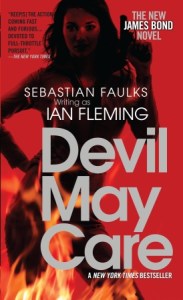 2008 also saw the first of the new novels. IFP had decided not to continue with a “contemporary” Bond, and instead turned to a “name” author to pen a novel that sat within the framework of the Fleming stories. While EON had a new Bond in Daniel Craig, whose entire career as 007 from first kill to last, was chronicled over 15 years, Devil May Care, Sebastian Faulks’ contribution, stayed back in the 20th century and was set directly after The Man With the Golden Gun – but managed to ignore the fact of Bond’s odyssey through Russia just prior to that book.
 IPF turned to Lincoln Rhyme creator Jeffery Deaver for the next novel – but 2011’s Carte Blanche tore up the new rule book, such as it was. While there were characters who bore the same names, and a degree of the same histories, as those in the Fleming saga, this was a defiantly 21st century take on 007, and had the now irritating trope of backstories involving the lead character’s parents (cf The Amazing Spider-Man movies and the unsold Saint pilot from 2013). Although it’s an enjoyable read, it was a very different take on Bond – and without any doubt, the first of the “alternate universe” 21st century Bonds. We’d have needed to create a whole fresh timeline…
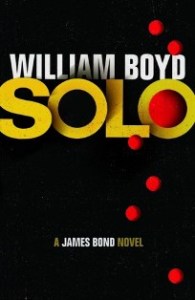 However IFP went back to basics for the next novel, William Boyd’s Solo, out in 2013. Boyd elected to go with Fleming’s later date of birth for Bond, so his 007 is 45 in 1969, when the book is set, and there’s a lot of reference to aging in a series that, frankly, does its best to ignore it the majority of the time. The real world intervenes more than perhaps one would expect in the escapist Bond universe, and the end result is quite underwhelming. Still, as far as continuity is concerned, it did hove true to Fleming’s established facts. (Personally, as I said in my review at the time, I’d have rather had a novelisation of Skyfall.)
However, 1920 was still Bond’s date of birth in Shoot to Kill, the first of Steve Cole’s quartet of novels continuing Young Bond’s adventures, which appeared between 2014 and 2017, and, as with Higson’s early novels, they fit with what we know from Fleming’s stories.
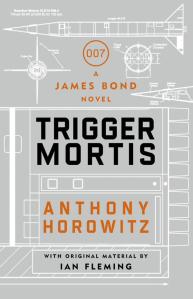 Also very deliberately neatly fitting in were Anthony Horowitz’s trilogy of tales, which were published out of chronological order – Trigger Mortis (2015) follows Goldfinger, while Forever and a Day (2018) precedes Casino Royale, and With a Mind to Kill (2022) follows The Man with the Golden Gun. The rule that the authors had to simply fit in with Fleming is taken to its limits here in the final book – but there’s enough of a loophole for Colonel Sun at least to follow (if not Devil May Care).
 At the same time as Horowitz was expanding the Fleming stories, Dynamite Comics was doing something very different with the characters. This was a full scale update to the 21st century, something which had been tried with Carte Blanche but which was far more successful in graphic form, with stories and spin-offs for the modern day versions continuing for over 10 years. This was a second “alternate” print universe. (Dynamite also has its own version of Young Bond, James Bond Origin which worked off the 1924 date – this doesn’t fit with the Higson/Cole books at all.)
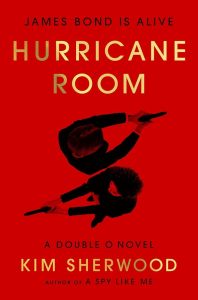 Dynamite’s series overlapped with the largest revamp of the Bond world to date, with Kim Sherwood’s OO series of novels which takes the concepts by the scruff of the neck and gives them a good shake. Some of the agent names are a little on the nose – they feel like in-jokes for a first draft, or at the very least should have been spread a bit wider across the trilogy – but Sherwood has gone back to basics (as Deaver did), and reinvented the whole Bond mythos (and created a third “alternate” in the process). Bond is missing at the start of the trilogy, Double or Nothing, but his presence is felt throughout, and the third volume is out very shortly. (I do feel a bit sorry for Deaver, who tried to do the same thing 12 years earlier – it’s a bit like Timothy Dalton’s Bond being so criticised for everything that was praised two decades later in Daniel Craig’s interpretation.)
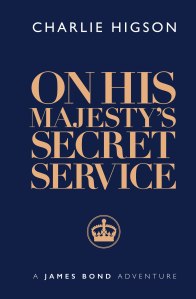 But even though Sherwood has gone to considerable efforts to create a viable version of MI6 for the 21st century, neither of IFP’s two most recent contemporary-set books have been set within it. (Raymond Benson’s The Hook and the Eye is a Felix Leiter story set around the same time as the early Fleming books and fits in there.) Charlie Higson’s On His Majesty’s Secret Service was a rapidly written tie-in to King Charles’ coronation, which was tidied up to an extent for the paperback version, but which revamps things for effectively a fourth “alternate” – and it’ll be interesting to see if his forthcoming King Zero follows on from this.
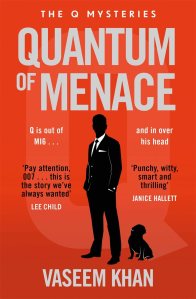 Bond also features in Vaseem Khan’s Q Mysteries, which began last year with Quantum of Menace. No two ways round it, this has to be yet another alternate – the central character of Q (aka Major Boothroyd) interacts with two versions of M, neither of which really fit the literary versions (and aren’t really consistent with the film ones either) and couldn’t fit with Sherwood’s series. The devices he’s created for Bond are ones from the movies, and the Bond we meet feels more like hero worship on the part both of character and author.
 So there’s a degree of pick and mix nowadays. There’s more stories about the original character and set up created by Ian Fleming than anything else (which include Higson and Cole’s Young Bond, Robert Markham’s Colonel Sun, Christopher Wood’s James Bond, The Spy Who Loved Me, John Gardner, Raymond Benson, Sebastian Faulkes, William Boyd and Anthony Horowitz’s novels as well as the newspaper strips).
But if you want a 21st century revamp you have various options:
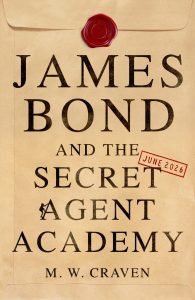 And, apparently there’s a retired Bond on the way in M.W. Craven’s James Bond and the Secret Agent Academy, delayed now into next year. Hmmm…
 Doctor Who News Star Trek News
