The Underground Railroad: Review: Chapter 2: South Carolina
Spoilers Cora and Caesar are free of the plantation and the slavery they endured under their old master, Randall. This episode sees them having settled into a town called Griffin […]



Spoilers Cora and Caesar are free of the plantation and the slavery they endured under their old master, Randall. This episode sees them having settled into a town called Griffin […]
 Spoilers
Cora and Caesar are free of the plantation and the slavery they endured under their old master, Randall. This episode sees them having settled into a town called Griffin in the neighbouring state of South Carolina where White and Black people appear to live side by side.
Our opening is in a museum where Cora is working as something of a live exhibit – pretending to be an ‘African’ so White folk can see what it was like for Black people before they came to America. If it seems absurd we should remember that ‘museums or zoos’ like this actually existed – and not only in the US but also in Europe (not least the 1958 World Fair staged by Belgium). In other words my parents were alive when it was still considered acceptable to have PoC parade around in a zoo like animals.
Caesar is working in a coke house – shovelling coke around with a rudimentary filter strapped to his face. On the face of it they have jobs, a measure of freedom and a distinct lack of persecution. White folk are generally polite, there’s no violence and they are free to come and go as they please.
It feels like a small glimmer of a better life.
Cora and Caesar are living their lives pretty much separately, going about their business and slowly courting when chance allows. Yet despite how different their lives are there emerge commonalities.
Cora has to engage in roleplaying being a slave, a real experience for her but here rendered as entertainment for the White people of the town who come and gawk and listen to absolute nonsense about what Black people think, feel and are capable of. The town works hard to bring Black people among the majority White population but does so by painting them in a particular way.
Caesar, who can read and write, is quickly found an assistant’s job, his skills lauded as the ‘future of the Black race’.
There is no physical violence in this episode. However, the emotional and spiritual violence visited upon Cora, Caesar and the Black people among whom they now live is deeply disturbing.
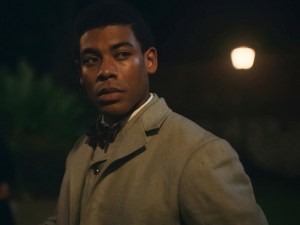
Both Thuso Mbedu and Aaron Pierre carry themselves with quiet dignity, entering the episode full of distrust, only slowly letting their guard down and in so doing discovering a kind of horror which, in its own way, is as bad as anything they’ve known so far.
The reason? Griffin is a town running a grand experiment. The White people here are using the Black population as test subjects. Whitehead’s material compresses events which, in the real world, occurred over many decades, putting them as a single stream of encounters for Cora as she explores what the true Face of America looks like.
Griffin and its doctors in the shape of Chris Berry’s Mr. Fields and Megan Boone’s Miss Lucy have a singular view of the future and their place in it. To whit, they regard themselves as the saviours of the Black race, entitled to educate them, to save them and to literally shape them into the kinds of bodies which will fit usefully into (White) American society.
The men are being poisoned in small doses to see just how much punishment they can take. The women are being tested and then universally sterilised – nearly all of them against their will. All this is happening undercover, hidden and mythologised as the perfection of the Black Race.
When Cora asks why there are no Black babies she’s told it’s because the Black population is growing too quickly but when Cora’s doctor talks about who should be sterilised, his list includes only the socially ‘undesirable’ as it stood at the time – the imbecile, the criminal, the loose woman, the mentally unstable.
We know America was a world leader in racially motivated Eugenics (estimates put the number of involuntarily people sterilised in the hundreds of thousands and, at one point in the 1970s, up to 40% of all indigenous women had been sterilised).
America’s views on eugenics have always been deeply racist, intersecting with poverty, and racial stereotypes being seen as actual biological markers of genetic status. Indeed, the racism towards southern and eastern Europeans so prevalent in the US also finds its voice in this movement (and indeed in expert witness before Congress and legislation to enshrine these ideas in law and policy decisions).
Griffin in the show is portrayed as the very avant garde of society, with its skyscrapers and calisthenics classes, its free vitamins for its population and its literacy classes for all new arrivals.
The show here is interested not simply in presenting a town in which eugenics is a driving force but in looking at the colonial/patriarchal mindset which underlies a mode of thought which can seriously suggest it is the right of one person to decide how another should live.
What is most astonishing about Griffin and how Cora and Caesar navigate their way through it, is the simmering threat of this being the only option for them.
Get sterilised or return to the plantation.
It’s not about choice but about control via different methods. If slavery is about control through dehumanisation, then what the town of Griffin tries to do to Cora and Caesar is to colonise their bodies, to render them as children to be controlled. If Cora wants to be a good citizen she must see herself as her White neighbours do and live accordingly. Her own view of herself is irrelevant – to be resisted and dismissed as meaningless.
Through this episode we see Cora slowly growing, slowly realising she can be more than someone else’s lover, more than a runaway slave roleplaying at being a slave while a White man pretends to use a whip on her.
The racism on display in Griffin is systemic. It’s the kind of racism so many White folks in power are trying to tell us doesn’t exist. Of course, compulsory sterilisation is not a thing today – nor is deliberately poisoning an entire ethnic minority in the name of science, but it’s still a living memory for many. Indeed there were still illegal sterilisations occurring in California as recently as 2014.
For Cora a recovery of the self isn’t simply about facing her trauma, or learning to live with it while she continually brushes up against it or fears for a return to the life from which she’s fled. A recovery of the self is about looking at the future and what it might bring, at a future where she might make her own choices and live a life free from systems and their agents who are determined to have her perform a certain role, to be what they consider an ‘acceptable Black body’.
We see it in how neither Cora nor Caesar dare make a loud fuss about what they discover. When Caesar discovers the men among whom he works are being poisoned there is nothing more he can do except ask why it’s being done. There’s no prospect for him to challenge the system in which he finds himself – survival itself is his act of defiance.
Cora doesn’t even have this option – she is scheduled to be acted upon regardless of her wishes and her only agency is to flee the life she’s started to build. And all the while they’re threatened with worse should they rock the boat.
One of the key markers of White fiction is its focus on agency – on how it insists characters are able to change the world, to act upon it. For people like Cora and countless others, whose lives are a struggle to simply survive, let alone shape themselves in a way which coheres with how they see themselves, this kind of agency is a cruel joke. The show lays out their resistance as a quiet, gentle kind of persisting – not through choice but because it’s the only path before them.
Verdict: Once again Whitehead and Jenkins deliver a story of humanity finding a shape which lets it continue despite the pressures weighing down from above. It is tough to watch but it never abandons its hope for something better. 9/10
Stewart Hotston
 Doctor Who News Star Trek News
 Sci-Fi Bulletin: Exploring the Universes of SF, Fantasy, Horror and Spy-fi!