The Peripheral: Preview: Series 1 Episodes 1-3
Stewart Hotston presents a preview of Prime Video’s new SF series The Peripheral; the first two episodes dropped on Friday 21 October, with the rest arriving weekly on Fridays… Prime […]



Stewart Hotston presents a preview of Prime Video’s new SF series The Peripheral; the first two episodes dropped on Friday 21 October, with the rest arriving weekly on Fridays… Prime […]
 Stewart Hotston presents a preview of Prime Video’s new SF series The Peripheral; the first two episodes dropped on Friday 21 October, with the rest arriving weekly on Fridays…
Prime Video brings us an adaptation of William Gibson’s 2014 novel of the same name (and which was the first of an as yet incomplete series). The novel was great if a little cold emotionally.
I’ve found this with Gibson’s writing more generally – he is concerned with the ideas and that sometimes leaves the people living his stories as vehicles for exploring those consequences as much as they might be actual characters.
The first three episodes are each an hour plus in length and as a result we get a pretty detailed and nuanced interpretation of Gibson’s novel.
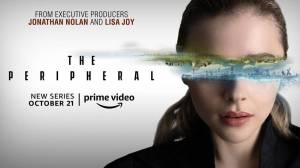
It’s also clear that Amazon have spared no expense in putting this onto the screen. Not just the big names involved (Chloë Grace Moretz playing Flynne Fisher for example) but, for a story like this, in making Gibson’s vision of the future feel absolutely seamless.
In other words it looks stunning.
It’s also directed with a tight no nonsense rhythm by Vincenzo Natali and Alrick Riley.
Beyond looking pretty and having a cast that know how to inhabit their roles the show works because it brings a humanity to the story that, honestly, is missing from the novel.
Flynne and her brother Burton (played by Jack Reynor) feel real. Their lives and their experiences have a weight to them that grabs you and takes you along for the ride.
On top of that we’re not left in the dark with tiny little revelations – instead we are quickly given enough information to understand what is happening and, to some extent at least, what the stakes are.
There are larger mysteries in the show but they’re on screen from the beginning and we experience the hunt for their resolution not as cryptic shadows which the characters understand but we don’t – instead we experience the detective work alongside the characters, learning as they do.
In some senses this is a police procedural just with unconventional stakes and locations. Those elements lend the show an interesting structure because there’s a second half to it – that of Flynne when she’s not wearing the mysterious virtual reality headset that brings so much trouble.
In the ‘real world’ of Flynne’s life we experience troubles which mean medicine is bought one pill at a time from illegal dealers by people who have to find a grift in order to afford just that. It’s a dystopia of rural America and a society slowly falling apart.
 We see a blighted high street where a 3D printing shop is about the only place anyone might find employment.
The low key existence of this backwater is contrasted with a high tech and extremely futuristic London and the two play off one another brilliantly, especially as they intersect and the actions in one place ripple to the other.
There is a lot of talking and quite a chunk of politics but these conversations and dealings simmer with tension that occasionally explodes into full on violence.
The action sequences are directed with such economy that they leap off the screen and punch you in the chest. They’re chaotic, elegant and feel like they matter. When they arrive they’re beautifully cathartic, the tension of all those discussions bursting out of gun barrels to make the final part of the argument.
The last thing I want to focus on are the politics of power as presented in the story so far. There are several players at work in this world. All of them have power except for Flynne and her family.
What she has is brains and determination and she’s willing to do what she can not to be outplayed or overwhelmed by what she’s found herself involved in. Everything about how the different powers interact feels authentic – the little irritations that lead to outsized responses, the calculation, the planning and the terrible outcomes when those plans meet reality.
We also see how the asymmetry of power leaves people on the wrong end with few choices and fewer opportunities to break free – even if they want to. If there’s one element to this show that’s in almost every scene, it’s the corruption of power. From local communities forced to make peace with deadly industries to a world in which the ruling cadre is literally named the Kleptocracy, power is very much on the mind of the writers and what it means when ordinary people get caught in the machinations of the powerful.
If it doesn’t challenge those structures it certainly shows them for the cancerous growths they can become if left unchecked.
 On the basis of these first three episodes I’m utterly committed to seeing the rest of this show. It’s mature, thoughtful science fiction brought to shuddering life by Amazon and given a healthy dose of humanity by its writers – Scott B Smith, Jamie Chan, Greg Plageman, Bronwyn Garrity and, of course, William Gibson.
There is a lot of good science fiction and other genre adjacent drama on our screens right now but this rides at the top as deserving of your time and attention. Having read the novel I know what’s to come but that isn’t detracting from my enjoyment one bit, indeed it’s left me drooling in anticipation. This feels like a feast where I’ve read the menu and each and every course is one to savour.
Rating? 10 stubs out of 10.
 Doctor Who News Star Trek News
 Sci-Fi Bulletin: Exploring the Universes of SF, Fantasy, Horror and Spy-fi!