 For the second of our interviews for The Peripheral, executive producer & director Vincenzo Natali is joined by actors JJ Feild and Julian Moore-Cook who play Lev Zubov and Ossian respectively…
What was your first exposure to Gibson and this sort of “cyberpunk” world?
Julian: With Gibson directly, it was The Peripheral. I read the book and then went on to read Neuromancer and I saw so much of his work in things I’d watched before. I hadn’t realised how prolific he was and how much of his things I’d seen without realising this is who it belongs to.
JJ: I was the same, I’d read Neuromancer and I knew of Gibson. I was in huge awe of Gibson and then when Jonathan and Lisa Joy came to me with this, it was like …Gibson, Kilter Films, Chloë…I said yes, I didn’t have to read the script. And then dived into the book and pulled out as much as I could.
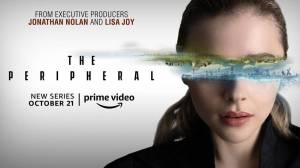 Vincenzo, obviously you’ve had a Neuromancer project in the background for some years. What attracts you to Gibson’s writing.
Vincenzo: There’s a texture to his writing that I don’t see anywhere else. I feel like, of all of his contemporaries, he is the one voice that still rings loud and clear. And for the, whatever it’s been, forty-odd years that he’s been producing novels, he still is at the vanguard of anticipated on what’s to come and commenting on our present condition in the world.
I feel like The Peripheral is very in tune with this moment even though it was published in 2014. It feels as though it is commenting directly on the precarious position we find ourselves in the world, right now.
Was there a feeling, when you were working on it, that our world has changed a lot in that period and therefore, the reflected world needed to? Or is it very much that his view of our immediate future and then the future London, remains similar?
Vincenzo: Well, I should mention that Scott Smith was our showrunner/writer and did a brilliant job adapting the book, which is not an easy adaptation, by the way. But my perception of it – I don’t know how Scott would feel – is that the book gave us a lens to better understand what’s happening in the world right now, rather than us updating the book. It’s like the book was updating us!
 You were still filming this under Covid protocols so did that make much difference to you as a director or as actors?
JJ: I had one advantage in that because we were block shooting and staying in tiny bubbles, they shot my entire season in two weeks. Which meant, a shit load of lines to learn in a very small amount of time. It also meant that you could be completely immersed in the character and the journey in one unbroken line. Normally it would take, what? Five or six months to shoot this? I’d have been bit-y and piece-y, one day every two weeks and you’d have been trying to catch up where you are. I loved it and I hope to God that I get, not just on this, to have that intense time where you can just be in your character. It was incredibly beneficial.
Almost sounds theatrical, that sort of going in, reading the play and then actually workshopping it and doing it.
JJ: In some ways and credit to Kilter Films, instead of relying on all CGI, is they built the sets. A lot of the questions we get are ‘How did you create the future?’ Yes, there’s the extended reality of the special effects when we open up to the broad shots of London but every interior was built. That’s what was extraordinary and as an actor, that meant you could walk on the stage and perform against the stage that was next to you.
What were the biggest challenges for you, in terms of both acting in this and directing it, that you weren’t expecting? There are always things that throw themselves at you as you go along but what weren’t you expecting that came up in this?
 Julian: The language style – that was surprisingly challenging. Again, in the book, you read the language and you get a feel for what that’s supposed to sound like so you try to have a creative process to be able to be faithful to the book and then, when we finally agree on what it’s going to sound like, it’s like ‘How do we convey the truth of the lines, of what we’re actually saying?’ It’s such a beautiful language and once we get going it’s so nice on the ear. But to remember that and have the focus and the meaning was tough, surprising.
JJ: It was extraordinary to hear you guys do it.
Vincenzo: It was.
JJ: They didn’t just make it up, they randomised the text and created a random language which they then had to learn and if any lines changed… There were a couple of days where they suddenly handed them what looks like gibberish – and they had to quickly learn it.
Julian: Yes, it was good fun though.
And as director?
Vincenzo: It’s part of the evolution of the series is that it’s being written as you’re shooting, to some degree and all of a sudden some background characters became very foregrounded. So my initial design for them wasn’t really designed to be in the foreground.
The first two episodes of The Peripheral are now available on Prime Video; further episodes arrive each Friday.




 Sci-Fi Bulletin: Exploring the Universes of SF, Fantasy, Horror and Spy-fi!