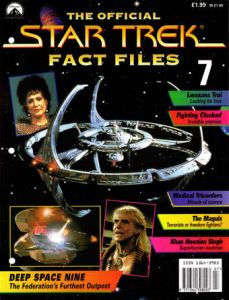
 Former Star Trek Magazine senior editor Simon Hugo’s most recent Trek project has been Eaglemoss’ Deep Space Nine Illustrated Handbook, which reorders and repurposes material from The Fact Files released over 20 years ago into a coherent whole. Shortly after publication, he chatted with former colleague Paul Simpson about returning to the edge of the wormhole…
What exactly was involved with preparing the book? Grabbing old articles, making sure they still were correct, putting them together, topping and tailing and the order? Or were you actually writing a load of new material for it?
It’s a bit of both because The Fact Files started in 1997, before DS9 finished airing, so there was stuff in there that just wasn’t accurate because it had been guessed for The Fact Files and then contradicted on screen. There’s a lot of places where you’ve got the same information coming up again and again because originally it wasn’t presented in one go. There’s a lot of taking out of duplication and then thinking ‘Right, I’ve got a big gap now where I had duplication, I’d better think of something interesting to say.’ So it’s information there just wasn’t room for the first time around.
There’s quite a lot new – nothing earth shatteringly new but there is plenty that’s written from scratch. This should be the only DS9 reference book you’ll ever need.
 Somebody who’s got every Fact File is still going to find a load of new material in here then.
Yes and at the very least they should find some of the small mistakes first time around, corrected and maybe we put some new mistakes in just to keep with tradition.
We’ve got to keep the next generation of proofers in business haven’t we?
Exactly.
In terms of the new information, were you just purely going off what’s on screen or were you getting material from the archives?
The Fact Files were sufficiently in depth the first time round so I didn’t actually have to go back that much other than just confirming where things sounded dodgy (laughs). There’s not a huge amount of actual new information in there; it’s just now presented in maybe a more concise clear way whereas with The Fact Files because it was on the schedule that it was on, there wasn’t time to go back and cross reference with what came. Hopefully it’s a bit more coherent but I didn’t do a big archive trawl.
 Did The Fact Files have the photos?
They had different photos. Again, it’s a small difference but we’re able to take from slightly better quality sources. There’s a lot more that’s digitised now. Obviously you don’t have a complete set of Blu-rays of DS9 to draw on in the way that you now do with TNG.
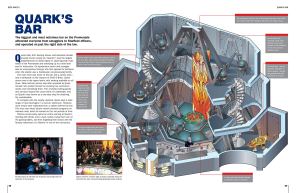
The Fact Files also had lots of really nice, really informative, specially commissioned artwork, and it deserves to be seen again in a new context.
Were there things that you learned when you were doing this that you went ‘I never realised that?’ or ‘No, that just doesn’t make sense based on what I remember’.
(Laughs) Things always catch me out when I read behind the scenes stuff. I always feel a bit foolish for not realising quite how many times the same sets were redressed as different things. Once you’ve read it and you go back and look at the episode you go, ‘Of course it is’, but things like people’s quarters and offices and things you realise oh yes.
That’s the good thing about The Fact Files with the diagrams as well, you can actually see that overhead and realise ‘Oh yes, that’s just been rotated 90 degrees’.
Stuff like that that I thought, I like to tell myself that I knew once and have forgotten it but I probably just never knew it.
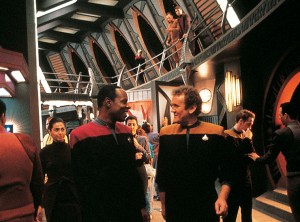 Because I went on set quite a bit, it was really interesting looking at the 3D version of things that I only ever saw with possibly two walls, if that. That was a permanent set, the promenade and everything, which they built in 1993. It’s probably the most detailed of all the Rick Berman shows – there certainly seems to be more moving parts on the station than there were on the other shows.
I think when they built those sets the first time round there was a confidence, given that they’re in the peak TNG years at the point, aren’t they? They’re really in their pomp and they’re just, “Yes, throw the money at it.” So even then when it becomes the slightly unloved child when Voyager’s on air it’s still, at least, got that initial grounding that really pays off over the years. If they’d done it on the cheap in the first place it never would have got the investment later on but luckily because it had the investment at the beginning it was able to sustain on that.
Is DS9 a show you particularly loved or is it, to you, the bastard child that we don’t like to talk about?
Maybe it’s both, maybe that’s why I like it. Maybe it’s precisely because it’s the slightly less loved one. I think my first love was TNG but DS9 is the one that I will go back and rewatch more than anything else now. If I watch an episode of TNG, I’m satisfied; if I watch an episode of DS9, I want to then watch the next one and the next one and the next one. I don’t do that with the others these days so much.
I suppose that’s also partly a function of it being a serialised; even those first two seasons, there’s a large serialisation element to it.
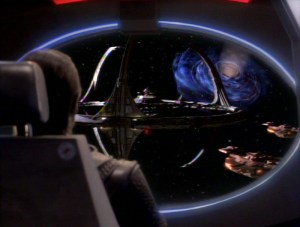 Even season 1 where they are almost doing TNG style stories, where instead of going to meet the alien of the week, the alien of the week comes to meet them. Everyone always goes, ‘Oh it gets good from season 3’ but I love those early episodes.
I’m not sure what it is about it but right from the start it has that lived in quality. TNG really does take time for the characters to establish who they are and you can tell the writers are working out who the characters are. I think from the start of DS9 they had their bible down pretty well and they knew who the characters wanted to be.
I think Emissary is the best pilot of any Trek series.
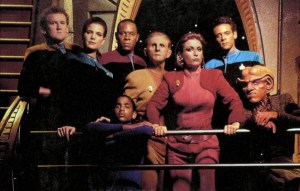 Yes, I’d go along with that.
And none of the characters that you meet in that, two or three seasons later, are unrecognisable. They’re all recognisable to be the characters they were introduced as being. They’ve grown up obviously and they develop but they don’t get reimagined.
The Deep Space Nine Illustrated Handbook is available now from Eaglemoss. Click here to order from Amazon.co.uk
Read our review here.




 Sci-Fi Bulletin: Exploring the Universes of SF, Fantasy, Horror and Spy-fi!