 456 more contestants play children’s games to the death, but this time it’s personal.
Back in the autumn of 2021, I, along with about 250 million others worldwide, was gripped by the Netflix streaming phenomenon that was Squid Game, season 1. It seemed to have a bit of everything: the highest of painfully simple and uncompromising concepts; a brutal inevitability about the nihilistic violence punctuating every episode; a startling bubblegum aesthetic counterpointing its Nietzschean world view; satire more acidic than lemon juice squirted into the viewer’s eye; a vice-like grasp of the angry global post-capitalist zeitgeist; and characters to care about, to love, to hate, to root for.
If I had any reservations, it was that the supporting characterisations occasionally veered into the stereotypical, not helped by some histrionic acting. In production terms, the bubblegum seemed overly artificial at times (Alice in Borderland, a similar show, had far superior production values). Thematically, while the Squid Game impressed for its head-butting socio-political subtexts, the shadowy conspiracy was so cartoon-like, it upset the balance of the show, undermining our ability to suspend our disbelief.
Just over three years later, I was braced for disappointment. Could creator Hwang Dong-hyuk possibly pull it off again, now that the element of surprise has gone? Was he aware of the first season’s shortcomings enough to remedy them, or would they expose the limitations in the concept?
Four episodes in, I’m thrilled to report that the show has matured to remarkable effect. It isn’t just that it looks classier, what strikes you is the pacing; the richness and the layering of the storytelling. Where we were thrown into the games about halfway through the very first episode, season 2 has the confidence to take its time. We are reunited with Seong Gi-hun, player 456, the reluctant victor of season 1, now a far more nuanced character, suffocated by PTSD, moody and vengeful. It’s a terrific performance from Lee Jung-jae who has the balance of damaged everyman and wannabe avenging angel pitch perfect. Also returning is detective Hwang Jun-ho (Wi Ha-joon), now demoted to Traffic, and hiding the awful truth he discovered about his brother at the end of season 1, but determined to track him down whatever it takes. We are also introduced to Kang No-eul, a North Korean defector desperate to find her missing son.
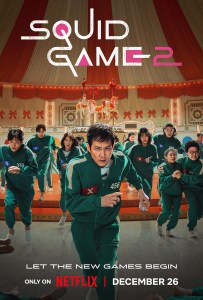 I’m not going to say any more about how the story develops because it’s full of delicious twists and turns. What I can reveal is that the acting and characterisations are mostly far more satisfying this time around, partly because they have a narrative back story to draw upon, but also because show supremo Hwang Dong-hyuk is so much more self-assured.
So what about the games themselves? Having Player 456 return to the arena is a masterstroke, because we realise that, counterintuitively, it’s actually more emotionally interesting to have a character in there with a certain degree of foreknowledge… just as the audience has a certain degree of foreknowledge, which the show uses against us quite brilliantly.
The other improvement is that the world of the pink-suited guards, and the nuts and bolts of the organisation of the games, is explored in a lot more depth, which adds to the richness and intrigue of the storytelling.
Caveats? Well, once we’re inside the giant dorm, with over four hundred players, I think it probably means that Korean casting is stretched to its limits, and so there are still one or two less convincing performances, but the writing is better so they don’t grate as much as they did the first time.
And the episode hooks are just terrific. I could write reams about them… but I won’t. You need to watch this for yourselves.
Verdict: Squid Game season 2 has got off to a cracking start. I’d go as far as to say it’s even darker than it was before. In season 1, the blood had the off-colour notes of a video splatterfest. In season 2, it seems to run darker, to be more glutinous. Or perhaps that’s in the eye of this enjoyably disturbed beholder. 9/10
Martin Jameson
www.ninjamarmoset.com




 Sci-Fi Bulletin: Exploring the Universes of SF, Fantasy, Horror and Spy-fi!