Review: Pluto
When the world’s seven most advanced robots and their human allies are murdered one by one, inspector Gesicht soon discovers that he’s also in danger. Pluto is an animated series […]



When the world’s seven most advanced robots and their human allies are murdered one by one, inspector Gesicht soon discovers that he’s also in danger. Pluto is an animated series […]
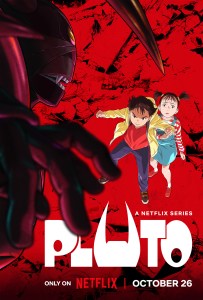 When the world’s seven most advanced robots and their human allies are murdered one by one, inspector Gesicht soon discovers that he’s also in danger.
Pluto is an animated series on Netflix featuring a swathe of characters but revolving around a robot detective called Gesicht played by Jason Vande Brake in the English dub. Gesicht is a German word meaning face but it covers a number of different nuances – not least of which it can infer the surface of something deeper, the appearance of something which you look at and carries with it the sense of the identity of the thing being seen.
In this sense it captures the exact nature of the lead character.
However, Pluto is really a re-envisioning of Astroboy, the legendary 1950s Manga that has spawned numerous anime, remakes and movies about a young robot called Atom (who also appears in the same capacity here).
The crucial features of the original manga and this adaptation is that robots live alongside humanity and are, in many ways, indistinguishable from humanity in their wants, needs and aspirations. Indeed, for many robots the aim is to become ‘human’ – which in most cases means entirely integrated without distinction into human society.
In this it is worth noting that the recent underrated film by Gareth Edwards, The Creator, has also taken substantial inspiration from Astroboy and this link and the importance of the ideas Edwards took from this 70 year old Manga have been seriously under appreciated. If The Creator looked at modern politics through the Astroboy lens then Pluto takes a forward looking stance, thinking past current political debates but anchoring itself into what makes for peace among different societies and what it means to be human.
What’s important in Pluto is that it doesn’t dare suggest that its AI and robots aren’t ‘alive’ but it poses the question of what it means for those not immediately like us to be accepted as ‘like’ us enough for us to bring them into our lives without structural and implicit bias. In that it shares its DNA with The Creator and with Astroboy.
That the arguments about what humanity can claim as its defining virtues rather than the more common approach of demanding others live up to some arbitrary threshold goes back all the way to Astroboy is remarkable. It’s also a huge shame that we are still debating this question almost from first principles quite so often. I’ll leave you to think about how those discussions are informed and shaped by institutional and structural racism, misogyny and class but, for me at least, the legacy of these kinds of attitudes weighs heavy on these arguments – often without being identified and acknowledged.
 The animation is clear, crisp and comes with a hopeful retro-futurism reminiscent of Akira (and what doesn’t reference this giant?) but without the pessimism so inherent in that post-modern cyberpunk leviathan.
It’s a little like watching The Matrix crossed with Laputa, Castle in the Sky.
The voice acting in English is superb – one of the rare occasions where I would say that watching the dub is an improvement on watching the original with subtitles. It helps that the main character is German and the characters are global in nature – ranging from Scotland through to Japan.
Verdict: As is often the case, people with skin colours other than White are missing/absent, but this is a common feature of this genre and one that is only slowly changing. In that, Pluto does not advance any new ground.
Otherwise though, Pluto is an excellent entry into the field and well worth your time.
8 human robots out of 10
Stewart Hotston
 Doctor Who News Star Trek News
 Sci-Fi Bulletin: Exploring the Universes of SF, Fantasy, Horror and Spy-fi!