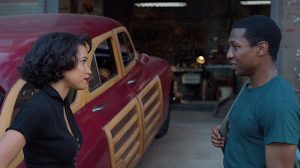
 Novelist Stewart Hotston presents the first of his weekly commentaries on HBO’s new series, Lovecraft Country.
NB these will inevitably contain some spoilers for the episode under discussion.
Lovecraft Country is about many things but it truly sings when it sings about Hope. Each step of the way the three protagonists are faced with dangers whose names may change but whose threats remain the same and each step of the way they respond with hope.
Hope that they can find what they’re looking for, hope they can build the life they want unmolested, hope they can change the world to how it ought to be. They hope and hope and hope.
And the world disappoints each time they confront it. Yet they don’t stop hoping because they have a sense of what’s right, of what’s just and of who they are. Each of the main characters is lost in their own way but their disorientation is as much external as it is internal and as the show builds the idea of them in this first episode we see that they have a sense of who they are and who they want to be. They may not be sure how to get there or even how they wound up where they are now, but they share a destination – a just and hopeful future.
The heart of this episode, and I suspect the entire show, is laid out twice. These two ‘creation’ stories, if you’ll allow me the indulgence, both cover the same ideas but from radically different viewpoints. The first comes at us with aplomb right from the opening credits and sold me on this show within the first twenty seconds. I stopped watching so I could watch it again and I encourage you to do the same because I’m certain every word, every image is going to be important to us across the rest of the series.
Here’s a spoiler for those first twenty seconds as to why; Martian tripods, Cthulhu, Flying Saucers and half a dozen other fifties pulp fiction monsters lay waste to a WWII Pacific battlefield while a male presenting voice talks about the state of the Black Man in America.
Lovecraft Country lays out its intent in those first twenty seconds and then builds and builds. This first episode does a lot of heavy lifting, but it does it with grace, an easy energy and tension which ebbs and flows like a storm tide still deciding whether it’s going to drag you under or deposit you back on shore.
However, the second statement of intent comes in a later conversation – ‘You can’t forget the past. The past is a living thing, you own it, you owe it.’
In that single line the show’s entire relationship with its subject matter and inspiration is laid out. When asked why he’s reading a book about an ex-Confederate soldier, a character remarks that one can love something without overlooking its flaws. He’s answered with the reminder that overlooking flaws doesn’t make them go away. His response is hope, that in those stories he can hope for a life he can’t see himself living.
You can almost hear the writers answering Lovecraft prejudices and racism and telling him they don’t care what he thought of the world, they own and owe their history – they won’t forget it and nor will we.
I’ll be writing something on each episode as they come – so stick with me because there’s so much in this first tranche I could write several books. Instead I want to explore them with the luxury of more time as we get to stretch out across the series and see what the showrunners do with all these delicious threads they’ve laid out before us in episode 1.
Still, there’s another subject I want to cover in this review of the first episode and that’s how Black experience of the USA is presented from the opening frame to the last. When I write about the show being one concerned with Hope, I mean it like this – the characters aren’t fighting White oppression, they’re simply living their lives and doing what they need to do to live the lives they want. Whether that’s eating in a diner where they have every legal right to be or reading a book their parents frowned up or fighting in a war for a country that at best… tolerates them. Whether it’s singing, laughing or arguing. They aren’t defined by their fight with White power. White power and its pressure upon them defines itself that way but they are presented as a freer than this, defined by who they want to be. It’s a refreshing thing to see and a slightly different presentation of that experience than what I experienced watching the equally superb (although on the evidence of this opener, no longer peerless) Watchmen.
Too often shows with a majority BIPOC cast end up building so much of who those characters are by their relationship to Whiteness. This could have done the same but it doesn’t. It steps around it without ever avoiding the experience of White power for those who weren’t White at that time and in that place.
I love this because, harking back to that opening statement of intent, the show owns its history but isn’t owned by it.
So where do we go from here? In case you hadn’t picked it up by now, I’m loving this. I found it exhilarating to watch and I feel a little tingle run over my skin when I think about watching the next episode.
Stewart Hotston lives in Reading, UK. After completing his PhD in theoretical physics, Stewart now spends his days working in high finance. He has had numerous short stories published as well as three novels. His last novel, the political thriller Tangle’s Game, was published by Rebellion. His new novel, Bridge of Light, a story about how we make cities and how they make us is out on submission. When Stewart is not writing or working he’s a senior instructor at The School of the Sword where he fights with and teaches all manner of swords.




 Sci-Fi Bulletin: Exploring the Universes of SF, Fantasy, Horror and Spy-fi!