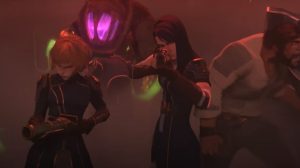
 Unless you’ve been living under a rock then Arcane was the biggest animation to hit English-speaking streaming in the last couple of years and for good reason – sumptuous and ground breaking animation, excellent voice casting and a superbly written story powering out completely unexpectedly from video gaming roots. We won’t mention how much it cost to make.
Season 1 finished on a literal bombshell and fans have been waiting for season 2 ever since. Given the lore and the culture of the game itself it was anyone’s guess where this would lead us. Except, of course, the powerhouse relationship between the two central cast members, Vi and Jinx/Powder. Sisters, enemies, leaders and outsiders all at the same time.
Season 2 picks up where Season 1 left off and the first episode, perhaps the most moving, is crushing. The animation is astounding (the funeral scenes in particular use colour in devastating ways), the music superbly chosen and layered over the aural landscape and, as ever, no one is given more than a minute to contemplate their situation before the world moves them on regardless of if they’re ready or not.
This show goes hard and if you value literature you need to be watching.
If that’s what you want from a review you can stop reading now.
10 magical mysteries out of 10.
However (and spoilers from here on in)
There’s more. I’ve been on something of a journey myself in these first three episodes and they relate largely to my relationship with Jinx. I have found myself inching towards hating her. For reasons that were unexpected to me. I hated how the show made her desire to burn the world down inexorably linked to her mental health. It seemed a cheap shot and so I grew very impatient with her.
Yet I had to do some work here because the show is very clearly exploring the idea of trauma by an oppressor narrowing your options, damaging the oppressed’s world view, health (physical and especially mental) and creating an environment in which there are no opportunities, no hope and certainly no levers for change.
The oppressor nearly always justifies its actions in the name of decency, of civilisation and of justice. You can read into that as much about Palestine as you can about the Uighurs and Ukraine as you want.
I was challenged by my reading of Franz Fanon to look more closely at how my own response to the character of Jinx was conditioned by those same cultural axioms and myths that suggest only a rational actor can resist in a way that needs to be taken seriously and, more importantly, that it requires a ‘rational’ actor to provide grounds for being an ally.
If I put conditions on how someone resists then I am acting on behalf of their oppressor. No ifs, ands or buts. It is a dangerous truth but it is truth.
You could validly watch Arcane and see the relationship between Jinx and Vi as that of two sisters separated at a critical moment and whose lives diverged as a result, their battles sisterly in nature.
I think the writers here have a clearer view of what oppression does to us, of how it twists us, breaks us up and attempts to reshape us as something malleable to its own agenda. Using two sisters who love one another is a perfect vehicle for this exploration.
Reshaping can succeed to an extent but even where it doesn’t there is an epiphenomenon that’s almost impossible to avoid – resistance to being reshaped shapes us too. When we resist we are squeezed into shapes just as when we collaborate with power.
The central question in Arcane is then, what does resistance look like?
When you can deny someone work and education and health, take their money, take their voice what do you leave them with? Their bodies. And when they resist with their very own flesh? What then? You destroy them entirely. You suffocate them, raise their homes to the ground and erase them from memory.
The upside dwellers regard those beneath them (physically as well as metaphorically) as animals – the phrase is repeated again and again in these first three episodes and there’s a sense here that animals are there to be treated however humanity wants.
It’s deeply revealing of power that it defines a boundary within which certain rights and privileges apply but if you’re outside then you might as well be a worm or a maggot because you will be categorised in a bucket that gives you and them exactly the same rights, recourse and voice. That is: none.
If you refuse to let people speak, to participate, they will find a way even if that way results in self-destruction. And for Power that self-destruction is part of the aim, for it only further justifies the initial measures and dehumanisation.
Dehumanisation is probably the wrong word because it centres humanity as if we deserve special rights. Delegitimization is probably better but it’s secondary to the fact that if you’re outside that boundary all your actions will only serve to justify your exclusion.
This is a radical truth to remember – there is no way across that threshold that can transform you into something acceptable, into kin. At best you can become ‘one of the good ones’, which is exactly what happens to Vi (this phrase is even said about and to her in these opening episodes).
And if you remain outside? There’s no way of weakening that boundary to widen what counts as being a part of the empowered. Why? Because power of this kind sees itself as finite and to share itself is to be diminished and that is unconscionable, immoral and traitorous.
I’m reminded of Mary Douglas’ work on how communities build their foundation myths (their Cosmologies).
I am convinced that the only way to tackle such sectarian epistemologies is to provide alternatives that address the same needs and provide radical redistributions of power to those who, under the existing framework, have something but not enough.
Which brings us back to Vi and Jinx. Neither of them can challenge the world view which oppresses them. They have three choices: be destroyed by it, resist or be co-opted. All three choices result in emotional destruction because they mean being twisted out of shape to be something that only exists under stress. Imagine the emotional equivalent of a stress position – it is unarguably a form of torture but it is invisible and justified by those who are inside because they see the shape of themselves and cannot justify those who don’t share it. Outsiders are, at best, scenery and at worst, bacteria bringing sickness and plague.
Vi has fallen into co-option and drunk up the hopes of those with power. She is twisted by it, conflicted and trying to find reasons to accept this corrosive acid in her guts. The easiest way is to go further than required and hate that which Power criticises. Why? Because for someone who is conflicted the only escape is to end the conflict and if you’ve been co-opted that means destroying what you were and where you come from. Erase your memory and remake yourself.
Jinx sits at the other end, resisting. When she states she wants to burn the world down this is resistance to a power that wants the status quo – a world in which its structures remain and rule.
And so I move on from hating Jinx to hating everything which makes the world in which her choice of desolation is one that makes sense.
I’m going to finish by remarking on one more excellent element of the show. When those in power finally decide to destroy those who continue to resist them they do so as if they have no history of oppressing those they’re destroying. Their narrative is one of ‘how did this happen suddenly? What on earth explains this behaviour by these others?’
Because they see themselves as distinct (and hence without any form of two-way relationship) from those they oppress they have no sense of how they are culpable for the hatred and suffering being brought to their door. Such ideas are too dangerous to be permitted so they are delinked by building the narrative that those outside the boundary have nothing to do with us and hence anything they do is, by definition, unpredictable and shocking and amoral because it has no reason behind it.
When your Logos is one that sees you as righteous then everyone else’s actions are illogical, unreasonable and castable as evil.
This show is some of the smartest writing about power, oppression and trauma you’re going to see and I beg you to watch it.




 Sci-Fi Bulletin: Exploring the Universes of SF, Fantasy, Horror and Spy-fi!