The Demon Headmaster: Interview: Nicholas Gleaves
Known to genre fans for his appearance in Adrian Hodges’ reboot of Survivors a decade ago, Nicholas Gleaves has now taken the lead role in Emma Reeves’ revival of The […]



Known to genre fans for his appearance in Adrian Hodges’ reboot of Survivors a decade ago, Nicholas Gleaves has now taken the lead role in Emma Reeves’ revival of The […]
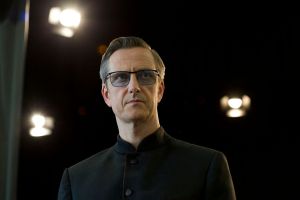 Known to genre fans for his appearance in Adrian Hodges’ reboot of Survivors a decade ago, Nicholas Gleaves has now taken the lead role in Emma Reeves’ revival of The Demon Headmaster, based on the books by Gillian Cross, and shortly before the final episodes aired, he chatted with Paul Simpson…
Did you know the original series?
It was in the back of my mind like most iconic TV shows but I didn’t watch it – my kids are older. I didn’t know anything other than the general knowledge. It’s funny – I had a tiny look online just to see, and Terrence [Hardiman[ was in a really terrible sci-fi helicopter and was landing it somewhere. It was very of its time. Then he looked at someone and there were these swirls that went on in his eyes. I thought, “Wow, that’s quite effective – and quite dated” – and it didn’t correlate with what I’d read, which was [lead writer] Emma [Reeves’] first three scripts which were really good.
I think one of the really special things that Emma did was bring the 90s show and the 90s story into today. I found that tremendously exciting. That whole world that was created back then is different now but it still has that control and power. I think she’s done a brilliant job.
 There’s far more psychological than physical power from the Headmaster a lot of the time in the new show – episode 8 where he’s trapped in the storeroom, it’s amazing how powerful he seems just when the louvre slats are opened…
There’s a wonderful fairy story element to it. They’ve created this world where there really is a Beauty and the Beast story. Blake’s story is a sideline to that, a sort of Frankenstein’s Monster myth that goes on there: the Demon Headmaster created him and now he’s turning on the Demon Headmaster. What Emma has done is brilliantly have these different threads that go through the show – they know what they’re doing, John McKay and Spencer Campbell, our first director and executive producer. They’ve really brought a world together so we can have all these really strong elements within a school and that’s very exciting.
 Did you have a lot of discussion before taking the role about how you’d play him, or were you working from what was in the scripts?
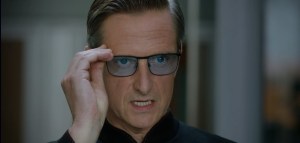
I really got the scripts, and when I started to read them, I immediately understood the tension and I got the presence of him. I auditioned twice and then when I had got the role, John literally opened the door to the Demon Headmaster. He said, “Let’s meet, let’s talk”. I went into the production office and I looked at all the mood boards and we had a very long conversation about character and costume – can you imagine how many pairs of glasses I tried on? There was a great makeup department there who were right on hand.
I had this workshop led by John as to how we were going to do it. Thankfully they were very inclusive with that so I felt as if I had a great ownership of the character and wasn’t playing anyone else’s part than mine.
 What scenes did they use for the audition?
It was scenes from the first episode – a little bit of hypnotising and quite a long scene that actually got cut down in the Headmaster’s office with Lizzie. I think they got the tone right of him – at times he has to be really, really terrifying, but as you pointed out, it’s not a visual thing any more. It is a psychological thing – to understand how one can play with a child’s psyche. I like that idea a lot. The scenes were about how do we do this? What are the rules for him?
I also knew – or instinctively got pretty early on – that he’s not a human being. This is an alien, so [we had to] make up those rules. Work out how this character actually works. As an actor that’s exciting.
A younger audience picks up on something that’s slightly out of kilter much quicker; adults gloss over things.
That’s right. If you notice, you never see him drive a car, you never see him with a key or a phone or anything relating to the real world.
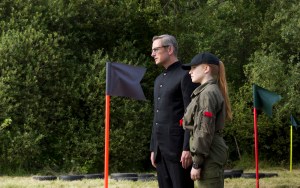 But he does drive back to St Champion’s when Tyler’s in the boot…
But you don’t see him drive. Emma’s really good – you just see him there. John McKay made him appear in sequences. You never saw him entering into a classroom – you do sometimes – but he’s just in one. How did he do that? How did he get there? Why do the normal rules not apply?
I’ve said this before but I think this is the heart of the character we’ve created: he is a dark Doctor Who. He’s the polar opposite of a life-giving, enabling magician; he’s a dark magician that will take absolutely every attribute you have and bend it for his own selfish means. What those selfish means are is yet to be revealed.
That character really does live in the psyche of every school child. There is a dark judge and a person at the back of every kid’s brain that is telling them what to do and is downright unfair. That’s why I think this character has his own place in the canon of super-baddies.
 Did you know his endgame when you started filming the series?
Yes. And I’m wholly on board with it. There’s an audacity about him that is just jaw-dropping.
There have been some terrific cliffhangers – realising that Mary is Rose…
I know. But what’s great about what Emma’s done is that Mary’s ill so what she went through as a child has had a consequence: not being able to flourish, not being able to be an individual. Being manipulated and being bent out of shape has a cost as you get older as a human being. She’s very clever in having these emblems – they’re true in real life and in this sci-fi world we live in. That’s how all great sci-fi works, isn’t it, it’s a big metaphor. There is a cost to what happens to Mary Rose as a child.
 What’s surprised you most about working on the production?
What surprised me was just how much I enjoyed it. I didn’t think I’d enjoy it as much as I did and I looked forward to going into work every day.
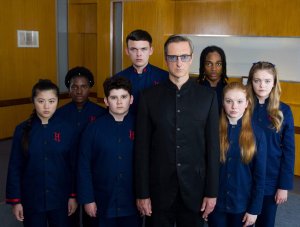
I really had a good time. I felt very free to explore the character. I really enjoyed working with the kids. I fed off their energy – at times I did have to lock myself in a room because they’d shout and scream and have this amazing energy and I’d need to head off somewhere. They’re all really good and very invested in their characters. We talk about them the moment we get in the car in the morning, drive 45 minutes then we start work.
Were there particular challenges?
 As I said earlier, it was about working out the rules of behaviour. Not blinking is quite difficult so I don’t like to blink on camera. There’s a staccato movement about him; there’s a real control.
Say I was doing a northern drama, a six-parter for ITV, you learn the lines and they say “action” and you are just as real as possible in that scene. Whatever happens, happens.
Playing this character I’ve actually meticulously worked out through the rehearsals that we’ve had what he is going to do, where he’s going to move to, where his eyes are going to go, to get the full effect of this power that he has. When they say action I try to infuse that with as much reality as possible but there’s a technicality that I really enjoyed working on that that I’d not experienced before. If I’m doing Scott & Bailey or something like that, it’s about making something as naturalistic as possible. This is not naturalistic.
Years ago, we met on the Survivors set – that was another part with heightened reality, but the reality was needed for [your character] Whitaker…
 Absolutely – great show that. A real shame it didn’t get the chance – it could have had some wonderful ideas explored about how you recreate community and people again. You’re right – the conceit was there’s not many people left in the world, but the world is a real one. Whitaker was not hapless, but did not know what the hell he was getting himself into! There was a lot of trying to look calm but the feet underneath the pond were paddling as fast as possible. Whereas with the Demon, he is calm. Nothing is going to ruffle his feathers.
It’s an almost preternatural calm – almost divorced from reality.
Absolutely.
The first season of The Demon Headmaster concludes on CBBC tonight at 5 and 8 pm; all episodes are available on iPlayer.
Thanks to Ciara Mongan for her help in arranging his interview.
 Doctor Who News Star Trek News
 Sci-Fi Bulletin: Exploring the Universes of SF, Fantasy, Horror and Spy-fi!