The Avengers: Interview: Linda Thorson
Linda Thorson’s adventures as Miss Tara King delighted audiences in the late 1960s as she battled evil stylishly alongside Patrick Macnee’s John Steed in The Avengers. Now, over 50 years […]



Linda Thorson’s adventures as Miss Tara King delighted audiences in the late 1960s as she battled evil stylishly alongside Patrick Macnee’s John Steed in The Avengers. Now, over 50 years […]
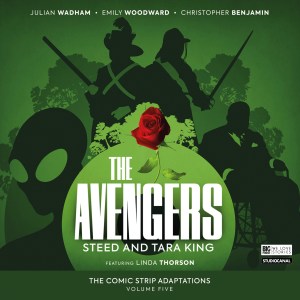
 Linda Thorson’s adventures as Miss Tara King delighted audiences in the late 1960s as she battled evil stylishly alongside Patrick Macnee’s John Steed in The Avengers. Now, over 50 years later, she’s returned to that world for Big Finish’s audio series, joining Julian Wadham’s Steed and Emily Woodward’s Tara King for an episode of the new box set coming out in April. To mark the event, Thorson chatted with various journalists during recording of the episode…
What is it like being part of the Avengers universe again? But not this time, playing Tara King.
 Well, it was very strange when I knew I was going to meet Emily Woodward today (laughs.) We happen to have the same agent. She’s divine and adorable but I thought, “I’m going to be meeting Tara King and that’s going to be very strange”. Of course, I never was Tara King, I played Tara King.
The thing that I really love is that The Avengers continues to have many followers. I am sadly at this point, the only living actor from the original Avengers and in fact, Jo Lumley is the only living actor from the second incarnation The New Avengers because Gareth Hunt died as well, and of course we lost Patrick a few years ago. But this keeps it alive even longer, the madness of it all… this world of The Avengers.
I think it fits in with all sorts of things that are going on, so contemporary. In this episode there are all sorts of things that ring bells about what’s going on today.
I’m thrilled to be a part of it. What a wonderful thing, that this classic series has this new life with these wonderful actors Julian Wadham and Emily Woodward. So I think it’s all good.
As a Canadian, how did it feel stepping into a show that was so quintessentially British? Did you get the tone straight away?
 I think I did. Canada is a Commonwealth country, and I’d also been at RADA, the Royal Academy of Dramatic Art, for two and a half years before that.
When I arrived there, my teacher, the great Kate Fleming, said ‘You sound like Donald Duck to begin with, so we need to get rid of that Canadian accent and that nasal tone’ – the way Canadians ask a question with everything they say, with an upward inflection at the end. She said ‘This all has to go’. I sounded like a valley girl.
After two and half years at RADA I had a very nice RP accent so that side of it was OK but I didn’t have a television. I was a starving student so the thing is, ignorance is bliss. I didn’t know anything about The Avengers but I came into it and I learned there was this wonderful man Steed who she was going to be working with as his sidekick. I thought, “Oh, she’ll be in love with him” and I had all these ideas of my own and I must say, the producers at the time, they just let me have my own ideas and of course the scripts were there.
John Bryce, this wonderful man, let me make Tara “Miss Tara King” and allowed me to be in love with Steed, which she was. She was in love with John Steed because when I took the job I was 20, just turned 21, and Patrick was almost 42 – and anyway, wouldn’t you be in love with John Steed? With Patrick Macnee? Wouldn’t we all?
I don’t think I was intimidated, now I’m much more intimidated by coming into the studio today and playing Mother’s aunt.
What would you say are the key ingredients that have to be in an Avengers script, to feel like The Avengers?
 You’ve got to have that team work with Steed and Tara, they’ve got to have one another’s backs. It’s got to have something that is completely outrageous that they find normal.
The scripts have to be sort of otherworldly, unplaceable but very important. [Steed and Tara are] highly skilled, highly trained and [have] an elegance about them. They’ve got this acceptance of the utter madness of things, the impossibility.
When I did them you would never have anything like people flying out of wheelchairs or jumping off buildings because it was very reality based. Also when I shot them, you couldn’t even have a gun. You couldn’t point a gun at the camera, the sword was in Steed’s umbrella.
But mostly it is the fantastical thing which is based on the two of them going out to solve something and there’s this feeling that they have a wonderful time doing it.
In hindsight would you have preferred to have filmed The Avengers nowadays when you can get away with those things or would you be happier with it being in the late 60s?
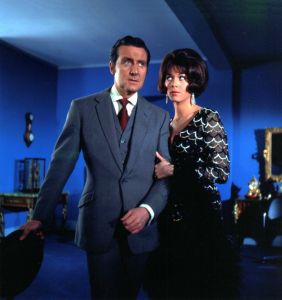 No, I actually do not see The Avengers working now at all. If you look at Bond, he does things which are just completely impossible.
I think we were at the end of the spy vogue by the time I was coming in. We caught it and because of Russia and Philby, spying was right on the edge of everyone’s brain. It was really truly happening.
I think that once that had gone away and once you had cell phones, mobiles and supersonic jets… I don’t know. You’ve got [Steed’s] Bentley, you’ve got the cars – of course everybody still loves vintage cars – but it was very much of its time, I think.
I actually think it came to an end when we went up in the rocket ship, vaguely dressed as if I was in a wedding gown, maybe going to be married and have a real honeymoon on the moon. I think it ended at a good time.
How did you find the transition from screen to audio?
 It worked seamlessly, it seems to me. There’s a great deal of emphasis on dialogue in The Avengers and repartee and the back and forth between Tara and Steed which is there wonderfully in these scripts. There’s adventure but there’s exposition so you understand what’s going on.
You could almost watch some Avengers episodes without the sound because the characters were strong, and of course we had all these wonderful great actors who came in to be in the show. All the best actors in England wanted to do an Avengers episode so it was really a treat for me, I got to meet them all.
But I think it goes very well, just with a soundtrack. I think people feel that because they really love Big Finish and the work on the Avengers so I give it 10/10 for the transition.
Do you prefer working on the screen, stage or in audio?
In a pandemic, I’d rather work in sound because all my friends who do lots of audio are working all the time. My preference has always been the stage and I’ve done a lot of Broadway shows. I just think that’s the place where an actor gets to go out and, unless you bring down the curtain, they are in control when they’re out there and I like that part.
What did you find the biggest challenge of playing Tara?
 This might sound odd but the biggest challenge was trying to keep the press away because I was very nervous about the fact that there was a lot of speculation that no one would ever be able to replace Diana Rigg. I didn’t really understand so much why, although I’d seen her in the theatre being wonderful.
I just wanted a chance to show that I could do it but I filmed for one full year before they went on television, for a year! So I got a reputation – ‘Does she think she’s Garbo?’ – because I didn’t want to give interviews. And of course the studio weren’t so thrilled either but I thought, “If I say all these things and then I flop and it’s a horrible failure….” It’ll be even worse if I opened my mouth and said things about how excited I was. That was very difficult.
The work was so intense: you were there all day every day, we had air dates to meet. There was very little time to worry about anything else. You were Tara and when you’re in a series you have to bring yourself to the show. The scripts were mostly great and of course Patrick Macnee held my hand and said ‘Follow me’ and I did.
What did you bring away from it, in terms of your future work as an actor?
 That’s just a wonderful way for me to say how fortunate I was, at that age, to have in the end 33 hours, 33 one hour films that I had been in a lot of. I stayed on the set a lot. I learned about cameras and lenses and lighting and that took me so far once I got in any other set for the rest of my life.
Because I was actually au fait with movie making and it was the first time [technology] was ever used in any studio that meant as soon as you did a take, you could go over to a screen and have instant playback, so you could learn from that.
The other thing I have to say is that Patrick Macnee taught me how to be in a TV series. When people arrive on the show, you make them so comfortable, so welcoming. You go to the executive restaurant and have lunch, you make sure they’re happy, you ask them about their lives and their careers and you just make them feel part of the family right away.
 So, whenever I’ve gone to guest star on the hundreds of shows I’ve guest starred on subsequently, I have so appreciated it when I wasn’t just [ignored], as happens more and more maybe with very young people. They don’t have any idea who you are.
The best experience recently I had was going onto Schitt’s Creek, which films in Toronto and doing those scenes with Catherine O‘Hara. The producers and everyone in the cast, they were divine. They couldn’t believe their luck at getting me there, they went on and on, they asked me all these questions and I thought, “Here, this is what I learned and you guys do it”. It was the best experience I’ve had since The Avengers, on a show.
Is it true that you yourself christened Tara King?
 It is absolutely true and I also insisted that she be Miss Tara King based on the fact that it seemed much more correct for her to stay the night [if she was unmarried], which was always the question. You couldn’t ever look like she stayed the night at Steed’s flat, if she were married to somebody… she [would have been] committing adultery, I suppose.
I based the name on my two favourite things, my favourite movie which is Gone With The Wind so Tara was the name of the land and if I’d had a daughter I would have named her Tara – but I had a boy and his name is Trevor.
And also King because I’m afraid I am a bit of a monarchist and I always have been and I’m really keen on the royal family (laughs). Sorry, people will probably hate me for that.
I love King and Country – of course I’ve always loved this country so much and always wanted to come here since I was a child so I thought Tara King was a wonderful name.
 What are your memories of the series coming to an end? Was it clear at the time that you wouldn’t be doing any more or is that something you discovered at a later date?
It wasn’t 100% clear but we’d been given a very fine backhanded compliment by the networks in America. Of course a lot of money came from there so we had to follow a lot of their thinking and their rules and what they wanted,
A show that you know very well – Laugh-In – came on in America as our competition, on another one of the big three channels. It was a water cooler show basically: if you didn’t watch the Laugh-In you didn’t have anything to say because everybody stood around and talked about last night’s episode. Rowan & Martin were hysterical.
They thought it was the strongest competition but it really led to our demise, I would say because Laugh-In was a brand new show.
 So we did an [episode] called Bizarre which had Patrick and I going up in a rocket ship. I was dressed in a white dress and he was in a beautiful suit, tuxedo and the champagne. As they went up you weren’t really sure…
There was nothing about them not coming back down. But they went up in the universe, into the galaxies and that was the end of the show. We didn’t know, at that time, whether it would be the last show. It wasn’t certain, but I thought it was a wonderful ending.
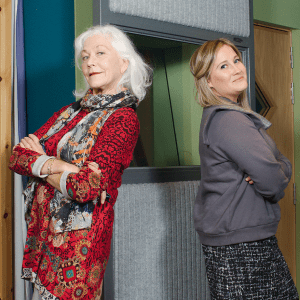
Studio photos of Linda Thorson and Emily Woodward by Tony Whitmore, and used with permission.
Linda Thorson is taking part in The Avengers at 60 event on January 29. Buy tickets here
 Doctor Who News Star Trek News
 Sci-Fi Bulletin: Exploring the Universes of SF, Fantasy, Horror and Spy-fi!