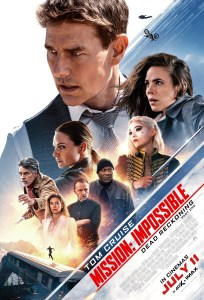
 Directed by Christopher McQuarrie
A Russian stealth submarine is taken over and sunk by the Entity, an Artificial Intelligence. The cruciform key that controls the Entity becomes the most wanted, and most dangerous, item on Earth. The Entity is everywhere, and it’s able to manipulate every computer system on Earth and with it, every market, every missile, every country. Ethan takes his team off the grid to find it. But this time someone’s waiting for them.
Mission: Impossible‘s great experiment is one of the oddest movies in the franchise. Made during COVID, and home to Cruise’s infamous on-set blow up, it plays like the sort of apocalyptic near future climate-based science fiction that’s unsettlingly topical and has never broken through into the mainstream before. It also plays a lot like a Quixotic stand against the ensloppification of modern culture A.I. has heralded. It’s laudable that Cruise and McQuarrie have steered into the world’s most infuriating singularity like this. It’s fertile, if uncomfortable, ground for the franchise too. The Entity is visually represented as a melodious, trilling cascade of light whose presence becomes shorthand for something awful being imminent. The submarine crash is a claustrophobic nightmare because of it, but the reveal that the Entity is the decor in a Venetian nightclub has deliciously sfnal vibes and emphasize just out of their depth the IMF are this time. They’re analogue spies in a digital world, living avatars of moral certainty in a world where ethics and consensual reality can be altered with every use of a dataset stolen from every artist and writer who’s ever lived. It’s an emotive issue, and as a human writer with emotions, a lot of this movie hits me closer than I’d like.
It also hits the IMF agents that way. This is a movie about why these people do what they do and how they’re recruited. Newcomer Grace, played with typically enormous charm by Hayley Atwell, is the centre of this plot. Initially an opportunistic thief in the right place at the wrong time, she’s a welcome shot of cheerful self-interest in a movie full of hyper competent altruists. She just wants to get paid, isn’t remotely interested in being part of their world and spends much of the movie running from the consequences of the actions she’s caught up in. That changes in the third act and Atwell sells the movie’s primary emotional arc brilliantly, as Grace responds to something horrific the same way the others all have in the past: by standing up and doing something about it. This culminates in the movie’s best dialogue exchange as she joins the team and Ethan tells her his life will never mean more to him than her own. She responds ‘You don’t even know me.’ and he says:
‘Why would that matter?’
It’s a stunning moment, and honestly and sincerely moving. These characters are determined, heroic, entirely without ego and absolutely dedicated to living in the shadows so everyone else doesn’t die in the light. It hits doubly hard due to the event that precedes it and the different reactions we see. Luther deals with tragedy by being calm and finding solace in the fact he knows what Grace is about to find out. Benji is furious, grief-stricken, barely able to look at anyone. Ethan recognises one of his own: someone marked by guilt and tragedy preparing to spend the rest of their life making up for it.
Now we need to talk about Ilsa, and Gabriel, and the movie’s biggest mistake.
Gabriel, played by Esai Morales, is the movie’s lead villain. He’s an acolyte of the Entity, a gifted thief and operator and Ethan’s nemesis. Now you know as much about him as we do. Gabriel isn’t a character, he’s an empty space with VILLAIN written on it and the rumour is that space is not filled in in Final Reckoning. It’s not Morales’ fault either. Whether in the script or cut, we’re given nothing about Gabriel beyond Evil, Competent, Knows Ethan, Worships the Entity. It’s a terrible choice, one compounded by what Gabriel does.
Murdering Ilsa.
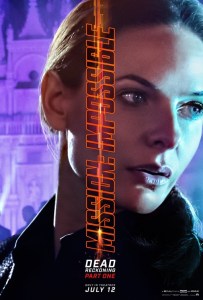 The most competent, nuanced, interesting character in the franchise is killed because Gabriel wants to teach Ethan a lesson by killing one of his women. After three movies where female characters have been allowed to be both characters and alive, we’re back to this misogynistic slop. And worse we’re here with a villain who has the personality of his suit.
Worse still the fight is shot in a very weird way. Ilsa’s initially stabbed in the shoulder, then we cut away and back to see the knife is moved. We never see the body. There’s no sense of how or if they get her out of Venice. Worse there’s a distinct vibe to the scenes before it of this being part of the plan. It’s very hard to not assume that this was left dangling in case Rebecca Ferguson’s schedule freed up for her to come back for the second part. Rumour is it didn’t, meaning a major character is killed for no reason other to emphasize the omnipotence of a villain we know is near omnipotent. It’s a horrifically bad choice and one I hope against hope the next movie fixes.
Dead Reckoning never quite recovers from this, and it’s hard to tell if that was the intention. It’s a shame because the action, especially the closing train fight/parachute jump/crash/climb is a franchise highlight. The Rome sequence too is action screwball comedy of a sort the series excels at and that’s what’s so maddening about it.
Verdict: This is often the very best of a consistently excellent franchise. But when it fails it fails completely and for a movie this ambitious that’s an enormous shame. 8/10
Alasdair Stuart




 Sci-Fi Bulletin: Exploring the Universes of SF, Fantasy, Horror and Spy-fi!