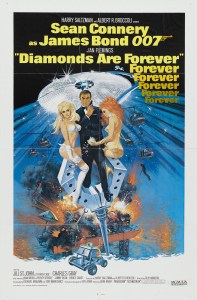
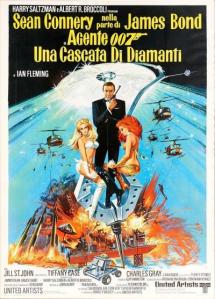
 With George Lazenby refusing to reprise the role of 007 after On Her Majesty’s Secret Service, American actors in the frame refusing the role on the basis it shouldn’t be played by an American and Michael Gambon refusing it on the basis of his being ‘in terrible shape’, the studio finally went back to what it knew best, securing Connery’s return in a ‘money no object’ £1.25million deal (Connery donated the fee to create an educational trust). With Guy Hamilton returning to direct (after OHMSS’ Peter Hunt was otherwise booked) and a mission to revisit the highs of Goldfinger, Diamonds Are Forever could hardly have had more riding on it – but, wonders Greg D Smith, would it deliver?
You Only Live Twice – in which Connery’s relationship with Broccoli and Saltzman had deteriorated so badly that he wasn’t on speaking terms with them – was silly from start to finish. On Her Majesty’s Secret Service, George Lazenby’s one and only try at the role, never really felt like it could get out of its own way long enough to be the breath of fresh air the franchise needed, and saw its lead outshone by his co-star in every scene. The Bond franchise needed something to get it out of the rut it was rapidly digging for itself. What it came up with was ‘re-cast the guy who started everything and hope that we can re-capture the old magic’. That’s a dangerous premise to begin with, and it’s a risk that – in my opinion – didn’t pay off.
 Lured back by an enormous paycheque, it’s clear from the start that Connery is doing this one for the money not the love, an impression which isn’t helped by the thinly veiled contempt with which he delivers his performance. Connery by this stage clearly isn’t all that bothered about Bond anymore, and it can’t help but bleed through in every shot in which he features. It reminded me of a much later entry in the franchise to which we will arrive in good time, but suffice to say having your lead look thoroughly fed up to be there isn’t the best start when your mission statement is ‘get the old magic back’.
The pre-credits opening promises a return to the sort of hi-jinks the series had been shooting towards before the rather abruptly sober turn of OHMSS – a face-off with Blofeld (played here by Charles Gray, also returning from You Only Live Twice and his brief role as Dikko Henderson) which turns into a face-off with body doubles and the eventual ‘killing’ of the arch criminal by immersion in….hot liquid goo? At any rate, his single-minded pursuit of SPECTRE’s notorious Number One done, what exciting and wondrous adventures of derring-do could wait for our hero next?
 Investigating international Diamond Smuggling.
Even in hindsight, knowing where this plot is ultimately leading, this feels like less a step down and more a plummet. A man who has taken on missions to retrieve nuclear weapons, stop the holding to ransom of the entire world and prevent numerous world wars breaking out, is assigned to see what’s going on with diamonds that are going missing because his boss suspects there’s a plot to depress diamond prices. Even Bond can’t hide his incredulity at the reality of the mission as it’s handed to him, and it just seems like a really odd beat to hit.
Still, the script commits to it and Connery actually gets to do some honest-to-goodness secret agent work, assuming the identity of a professional smuggler, ingratiating himself with smuggling contact Tiffany Case and thoroughly embedding himself into the part he needs to play to follow the money, as it were.
Unfortunately, while the script is committing to that sort of seriousness for our star, it’s going all kinds of oddly loopy elsewhere, and it starts with villainous henchmen Mr Wint and Mr Kidd.
 Coded as a gay couple (more by implication than anything that’s outright said), whereas the pair might cause the occasional wince at some of the more stereotypical aspects of their characters, for the time they’re actually relatively progressive. Their (implied) sexuality is never related to their capabilities by either the narrative or any other character. They are efficient at their murderous task, and take an obvious pride in it. Unfortunately, given that they are characters from the book who worked for a character who gets cut for the movie, the audience is basically left to assume that they are working for Blofeld, even though this is never stated by anyone and we never see them interact with or even mention Blofeld in any way. Even more unfortunately, despite the fact that Bruce Glover and Putter Smith deliver reasonably good performances (Smith can be occasionally a little wooden, unsurprisingly as acting wasn’t his main profession and this was his first movie), the film starts having them be situationally much dumber once they are required to cross paths with Bond.
 Their first kill in the film is a man they trick with a scorpion – quick, lethal and efficient. Their others include a bomb detonated on a helicopter, drowning a schoolteacher in a river and drowning Plenty O’Toole (and we will get to her) in a swimming pool with a concrete block tied to her feet. Yet when it comes to Bond, we have the theatricality of leaving him in a coffin to be cremated (and he’s saved by dint of them leaving assuming it’ll work), left in a length of pipe unconscious to be buried the next day and then in their final, fatal (for them) attempt a bomb in a cake which is hoisted overboard with Mr Wint tied between his legs along with his arms by his coat-tails. Why the pair are so intent on elaborately set-up deaths which they then walk away from, assuming Bond has perished, when they are so efficient elsewhere isn’t a mystery in a meta sense of course – Bond the hero must survive. But why not have them be as straightforward and murderously simple when dealing with Bond as everyone else and then have Bond overcome them? Surely that would make Bond’s character come off stronger and more capable? The contrast between their acts elsewhere and in relation to Bond just weaken the characters overall.
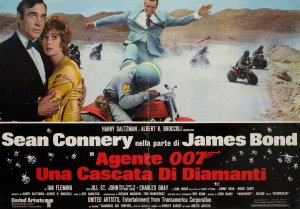 Though the movie is relatively gadget-light, it still packs in the action. A fight scene in a lift is one of the most brutal of the franchise to date, a car chase sequence in Las Vegas is perhaps a little bit long but still fun to watch and the third act showdown is full of all sorts of action. Less appealing is the sequence involving Bond driving out of a base in a ‘moon rover’ (the purpose of which is never fully explained for the entire film, give what eventually turns out to be the central villain plot) pursued by henchmen on motorcycles and motorised trikes, which seems to have been added more as product placement for Honda than anything else. Still, at least there aren’t any rocket launcher shoes or whatnot in this entry.
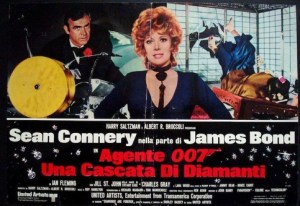 As to the women – well the ‘Bond Ratio’ seems to have altered, as here we only have two main female characters (three if we count Moneypenny, awkwardly squeezed in by way of a scene filmed after the rest of the movie had been shot once a pay dispute for Lois Maxwell had been resolved). Tiffany Case is, essentially, the ‘Bond Girl’ of the piece, starting as a sort of villain but basically flip-flopping between sides over the course of the movie. She’s potentially one of the stronger ‘Bond Girls’ to this point in this sense, not given to just swooning into Bond’s arms and renouncing her wayward behaviour because he smouldered at her, nor being a simple two-dimensional villain. Case is out for herself, always reading the room and judging where her interests best lie, switching sides as convenient to herself. Where the script does her a slight disservice is, in having established these traits which make sense for a successful professional smuggler, she suddenly gets injected with a dose of ‘ditzy blonde’ in order to prolong tension with a ‘hilarious’ mixup of the satellite control tapes. It doesn’t exactly destroy the good work that the script and Jill St. John have done to that point, but it does feel rather pointless. But then at least the character avoids Plenty O’Toole’s fate.
 Plenty O’Toole is perhaps the worst female character the franchise had served up to that point. Essentially there to be a distraction in a casino scene, then get thrown off a hotel balcony and into a swimming pool before eventually turning up having been drowned in a different swimming pool after being mistaken for Tiffany Case. Even by the standards of Bond, she’s a mere cypher, a piece of woman-shaped scenery, used to advance a plot point without the courtesy of any character trait other than ‘loud’.
The final reveal of the villainous scheme – a diamond-powered satellite laser designed to destroy nuclear weapons allowing Blofeld to organise a bidding war for nuclear supremacy – rather distracts from what would have been a much superior plot of Blofeld seeking to destroy all weapons to achieve a world without nuclear threat (which is what he turns out to have duped his scientist partner in crime to believe). It’s not the last time that a Bond plot discards an interesting setup for something far more conventional and dull but it is perhaps one of the more disappointing as one feels that it’s an angle that Charles Gray could really have got the most out of as the villain.
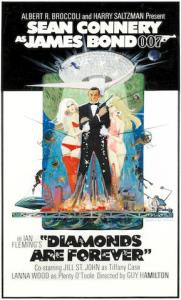 Overall then, while it’s an interesting entry to the franchise in many ways, it is for this reviewer ultimately a disappointing one. It has its bright spots in a relatively more complex ‘Bond Girl’ and some very nice action scenes, but it also has some extremely silly moments, and the penchant for wasting potential interesting setups in favour of conventional and disappointing payoffs. It is, as we know in hindsight not quite the last time Connery would don the suit and play James Bond, but it is his last entry as the EON version of the character, and it’s hard not to come away disappointed from the whole affair.




 Sci-Fi Bulletin: Exploring the Universes of SF, Fantasy, Horror and Spy-fi!