 How do you top the highest grossing movie in a franchise? That was the issue facing Sony and MGM when putting together the movie which would eventually become Spectre. A final cessation of the ongoing rights issues over Bond’s old nemesis organisation would mean a certain amount of careful retconning in this era of Bond movies which directly followed one another, and returning (eventually) director Sam Mendes would oversee an ambitious movie with an enormous budget – but, Greg D. Smith asks, could he do the business again?
Spectre really is an odd point in the series for me. I was a huge fan of Daniel Craig from the first time I saw Casino Royale, and I watched that, Quantum of Solace and Skyfall multiple times, enjoying them all greatly. Then there was what felt like a long wait for Spectre (in reality a mere three years) and it’s fair to say I bounced along to the cinema with high hopes. Suffice to say, at the time those hopes were not met. Though the pre-credit sequence thrilled me and had me on the edge of my seat, from then on the film was, for me, at best workmanlike, and at worst just dull.
 Time does funny things to the memory though. I was somewhat distracted by other factors at that cinematic screening, but I never felt the need to revisit the film from that day in 2015 until now for this piece. Having seen how the final chapter in Craig’s turn in the tux played out in 2021’s No Time To Die (a real interminable wait), and having watched every film in the entire saga from 1962’s Dr No, would I find myself re-evaluating Spectre’s qualities?
Well, yes. Ish.
That opening sequence really is spectacular. I know everyone at the time was entranced with the long, single tracking shot which began it, but personally I can’t help but feel that was a little showy – Mendes the auteur showing off in a technical sense. For me, the appeal of the sequence was its escalation, from the slow, purposeful stalking of the prey to massive explosions and a frankly amazing helicopter sequence. Genuinely the first time I saw it I was pumped, convinced I was about to see a really special Bond movie.
 And then the titles started.
At the time, Sam Smith’s Writing’s On the Wall did nothing for me. Call it the maturation effect of transitioning from my mid thirties to my early forties if you like, but it’s definitely grown on me a huge amount in the interim. Understated, but melodic with an easy rhythm to its chorus, for me it now joins the pantheon of what I consider to be underrated Bond themes, alongside Tomorrow Never Dies and The World is Not Enough. It signals, in hindsight, the mood of the piece. A continuation of the Craig arc from Skyfall, wherein we have an older, more jaded Bond heading towards the twilight of his career in a world where his very relevance is questioned. The very title of the song keys into that theme.
As to the graphics of the title sequence, I guess we can give it points for topless Daniel Craig (albeit in a weird gold-ish filter), though the real ‘innovation’ here is the images of past villains and heroes of the franchise parading across the screen. Silva and even Quantum would of course be slightly retconned to be a part of SPECTRE’s schemes in the movie, and again these images emphasise the journey of this iteration of Bond.
 And then, we are into the movie itself. It’s tempting to feel like we’ve seen all this before, not just in Bond but in any vaguely similar action thriller of the past few decades. Our hero has gone too far in his single-minded pursuit of a mission he cannot name to anyone, and finds himself relieved of duty and staring down the barrel of irrelevance as a new, digital form of his craft looks to replace his analogue. Now he must go it alone to do the thing that only he can do, and prove once and for all that he’s the one who’s in the right. From various cop movies to spy and even war thrillers, it’s a set of tropes we’ve seen a million times.
But oddly, on reflection, it does work here. Judi Dench’s M becoming a sort of quasi-mother figure to Bond in the Craig era is part of the reason for this. It is easy to believe that this version of Bond would recklessly go off book to do one last thing for his boss based only on a message she left him from beyond the grave. It’s also easy to believe that thanks to the nature of his relationship with his previous boss, he’d bang heads with new boss Mallory more and more, regardless of how much he might respect the man’s abilities. M’s death, and the events that surrounded and precluded it, perfectly explain why Bond is reluctant to trust anyone, even his boss, with the details of his new, personal mission, and therefore while this basic starting point for the plot is somewhat hackneyed, it does at least work.
 Bringing in Moneypenny and Q to the circle of trust is equally well-worn as a general trope, but relatively unique for this series. Moneypenny and Bond have always flirted in past iterations, but she’s never become really involved in any of his adventures. It’s good to see Naomie Harris get a more meaty role here to get her teeth into and she does the part credit. Similarly, where we may have seen Q in the field before, Ben Wishaw brings us a very different take to Desmond Llewellyn’s turn in Licence to Kill. Here, Q is a flustered boffin with no fieldcraft expertise to speak of who really just wants to stay somewhere safe with a computer. His reluctance is matched only by his genius, and it’s actually a much-needed note of levity in what is mostly a very dark film to see Q worrying about his job, his mortgage and his cats as he helps 007 out.
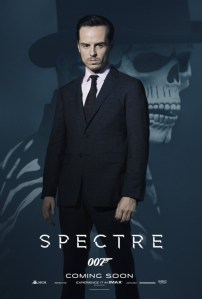 Where the film starts to have issues though, is with its villains. Andrew Scott as Max Denbigh is somewhat of a contradiction. On the one hand, he’s supposedly a smooth operator, seamlessly bypassing 00 branch and creating a new, tech-driven world of intelligence gathering while double-dealing with SPECTRE on the side. On the other, he’s far too obvious. His manipulations – with SPECTRE’s help – to get other nations on board the ‘Nine Eyes’ program are too transparent, and he’s too obviously antagonistic to both Bond and M to ever be considered not a threat, which takes the sting from his reveal as the villain complicit in SPECTRE’s schemes.
But worse, because the movie focuses much of its time on Denbigh (or ‘C’ as Bond and subsequently everyone else takes to calling him) it detracts from the eventual, glacially slow reveal of the film’s ‘real’ villain, Franz Oberhauser, aka Ernst Stavro Blofeld. Christoph Waltz was, in my opinion an excellent choice to play such a character, but he feels a little wasted here, confined mostly to shadow in his first onscreen appearance and then getting a mere handful of minutes, into which we get crammed his entire prior relationship to Bond, and his (apparent) reasoning for, well, everything. It feels odd to try to pin all of the events and villains of the last three films on Oberhauser’s long-simmering resentment of a man he feels supplanted him in the affections of his own father. Odder still that a globe-spanning criminal empire should have sprung up as a result, yet still inexplicably tied to mainly making Bond’s life in particular a misery in elaborate ways.
 Oddest of all, of course, is the decision to have the villain take the name he does. Like Star Trek: Into Darkness before it, the film rather clumsily breaks the fourth wall here, serving up a villain name which will resonate with the audience, but which would be meaningless to the movie’s actual characters. That being the case, the reveal feels artificial and stilted. True, it’s done less dramatically here than Benedict Cumberbatch’s ‘Khan’ reveal, but it still lands oddly.
 What of the women in this iteration of Bond? Moneypenny is, as mentioned, given a bigger role here, and Harris does her very best with what the script gives her. The studio and Craig himself made much of the franchise finally getting an ‘age appropriate’ Bond Girl in Monica Belluci’s Lucia Sciarra, but in truth she is onscreen for less than five minutes, and in all honesty the way in which they get together feels oddly nasty, even by the standards of the franchise. Sure, the film crams exposition into those few minutes in which we find that Scarria’s husband (the man Bond kills in the opening) was someone she loathed and feared in equal measure, but it still feels… off, breaking into the house of a newly widowed woman to have your way with her, even if you did just stop a couple of other people who’d also broken in from killing her. It’s a nice effort, I guess, but a little token and not really as ‘progressive’ as the hype might have led us to expect.
 Which leaves us with Léa Seydoux’s Madeleine Swann, the main Bond Girl of the movie, and James’ new love interest. Here, we have a potentially very interesting character – the daughter of Mr White, a previous Craig-era antagonist affiliated with Quantum. The problem is that the fetch quest which sends Bond to find White and its transformation into an important plot point and source of the Bond Girl feels a little too contrived rather than organically plotted. Bond, after all, goes to White for answers about SPECTRE, having attended their meeting in which White’s assassination was discussed. His offer to look after White’s daughter in return for information feels a little odd, doubly so when he starts to take that duty deadly seriously. For starters, as Madeleine herself points out, it’s Bond who leads the enemy to her. There’s also the matter of why Bond would implicitly trust a woman who is the daughter of a man he fought against. In fairness, the movie does at least try to paint White in a somewhat sympathetic light, declaring that ‘Our game is our game’ but that he blanched at the thought of the indiscriminate killing of women and children, but given that – at this point at least – White is, as far as Bond is concerned, a key architect in his ongoing misery, it’s difficult to see why this would move Bond much.
 However, I will say that Swann gets some good moments, albeit somewhat undermined by quite how quickly the movie ends up having her declare her love for Bond (which is standard for the series but feels regressive here). It doesn’t help that she’s a psychiatrist who literally declares to Bond that she won’t be falling into his arms because of her Daddy Issues, but then about twenty minutes of screentime later, falls into his arms after they share a scary encounter with Dave Bautista’s Hinx. That she then goes on to tearfully declare her love for Bond as he is tortured feels… formulaic in the worst way, the sort of trope that an Austin Powers movie would have been mocking in the late nineties.
 In terms of stunts and set pieces, the film veers somewhat from the sublime to the ridiculous. That opening sequence is amazing. The car chase through Rome is middling, the chase involving an inexplicably acquired plane barrelling down a hill after some cars and losing its wings is silly and the escape sequence wherein Bond, freshly tortured, wanders out of the enemy installation with Madeleine in two and begins almost casually plugging bad guys with his submachine gun feels less like an action movie and more like watching a video game character with the game set to ‘easy’. At its best, it’s a gloriously shot action movie. At its worst, it feels somewhat phoned in.
I think honestly the issue came with quite how much the movie tried to tie itself into the ‘cinematic universe’ of Craig’s Bond era. The retcons were not subtle, and the forcing of Blofeld into a plot whereby he’d been the architect of all of James’ woes from the outset was just a step too far. A few tweaks here and there and you’d have a movie every bit the equal of Skyfall. You could have that continuity without forcing it. You could have M discover something about Oberhauser himself rather than the elaborate breadcrumb trail. You could have Oberhauser be the Denbigh character, working from the inside to gather information from the world’s intelligence agencies all for himself. You could have Oberhauser’s resentment of Bond be based on something more complex than ‘Daddy issues’.
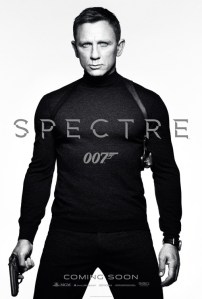 I come away from this viewing of Spectre then, with somewhat mixed feelings. On the one hand, it’s not anywhere near as dull or bad an entry in the Bond canon as I had once believed. It has a decent cast, some great moments and some solid ideas. Unfortunately, it’s weighed down by a need to create a continuity that necessarily messes with what came before, and the narrative convolution this then creates. In light of No Time to Die, some of its elements become slightly more forgivable (arguably the two sit together more as a double feature, as with Casino Royale and Quantum of Solace) but even given that, this feels like a confused effort which could have been great but ends up just ‘OK’.




 Sci-Fi Bulletin: Exploring the Universes of SF, Fantasy, Horror and Spy-fi!