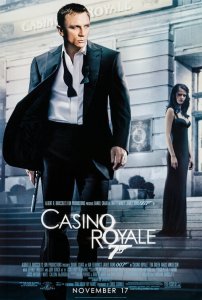
 Despite average to poor critical reviews, Die Another Day had performed well at the box office. Still, with the end of Brosnan’s four film deal, and his official announcement of retirement from the role, Eon elected to pursue a new direction for the next stage in the Bond saga. Could a new star and a new commitment to more ‘old-fashioned’ stunt work and ‘gritty realism’ work for Bond in a post-Bourne world, or was this sort of reinvention simply beyond the 44 year old franchise?
And so we enter the modern age of Bond, and the era in which I am most familiar, having been a fan of Craig’s tenure as the character from the beginning, even if it does highlight the vagaries of timing, with Casino Royale being, in many ways, broadly similar in tone and intent to Dalton’s poorly received Licence to Kill. In a post-Bourne Identity world, it felt as if the longest running spy franchise in Hollywood had perhaps missed a trick, and Eon were determined to make up the ground. What they did in the process, in my opinion, was create an absolute masterpiece of a movie.
 It’s not just the leading man who’s different here – every element of this movie feels reinvigorated and renewed compared to previous entries, and somehow elements which had been tried and had missed the mark in previous incarnations land perfectly. It’s almost alchemical how good this movie actually is.
It starts with the pre-credit sequence. No outlandish stunts, jumping out of planes or extended car chases. Bond and a man sitting in a room together, calmly discussing the fact of Bond’s 00 status and his killing of the other man’s agent. Shot in black and white and a series of low-angles, it’s an understated, almost matter-of-fact sequence, punctuated by flashbacks to a messy, painful fight in a public toilet which sees Bond battered, bloody and bruised, the desperation and animalistic blows contrasting perfectly with the stillness and predatory calm as he sits in the office. Here, the movie says, are the two sides of this character – bestial violence and absolute dispassion, distilled into one young, slightly naïve agent at the start of his dark career.
 Then we roll into that title sequence, and after four and a half decades, finally we have an opening which doesn’t consist of nearly naked ladies. Not a one. The decision to use stylised playing card-esque graphics serves to emphasise the slightly ‘old-school’ nature of this interpretation, as well as setting up the central premise of the card game Bond must win against villain Le Chiffre. And accompanying those graphics, the pulsing, intense riffs of Chris Cornell’s You Know My Name, a song as catchy as it is meaningful once you listen to its lyrics. Song and film are matched perfectly in tone and style, and by the time the film proper starts, you know you’re in for an intense ride.
 But we do have a new Bond, and now would seem a good time to address this. High profile casting decisions often meet with derision in the modern age, and Craig’s announcement as Bond was no exception. He was too blond, not the right height or build and so on and so forth. Craig, for his part, absolutely demolishes any and all objection to his turn in the tux from the opening moments of the movie. There’s an insouciance to his character which belies a raging cauldron of emotions you sense are never far from the surface. His eyes – strikingly cold blue – are often a focus of the camera in various scenes, and convey a range of emotions from intense anger to glacial calm and even fear. Yes, this is a Bond at the beginning of his journey, and all his capability and training don’t render him a superman. While Bruce Willis’ John McClane continued to become ever more invincible in each new instalment of the Die Hard franchise, Bond here goes in the opposite direction. This is a man, a capable, remarkable man but a man nonetheless, and that means he can be tricked, he can be poisoned and he can be hurt. That pre-credits scene involves a line from the antagonist – ‘Made you feel it, did he?’ The line relates specifically to how hard Bond’s first kill was, but it comes back to me time and again as I watch the movie – this is a film which wants you to feel how hard this job is on Bond, and that means not just the exhilaration of the successful mission but the pain of the fight, the emotional and physical toll of everything our hero’s body and mind are put through.
 Opposite Craig is Eva Green’s Vesper Lynd, who may just be the most complex and interesting version of the ‘Bond Girl’ to date. From their first meeting and all the verbal sparring it entails until their final moments together, underwater in Venice, this is a partnership of equals, though not in the traditional sense the franchise may take that. Lynd isn’t a superspy, and doesn’t have the ability to kill, jump out of moving vehicles and so on. Nor is she the hapless damsel, wont to swoon into Bond’s arms at the first opportunity. When confronted with Bond in his ‘normal’ mode, she scoffs at his arrogance, is able to see past the walls he puts up and flirts in a way which makes it clear that flirting is all he is going to get. When accompanying him in the fieldcraft side of the job, she’s out of her depth but not in a Willie Scott in Indiana Jones and the Temple of Doom way. There’s no hysterical screaming, no fainting and no over the top stuff – she reacts precisely how you might expect a capable career woman to react all the time: when the gunshots are ringing out and the fists are flying she’s terrified but capable of action. When the stakes are at their highest , finding a slumped Bond in his car with a loose defibrillator wire, she’s calm and collected. Even when they do get to the end bit of ‘Bond gets the girl’, it’s believable for two reasons – one, Bond hasn’t spent the movie shagging anything that moves and two, when you consider the revelations about Lynd at the movie’s end. Even Bond’s petulant ‘The bitch is dead’ rings hollow, the reflexive reaction of a young man feeling hurt and betrayed at having opened himself to someone emotionally, rather than a genuinely cold-blooded dismissal of a woman he saw as a ‘disposable pleasure’.
 Judi Dench’s M meanwhile, is at her absolute finest here. None of the nonsense of the Brosnan era where she would tell off Bond but there was always a hint of flirty eye there. Here, M is a capable, calculating agent of exactly the sort you’d expect to be running MI6, and if she has any feelings towards Bond beyond the professional, they seem to edge more towards irritated matriarch. Craig’s Bond is of course considerably younger than previous incarnations, being at the start of his career, which lends to an impression of a more parental relationship between the two that the series would lean into later. That said, there’s no doubting here that if it gave her the result she needed, M would indeed give Bond over to the powers that be in a heartbeat.
On the other side of the equation, we have Mads Mikkelsen as villain Le Chiffre. In keeping with the more grounded tone of the movie, our arch nemesis here isn’t a megalomaniac or an evil genius, but simply a gifted mathematician who uses his talents to win at cards and also happens to be an international financier who deals with people who can’t legitimately move their money around.
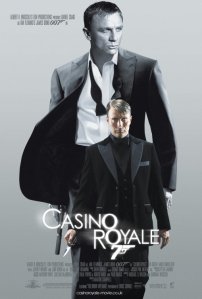 What’s nice here is that none of Le Chiffre’s plans are especially complex or overly intricate – ultimately he’s literally all about personal enrichment – and his plans are capable of being foiled without him looking stupid. In fact his plot to short stock in an airline by having their flagship new plane blown up is foiled twice, once when Bond kills the original bomber at the end of a breathless, parkour-filled chase and again when Bond actually stops the second bomber at the airport itself. That second foiling is the one which hurts, losing Le Chiffre money from a new and particularly vengeful client which he had been using for his sure bet, and making the poker game at Casino Royale all the more important for him to win. Again, this isn’t a villain who normally cheats (at least at cards) – he’s just good – and it’s a measure of his desperation that he has his mistress poison Bond when he realises just how vital it is that he win and how good his adversary is.
 What really comes out clear to me in a re-watch is now firmly the basis for Quantum and the importance of Mr White was being established here. Of course, thanks to ongoing legal wrangles relating to Thunderball, the studio was unable at the time to use SPECTRE as the evil organisation, and so Quantum (not named here) is the solution. White introduces Le Chiffre to his new client, and ultimately kills the financier when it becomes clear he’s bad for the reputation of his employers. He then ends up tracked down by Bond just before the closing credits roll, promising a more direct lead into the following movie.
Gadget wise, the movie is as restrained as elsewhere, though it perhaps leans a little heavily into the fantastical with how some of the mobile phones and computers tend to work. The car is a relatively normal one (for a given value of normal, being an at the time brand new model of Aston Martin) with emergency medical supplies and a gun in a concealed compartment. The gun is standard, there are no weird and wonderful briefcases, hats or shoes and the watch tells the time. This actually reinforces a core part of what makes the character standout – he doesn’t need an armoury of fancy toys to succeed but merely his own wits and strength, a lesson the studio had taken, one suspects, from Bourne.
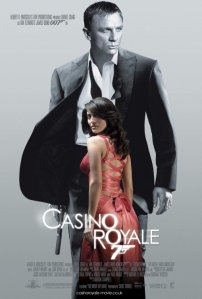 Is it a perfect movie? No, as strong as it is, some issues remain. Though it doesn’t have quite the sheer volume of product placement as in Die Another Day (aka Buy Another Day in some derisive circles) it does still feel quite aggressive. New distributor Sony made sure no other electronic manufacturer could appear, the watch is literally thrown into dialogue for no reason and despite having an Aston again apparently someone at Ford provided promotional consideration as Bond is first seen driving in this incarnation in a Mondeo. It doesn’t quite ruin the immersion of the movie, but it is noticeable, which means there’s too much of it for my money.
It’s also arguably a little too long – I’d argue that the movie could be ended with Le Chiffre’s death and the next movie started with what follows, but opinions differ. And if I’m being very critical, the parts in that ending where Craig wrestles with emotional dialogue are a little unnecessary and on the nose. In an era of show don’t tell storytelling, we didn’t need to hear about how Vesper had stripped him of his armour – it was obvious from context
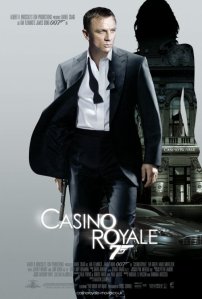 But these are minor gripes in an otherwise exceptional movie. For a long time I maintained that this was the best of the series, and now from a more informed stance, I would still argue that to be the case. The stunts are entertaining, the action is breathless and the casting is superb. It certainly set a high standard for not only Craig’s tenure but also the franchise as a whole. But could it maintain that momentum?




 Sci-Fi Bulletin: Exploring the Universes of SF, Fantasy, Horror and Spy-fi!