 After Moonraker did brisk business, surpassing the box office takings of its immediate predecessor and gaining mostly positive reviews, the studio made a decision that one couldn’t see happening today – to tone the series back down again and bring it back to its more grounded, realistic roots. A change of director would shape the focus of the movie, but could Roger Moore really deliver a Bond closer to Fleming’s original vision, per the producers’ wishes? Greg D Smith sits down to find out.
I’m starting to get to the point in the franchise where we are on movies that I remember from my youth, some better than others, and For Your Eyes Only is one of the ones I recall more vividly than most, helped no doubt by the fact that I recall watching it as an adult, albeit over a decade ago.
 But it’s more than that – this movie is absolutely packed with iconic scenes and sequences, whether it’s the mad-cap car chase in a Citroen 2CV, the impressive underwater vistas or the vertiginous final act freeclimb, For Your Eyes Only is a movie which makes the absolute maximum of its cast, its budget and its locations, even if there is a little bit of visual sleight of hand required along the way.
As far as openings of Bond movies go, it certainly qualifies for having a mixed one, going from maudlin to ludicrous and then dramatic while barely pausing for breath. Opening on Bond attending the grave of his wife Teresa to lay down flowers – the second overt reference in the Moore era to the events of On Her Majesty’s Secret Service, and hammering home the point that this Bond is the only Bond – the movie then takes a turn for the slightly farcical. Electing to take a slight sideways swipe at the long-term legal wrangles with Kevin McClory over the rights to the character of Blofeld, the movie has a bald, familiar looking character in a wheelchair who has a neckbrace and a cast on one arm taking remote control of Bond’s helicopter.
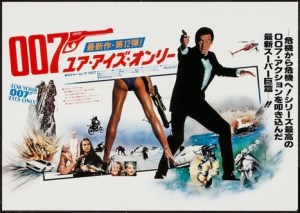 What follows is a sequence in which the helicopter’s pilot is killed and the helicopter itself is flung around as a voice taunts Bond from the speakers. Eventually of course Bond gains control of the machine and exacts revenge on the nameless assailant, dropping them down a factory chimney to (we assume) their death. Thus Bond gets revenge for the murder of his wife, and the studio disposes of a character they can’t use any longer, in a way that won’t get them into legal drama but also firmly sticks two fingers up at the other guys. Because it’s Moore, the movie gets away with it – it’s difficult to imagine any other Bond actor, before or since, carrying it off.
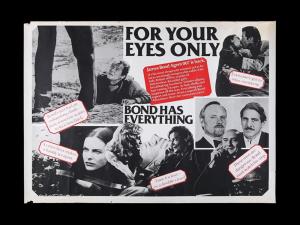 Then, following the title song and credits, performed unusually by an actually onscreen Sheen Easton, the movie switches focus and tone again. The secret British surveillance vessel St Georges is caught by a mine accidentally hauled in by its trawler nets and sinks with all hands in a tense, claustrophobic and action-packed sequence, the movie showing right out of the gate the tighter, more honed directorial style of John Glen, erstwhile an editor of the franchise. As the ship sinks beneath the waves and the grasping, desperate hand of an officer flails unsuccessfully for the self-destruct lever on the movie’s MacGuffin ATAC machine, it’s just possible that, like me, you’ll find yourself unconsciously holding your breath.
 Following this, things get darker still, with the assassination of Sir Timothy Havelock, the archaeologist sent by the British government to locate the St Georges, along with his wife, in front of the eyes of their daughter Melina. Bond, brought in directly from his helicopter adventures and sans the usual romantic clinch scene, is immediately tasked with taking on the task of tracking down the hitman and finding out who exactly has hired him.
What stands out about this movie, particularly in contrast to the previous Moore outings, is how much more businesslike Bond actually is here. Not that Moore is not allowed to be Moore – there’s still that little twinkle in the eye, the knowing smile to camera and the general sense he’s still finding the whole thing more than a little absurd. But there’s also no string of lovers, no jumping on every available woman he sees and an undeniable focus on the job at hand.
 This sense of seriousness extends to the overall plot as well – no cartoonish madman with plans of world domination or some outlandish scheme to enrich themselves here. The incident which sank the St. Georges was a pure accident, one which the Russians, in the form of General Gogol, returning once more, wish to take advantage of if at all possible. Stuck in the middle is Kristatos, introduced as a feasible ally for Bond rather than with a flashing neon sign above his head announcing that he will double cross him at some point and turn out to be the real villain of the piece.
Columbo, introduced as the villain by Kristatos, of course turns out to be an ally, and one who reminds this viewer of the crime boss Draco from OHMSS (Bond’s father in law, no less). There’s that same sense from the script that this is a loveable rogue – a man who does illegal things but not immoral ones, and who is a decent enough man willing to fight for what’s right, even if there isn’t money in it for him. Chaim Topol has obvious fun with the character, as does Pierce Brosnan’s late wife Cassandra Harris as his mistress the ‘Countess Lisl’ whom Bond does end up bedding and who is then swiftly killed because this is a Bond movie and we can’t quite leave behind every one of the tropes. For what it’s worth, Bond seems genuinely shaken by the death of Lisl (then again, he’s actually forced to witness it, which is in itself a change from the norm) and he does get a very personal revenge on her killer, in a scene which Moore apparently felt unhappy with.
 That scene, where Bond steps up to assassin Loque’s car, hanging over a cliff, and delivers the final kick that sends it over the edge and kills Loque, is in my opinion crucial to the character of Bond on several levels. Firstly as mentioned it establishes that unlike in previous movies, Bond actually felt attachment to Lisl and was actually grieved and possibly guilty about her death. Second and more importantly, it helps establish the normally affable and charming Moore as the government-sanctioned killer that his character is. It’s one of those moments – and they’re never overdone – where we see the darkness necessary to do the job which lies beneath the charming surface, and Moore – whatever his misgivings might have been – delivers it absolutely perfectly.
Carrying on with the theme of the franchise as a whole improving, it’s nice to have another Bond girl in the form of Melina who isn’t just there to scream and get rescued. From their first meeting where she kills the man who murdered her parents to the end of the movie where she’s part of the force which infiltrates the church where Kristatos is holed up with the ATAC, she’s always involved, always has agency and purpose and never gets relegated to simple window dressing. Carole Bouquet delivers a stellar performance in which it’s always very clear that she’s every bit the equal of the men around her in terms of grit and toughness, while still managing to be convincing as a normal person occasionally out of her depth in the sort of situations in which Bond often finds himself.
 In terms of action set pieces, it’s very much a Bond movie – we get an underwater fight with a submarine, sharks, a helicopter and a ski chase among others. Crucially though, unlike the interminable speedboat and car chases in Live and Let Die, The Man with the Golden Gun and Moonraker, none of these sequences ever outstays its welcome or feels played out. John Glen’s direction manages to ensure that the scenes always feel tight, nicely paced and action packed. Even the final impressive sequence, with Bond scaling a sheer cliff face, doesn’t feel too slow because of how tense it is, and how well shot the climbing is.
And speaking of that ending sequence, instead of the big horde of nameless bad guys versus the horde of nameless good guys, we have a small crack team infiltrating the monastery against a small team of enemies. Again, it feels more real, more grounded and less fantastical than previous finales, and it works all the better for it.
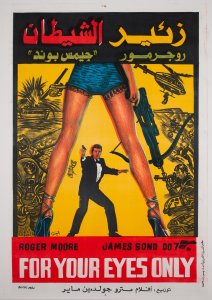 It isn’t without its silliness, of course. A car chase involving a Citroen 2CV is action-packed but can’t help feeling a little comical. The inclusion of Bibi, an oversexed ice skater who is the ‘ward’ of Kristatos, serves no purpose other than occasional exposition and someone whose sexual advances Bond can turn down. Lynn-Holly Johnson does the best she can with the role, but it’s paper thin and could easily be dropped without really affecting the movie. The end sequence too, with Bond leaving a parrot to request Prime Minister Margaret Thatcher (played by professional Thatcher impersonator Janet Brown) to ‘Give us a kiss’ is typical Moore Bond, and an excellent and much-needed bit of light relief for a movie that is mostly much darker than many of its brethren. There’s also the usual Moneypenny scene, a pointlessly over-elaborate and easily escapable execution attempt on Bond and Melina by Kristatos and a conveniently left-behind air tank.
 In terms of appearance, it’s a gorgeously shot film, and stands out as the first of these which still genuinely stands up visually. The underwater scenes in particular are impressive, doubly so when considering Bouquet’s pre-existing medical condition which prevented her actually being underwater, necessitating several ‘underwater’ scenes being shot on dry sound stages with much technical wizardry following to make them look believable. Truly a credit to the visual FX team on the film.
Between its more grounded villain, a darker storyline and a genuine sense of (slow) evolution, it’s easily the best in the franchise to this point. I wonder if Moore, who is starting to look his age by this point, can continue to impress me with the rest of his tenure…




 Sci-Fi Bulletin: Exploring the Universes of SF, Fantasy, Horror and Spy-fi!