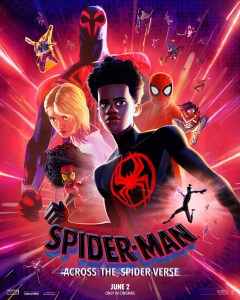
 Starring: Shameik Moore, Hailee Steinfeld, Brian Tyree Henry, Luna Lauren Vélez, Jake Johnson, Jason Schwartzman, Issa Rae, Karan Soni, Daniel Kaluuya, Mahershala Ali, and Oscar Isaac.
Directed by Joaquim Dos Santos, Kemp Powers and Justin K. Thompson
Sony, out now
Miles and Gwen’s lives intersect once more…
There is a pleasure in being overwhelmed by art. In having each sense blown past with stimulation until all you can do is revel in the sensation of being whirled around in technicolour and glorious audio.
Into the Spider-Verse, Sony’s first entry in the animated Spider-Man trilogy, was exactly this kind of surprise. A coming of age story with a message that any and all of us can make choices which make a difference.
Across the Spider-Verse follows in that first film’s substantial wake. It’s not too much to claim that the arrival of Miles Morales onto our screens in 2018 changed everything about what people believed animation could do and with a soundtrack and aural landscape which was similarly vibrant and thumping.
The sequel is all the first movie with more at every stage. I’m not going to talk about plot or story here because that’s almost the least coherent way to talk about the movie.
For me this movie talks about a number of personal emotional challenges facing young people and it does them really well. Crucially I think they’ll be lost on some people because there is so much going onto the screen that reading what it’s saying can be a challenge for those not used to being presented story like this.
Unlike a film like Thor Love and Thunder where piling ideas and characters onto the screen was often due to a lack of discipline and a requirement to build other movies into the overall storyline, Across the Spider-Verse’s never ending feast is there because it’s part of what makes the movie’s exploration of its themes so astonishing.
No one is on screen except because they should be there. Backgrounds are replete with clues, with love and attention and world building.
What I’m trying to say is that the design decision to put so much onto the screen relates directly to our protagonists’ journeys and those journeys are about loneliness and how that can feel entirely overwhelming. Miles, Gwen, even Peter and Miguel are isolated, lonely and unable to talk about who they are with those they love.
They are frightened of the response they might receive but also of the risks they take in their own lives to be themselves. The analogy here with communities who hide who they are for fear of being hunted, locked up, rejected and harmed is extremely strong and, although commented on at length over the course of Spider-Man’s comic book history, it’s here on screen in the most touching way (not least in the brilliant poster above Gwen’s bedroom door calling for the protection of trans kids).
All this ties in seamlessly with the sense of being overwhelmed.
The movie is an assault on the senses and in this it captures Miles’ experience of living two lives to their full, of struggling with trying to float while, really, sinking each and every day.
Added into all of this is the sense that Miles doesn’t know who he really is. Voices on all sides try to define him yet at his heart there’s a loneliness which consistently reminds him that he isn’t what anyone around him thinks he is.
You might think Miles has a secret identity as Spider-Man but that’s a mistake. Miles has two complete lives, both open to those who know and secret from those who don’t. The Spider Society he encounters all wear their outfits (with one very notable exception) all the time. The human life under the masks are always hidden as much as Spider-Man is hidden from Miles’ parents.
Miles has two secret identities, two personas who both occupy his mind all the time and he cannot, within that, construct who he is, who he wants to be.
The film builds on this cognitive dissonance through overwhelming spectacle that’s very, very carefully orchestrated to lead us through his (and Gwen’s) struggle with what it means to be them.
And it does so with such beauty and attention to detail that there were moments when I simply sat there wishing the screen would freeze so I could lose myself in the images and it’s the reason that I’ve already seen the movie twice.
This meditation on loneliness and the consequences of the choices we make is threaded throughout the film as clear as day, but I can see why people lose sight of that when they watch it because the medium here is the message and most people expect films to present the message within the medium not to be part of it as well.
There’s one scene where the entire background is a wash of two-tone watercolours that change from one tone to the other depending on the emotional state of the two characters on screen. It is astonishing and wonderful and heartrending with all of these feelings washing across the screen as much as it’s carried in the words and actions of the characters in the foreground.
Alongside this there is the idea of loss and grief and how we cannot stop it from coming into our lives. Spider-Man is cast as a teenage boy, not quite a man but old enough that he is encountering tragedy for the first time – this idea that loss is a part of life that cannot be avoided. Part of becoming an adult is this realisation – that no matter how hard we work we cannot win against tragedy.
Miles is faced by those who have reluctantly accepted this truth and in their conflict he rejects the idea – determined to have a world in which he can save everyone. How that will play out in Beyond the Spider-Verse I cannot say but this movie takes the idea of fighting against loss seriously, so I do not doubt the finale will do the same.
I also want to call out the different Spider-people in the film. Sure, they’re characters from the comics but here they’re also something more, something entirely in the service of the story. Every single Spider-person here is an archetype of the type of person Miles and Gwen are exploring. They represent the kinds of people, or perhaps shards of the kinds of the people these two young adults could choose to become.
The father, the activist, the anarchist, the mother, the conformist and the vigilante to mention just a handful. If Miles is lonely and feeling empty, each of them and their interactions with him reflect an opportunity to fill that gap with a particular way of being. Miles tries them all through the course of the film and makes fantastic, broken, thrilling choices about each of them.
If Into the Spider-Verse was about coming of age then Across the Spider-Verse is about finding your voice. And the truth is Miles takes some good from everyone, even those who, ultimately, oppose him.
You could compare this entry to The Empire Strikes Back and in many ways that is a very apt comparison for the tone, expansiveness and feel of the movie which, itself, is the second of three.
However there are important differences – not least in that Miles feels more human than Luke ever did and Gwen is absolutely fantastic because she’s given room to be the young adult she absolutely is.
What I mean is that the writing here focuses on the individuals and their experiences, not on an overarching plot. The story is delivered through their engagement with the worlds in which they find themselves. Part of this is exactly because modern story telling is built like this but it’s also a way of making sure that Gwen Stacy does not get lost in Miles’ story.
I come back to the truth that the plot here is in every frame, every moment, every appearance of the number 42. It was built from the first movie with seeding that even now I’m stunned to see linking up with the second movie (watch out for the reappearance of the coffee shop, Foam Party). The story grows in this film, building on the first and by the end there’s a sense that the third movie is going to be an utter juggernaut that will leave us crying and punching at the air simultaneously.
Is it as good as Into the Spider-Verse?
Yes. It has all the same care, even more ambition and it’s learned lessons from the first movie that are subtly put on screen in every frame. You might miss that subtlety in the overwhelming barrage of ART that this film holds to its heart but it is there.
It is also why I’ve gone back and watched it a second time. A third time is coming and I think it will be every bit as rewarding as the first two viewings because unpacking the love folded into the batter of this film is absolutely part of the experience.
Verdict: Across the Spider-Verse is remarkable and for lovers or art, storytelling and worldbuilding, it is an incredible feat.
Rating? 10 spiders out of 10.
Stewart Hotston




 Sci-Fi Bulletin: Exploring the Universes of SF, Fantasy, Horror and Spy-fi!