Feature: The Road to Infinity War Part 14: Doctor Strange (2016)
With the original team of Avengers slowly edging towards the end of their contracts and fresh blood needed for the future, it was time to start setting up some new […]



With the original team of Avengers slowly edging towards the end of their contracts and fresh blood needed for the future, it was time to start setting up some new […]
 With the original team of Avengers slowly edging towards the end of their contracts and fresh blood needed for the future, it was time to start setting up some new characters from Marvel’s vast back catalogue to take up the mantle. 2015 had brought us Ant-Man, and 2016 went even bolder to bring us the Sorcerer Supreme himself, introducing magic proper into the MCU after the fudging in Thor of ‘science you just don’t understand yet’. When he loses control of his hands in a horrific car accident, renowned brain surgeon Stephen Strange’s search for any possible cure sees him travelling to Tibet, where he will learn the mystical arts from the mysterious Ancient One. But as a new threat arises, will Strange have what it takes to don the mantle of Sorcerer Supreme? Greg D. Smith investigates.
Magic was always going to be a tricky prospect in the world that the MCU had built. From Iron Man onwards, the franchise had striven to provide a believable version of the world we know for its heroes to romp around in, making the franchise feel, if not exactly grounded, more realistic than stories about superheroes ever had before. Thor had touched briefly on the subject with its line about science and understanding (odd in itself, given that Loki is regularly seen to use magic) but that aside, the subject had been so ardently ignored you might have been forgiven for thinking Fox had a licence over it somewhere.
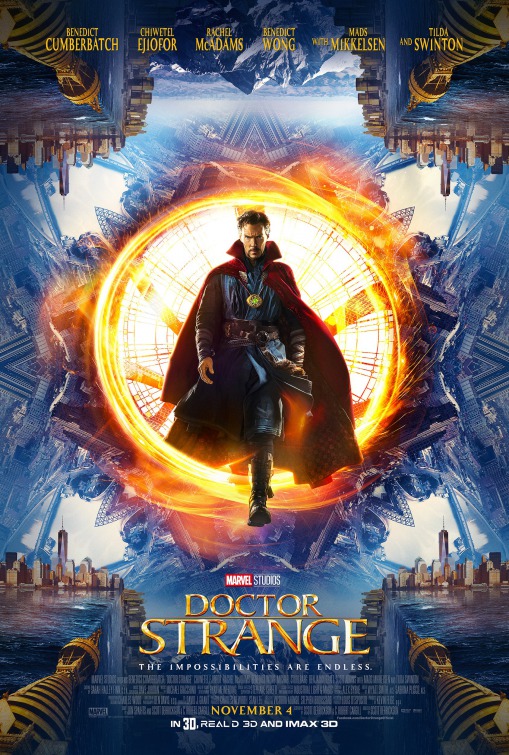
 That all changed quite abruptly with the release of 2016’s Doctor Strange, the origin story of the MCU’s version of the Sorcerer Supreme himself. Now, we would have magic front and centre (for how could it be otherwise?) and a whole world of otherworldly possibilities was laid out before us.
One of the more annoying shorthand dismissals of this movie is that it’s ‘Iron Man with magic’, referring to the superficial similarities between the two characters like facial hair and the fact that each starts their journey as a massive tool who is then subjected to a traumatic event which changes them and makes them become the hero. On those very broad terms, there is certainly vague alignment, but the reality is that these are two very different characters with two very distinct journeys to take.
When we meet Strange, yes he is a complete asshole. Exceedingly intelligent, superbly gifted as a surgeon, he uses these gifts not to try to make the world a better place, but to gain glory for himself even as he heaps scorn upon those around him. His treatment of people is awful, whether it’s a colleague who isn’t quite as super-intelligent as he is or his ex-lover with whom he playfully flirts even as he insults and mocks her. This is key difference number one – for all his (many) flaws, Tony Stark is never unlikeable: witness his seduction of a female journalist who turns up to berate him as the Merchant of Death. Stark has charm to spare, and knows when to use it. Strange, by contrast is funny in a sarcastic way without ever being fundamentally likeable to those around him. His theatre staff tolerate him as one would expect, whereas the people around Tony are a little… happier. Think back to the soldiers in the Humvee with Tony when we first meet him – how he puts them at ease, laughs and interacts with them. Now compare this to Strange when we first see him in the OR. There’s no warmth, no charisma, just the solid sense of self-assurance and a cold indifference to the rest of the world.
 This is borne out further in the moments before his accident as he is going through potential patients with his assistant. An air force colonel with serious back injuries (Rhodey post-Civil War or perhaps even the pilot of the Hammer suit shown at the senate hearing in Iron Man 2?) is something beneath his notice that anyone could deal with. A 68 year old woman would risk his ‘perfect record’. He has – despite his vocation – no interest in helping people unless doing so will benefit him.
Then let’s talk about the nature of the trauma which befalls him. His car crash leaves his hands smashed and useless, constantly shaking and not properly under his control. This leaves Strange adrift because his hands are the one thing upon which he relies. Any vague hint of amenability vanishes from his character as he becomes self-absorbed, spiteful and vindictive towards those around him. So consumed is he by the pain which has befallen him that he becomes tunnel-visioned, unable to focus on anything but the raw deal fate has given him. Contrast once again with Stark, whose trauma does not directly affect his greatest natural asset – his intelligence. Perhaps because of this, Tony is able (with Yinsen’s help) to focus past his predicament and think of a solution. Overcoming a physical disability and escaping from terrorists who have kidnapped you in a cave are not directly comparable experiences, but the point is that not only are the traumatic events which befall the two men very different, but so are the ways in which they respond.
 At any rate, once all conventional routes have been tried and have failed, our hero travels to Nepal to seek out Kamar Taj, having been told of the mysterious healing power available there. This is where the movie – from an outside perspective – starts to become a little problematic. It’s a truism that many of these stories are based on comic book characters created in a less enlightened time. The White Saviour trope is one that literature still struggles with to a certain extent today. Adapting a story about a Western white man going to the East and mastering ancient and wise practices to be found they’re better than the locals was always going to be a tricky prospect for a modern audience. This makes it all the more frustrating that the director chose to alter one fundamental character – The Ancient One – from a Himalayan man to a ‘Celtic’ woman. In a medium still so relatively short of decent female characters, the decision to gender swap such a fundamental one was welcome – the decision to make her a Western white woman less so.
That said, and acknowledging the controversy that went both with the casting decision and the director’s defence of it, Swinton turns in a bravura performance as the eccentric Sorcerer Supreme. Her unique looks combined with her physicality lend a sense of menace and capability that sit juxtaposed to her quirky, dry humour and wry observations. From her first appearance at the beginning of the movie right until her last, talking to Strange as an astral ghost as the pair watch the snow, she’s a captivating screen presence, who helps make the movie as entertaining as it is. She’s also given a complex and interesting character to bring to life.
 Still, the Kamar Taj sequence, which may also be thought of as an extended training montage, is entertaining. Chiwetel Ejiofor’s performance as Mordo slightly channels his turn as the Operative in Serenity, all calm, earnest seriousness and inflexibility though admittedly with a more moral edge to his character. Mordo is interesting because he’s presented to the audience as a character with whom Strange will need to work and ally himself, yet he’s got that fundamentally unlikeable air of a Teacher’s Pet about him. Always defensive of the Ancient One, always the one to shout about the Natural Order, following the rules and generally being an uptight goody-two shoes of a character, it’s not difficult to imagine the Ancient One rolling her eyes at the character more than once. Ejiofor plays the character perfectly, and that unlikeable prissiness serves him well for the turn in the post credit scene, setting up (presumably) a villain for the next movie, and it’s just a shame that the movie wastes him a little in the final scene. After the Ancient One tells Strange, before she dies, that he will need Mordo as Mordo needs him, Mordo doesn’t really do a lot in the final battle, before stalking off in a huff because Strange messed with the Natural Order.
And speaking of villains, yet again we had a MCU entry where the audience moaned that the villain didn’t deliver enough. That’s to miss two things. Firstly, Mikkelsen’s Kaecilius is a wonderfully complex character and one of the few in the MCU who actually has a proper reason for his path beyond wanting power/fame/riches and secondly – there isn’t one villain in this movie but at least three, possibly four depending on how you look at things.
 First there is Kaecilius himself – who we learn came to Kamar Taj ‘broken and looking for answers’. Initially he seems your standard comic book villain crackpot, wittering on about how the Ancient One betrays everyone and is a hypocrite. It’s not until later in the film that we come to learn he has a point – the Ancient One, no matter her intentions, has been drawing on power from the Dark Dimension, in exactly the ways she has forbidden others to do. She has used this power to unnaturally extend her lifespan, even as she condemns Kaecilius for his own attempts to achieve immortality not just for himself, but the entire human race. Sure, his plans are somewhat undermined by being delusional, but still, he’s much more than the average villain. He also serves as somewhat of a Dark Mirror to Strange, being an individual who genuinely wants to help the world, even if misguidedly, as opposed to Strange who is – at the beginning at least – entirely selfish and only ever thinking about helping himself.
This also highlights potential villain number two – the Ancient One. There is an argument to be made that Mordo’s own views on the matter – fuelled though they are by his own puritanical nature – hold merit. By doing as she has done, arguably the Ancient One has created the path towards doom that the movie finds humanity on. She has arguably had a hand in creating Kaecilius, and in turn in attracting the attention of far more dangerous creatures. Though we can see that she has good intentions, as the saying goes you either die a hero or live long enough to see yourself become the villain. And the Ancient One has lived up to her moniker, having endured for thousands of years. Perhaps this is why she so freely gives up her life in the end, confronted by the scale of her failings, finally able to let go and let others walk the path and protect the Earth, and hope that they do not make her mistakes.
 Then there’s Dormammu – an intergalactic (and to be honest fairly generic) bad guy who wants simply to destroy all life and has a particular hunger for Earth. He can be written off in the main because his main function in the movie aside from acting as a boogeyman in the shadows for much of its run time is to show off Strange’s clever way of defeating him. It is here where Marvel can be said to have perhaps dropped the ball creatively – Dormammu could and should have been so much more than a simple lounge act at the end of the movie.
And finally there’s Mordo. Though he spends the majority of the movie on the side of good, there’s always that quality that Ejiofor brings to the role of him being a little too starch and puritanical to be actually likeable. There’s constantly a sense that the man is holding something within him in check, and that asks the question of what and why. The post credit scene tells us, as we seem him embarking on a journey to rob all Sorcerers of their power, having adjudged there to be too many in the world. We can only hope this gets followed up on in a future movie.
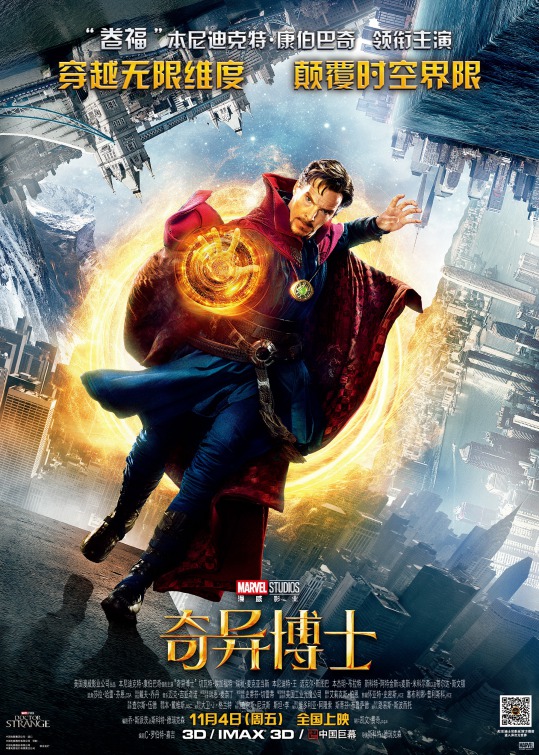 The climactic confrontation itself needn’t detain us too much here – thousands of effusive words of praise have been ladled on it elsewhere, simply for being different from much of its stablemates. It’s true that it makes a nice change for an MCU entry to end with a city being made whole and undamaged again instead of being left in ruins, and the way that Strange defeats Dormammu with his mind rather than with power or brawn is both refreshing and fitting to the character (even if the use of the Eye of Agamoto to do so smacks slightly of the character using a cheat code to beat the game). But the meat of the movie, of validating it as being more than a simple templated MCU origin story, lies in the progression of the character himself.
There’s an argument to be made that Strange alters very little. He is still, by the movie’s close arrogant, abrasive, and a bit full of himself. The mid credit sting with Thor, lifted from a longer scene in Ragnarok, is in keeping with this, as he talks rather condescendingly to a person who is – to him – almost a god. However, there’s more depth to this movie than that.
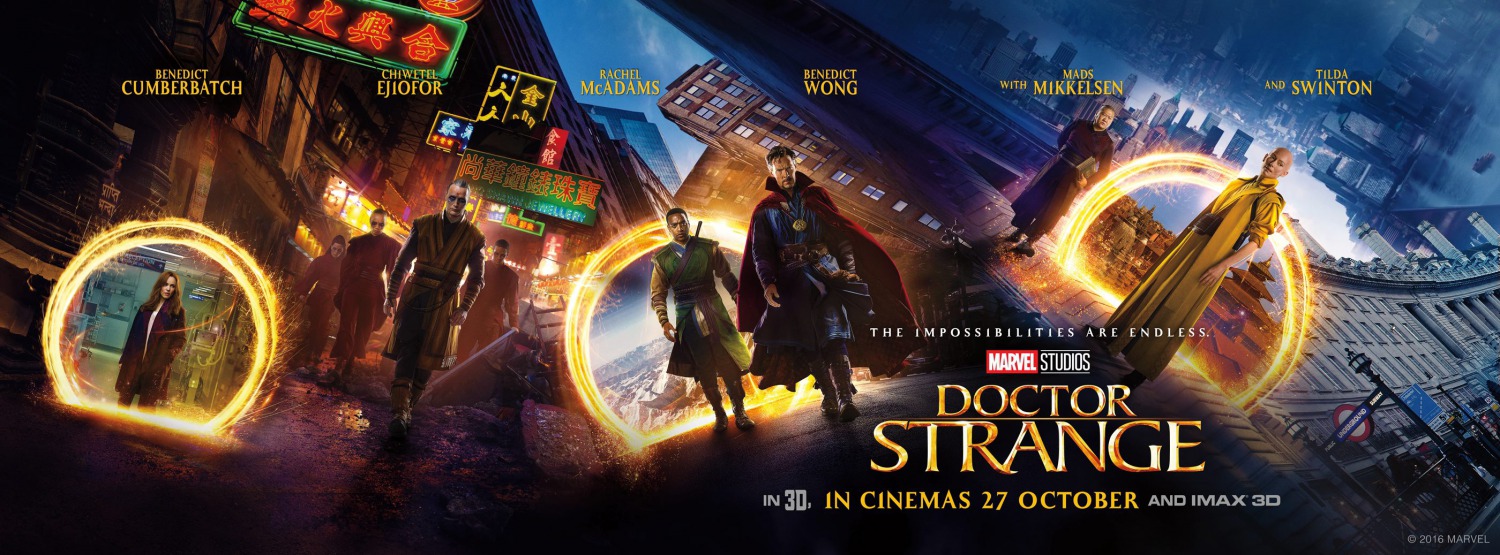 The change in Stephen Strange is more fundamental, and it comes about from the conflicts with which he is faced once he has begun to master his powers. His confrontation with Kaecilius and his disciples has him fighting for his life, and indeed killing a man, which deeply affects him. It is the death of the Ancient One though, which is the turning point. He sees at that point what the stakes are. He is able to recognise – in a way that Mordo cannot – that though the Ancient One transgressed, she did so for noble intentions. In understanding this sacrifice that she made, he comes to realise the true nature of the decision before him (forced in the main by the Ancient One herself in her final exchange with him). He can use the powers he has attained to make his hands better and go back to his old, selfish life, or he can grasp the opportunity to do and be better, to save the entire world, and protect all of humanity. He stops lying to himself in that scene, his weak defence of ‘saving lives’ in his former life demolished by the simple truth that he’d only ever worked to serve himself. It’s a moment of Damascene proportions, in contrast to the addict Stark’s journey of gradual self-improvement over years. It doesn’t make Strange any less of a superior, snarky asshole, but it does set him on a fundamentally different path, able to confront a destiny that’s about more than himself, and embrace those he may have shut out in the past.
It may be tempting to dismiss this movie as ‘Just Iron Man but with magic’, but that would be to do it a great disservice. My advice is much the same as that of the Ancient One: open your eye.
 Doctor Who News Star Trek News
 Sci-Fi Bulletin: Exploring the Universes of SF, Fantasy, Horror and Spy-fi!