Feature: The Road to Infinity War Part 1: Iron Man (2008)
Greg D. Smith begins a series of features on the Marvel Cinematic Universe with this trip back a decade to the very start (for the purposes of this series, we’re […]



Greg D. Smith begins a series of features on the Marvel Cinematic Universe with this trip back a decade to the very start (for the purposes of this series, we’re […]
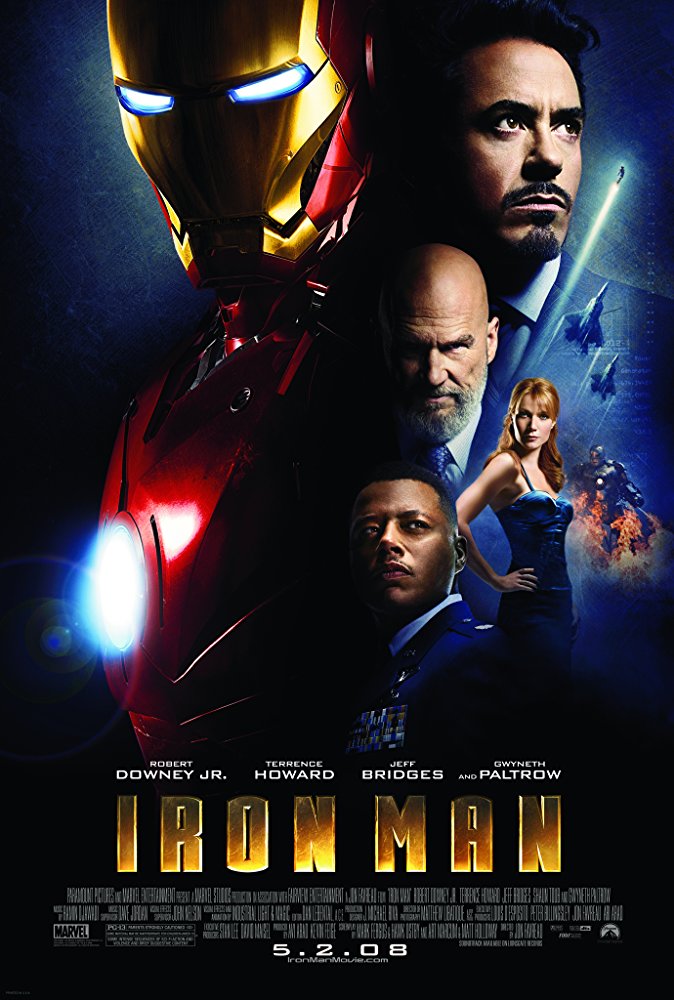 Greg D. Smith begins a series of features on the Marvel Cinematic Universe with this trip back a decade to the very start (for the purposes of this series, we’re not counting the original Hulk movie). Billionaire arms dealer and eccentric Tony Stark suffers a mishap in Afghanistan demonstrating his new products to the military that will alter the course of his life forever.
It’s easy to forget now, in the warm glow of the gigantic, multibillion dollar Disney-owned franchise that is the MCU that when Iron Man hit screens in 2008, it was somewhat of an unknown quantity. Robert Downey Jnr had experienced something of a rocky career path, the central hero was (at the time) somewhat of a second stringer even in the comics he hailed from, and over at Warner Bros, a certain other billionaire eccentric hero was enjoying something of a revival, with hype at explosive levels for Nolan’s second entry in his Dark Knight franchise.
A tough sell then, and one that was by no means guaranteed, even with big names attached. Which makes what we got all the more remarkable. When people talk about Iron Man, there’s often a lot of love for it: it’s the first, it started the franchise and ten years later, it’s celebrated for that fact. But I would like to talk about some of the actual qualities of this and the movies that have followed over the last decade, and why I think they are relevant not just as a part of some cultural Comic Book Movie zeitgeist but as serious pieces of work in and of themselves. When a franchise is standing at 18 movies over ten years and counting, and each instalment is regularly pulling in over half a billion dollars minimum in global box office revenue, it isn’t just because of pretty faces, nice special effects and lots of laughs.
That said, let’s address the ‘laughs’ first. Downey Jnr is renowned for quick-fire delivery and his ability to wring the maximum amount of snark from almost any line. The script plays to this, and Stark gets not a small amount of zingers to deliver, but let us consider exactly why. Tony is a man born with a brilliant mind into a life where he already wants for nothing. He’s the smartest person in any given room he’s ever been in (which means not as smart necessarily as Black Panther’s Shuri – we will get to her in due course) and he can do/say anything he likes. He is, to put it bluntly, bored. He alleviates that boredom by acting out, and part of that acting out involves saying outrageous things. It also helps him keep people at a distance. Tony doesn’t like being handed things, has a string of meaningless physical relationships with women he never sees more than once and spends money like it’s literally water. He takes nothing seriously, not even his only apparent friendship with Air Force Colonel Rhodes. He is already, as we first meet him, a deeply psychologically damaged individual. This point is important.
Because what happens next is that while on location with the army in Afghanistan, demonstrating his latest weaponry for their approval, he ends up ambushed, severely injured and captured by terrorists who want to use him to build his newest weapon for their own use, from a stockpile of Stark Tech weapons they shouldn’t have.
Now, a psychologically healthy person would be horribly scarred by this experience and by what follows. He does, after all, very nearly die and is left with a wound that will forever (as far as this movie is concerned) be trying to kill him, stopped only by a big old magnet in his chest. Not only that, but his fellow captive, Yinsen, is a reminder of how awful a human being Stark has been his entire life. He can’t even remember the man, because he was so paralytically drunk the one time they met. Tony should, by all rights, give up here. He should simply wave a white flag and either let the terrorists kill him now or do whatever they want. He is after all on unfamiliar ground. He can’t just buy or smooth talk his way our of the situation he’s in. He can’t escape the close proximity of another human being who forcibly reminds him of that previous, freewheeling lifestyle he’s become used to.
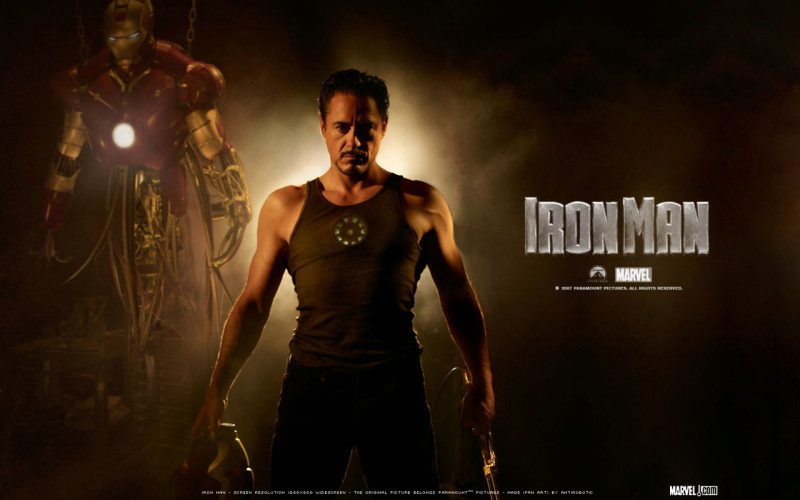 But what he does instead is take an opportunity to grow. Not all the way (and this is important too) but for once, faced with what seems like an impossible situation, Tony digs deep and starts to work away at a problem with which only his own guile and intelligence can be of any assistance. Even in that circumstance, the best solution he can envisage is a tool of war – the prototype Iron Man suit. But he learns to share with another, he learns to respect the skills and abilities of another, and more importantly, forced to spend all of that time with possibly the best human being he’s ever been in close proximity to for more than five minutes, he learns to care about someone else. Now, as we find out later on, the loss of his parents (and his mother in particular) hit Tony hard, and we can surmise that at least part of his refusal to be close to people stems from this, but again that’s getting ahead of where this movie, on its own merits, has us.
But still, having learned to care for another human being, the loss of that same human being hits our hero hard. Though he escapes with his life and gets back to civilisation, something has altered fundamentally within Tony, though again it must be recognised, not all the way. The refutation of arms trading for his company effective immediately is a sweeping measure, but it’s done equally as much (if not more) for personal as for philanthropical reasons. Tony is hurting because he learned to care for another person and they were violently taken from him, by men using his own weapons He feels guilt at the death of Jinsen, not just survivor guilt or guilt that he couldn’t help his friend escape, but real, personal guilt that he was – however far removed by the chain of events – complicit in the circumstances and death of a man who not only saved his life, but for whom he came to care deeply.
This is important, because Tony’s following moves can only be properly understood in this context. His construction of a new suit, his going alone to Yinsen’s own war-torn village to take out the terrorists slaughtering it, which then leads to him tangling with (and downing) a USAF fighter jet – all need to be understood as what they are – the reckless actions of a man who is hurting personally. This is very much only the first part of Tony’s journey to becoming Iron Man, regardless of the movie’s closing line. He doesn’t think through the consequences of his actions, he doesn’t enlist the assistance of others when he should, and when he does, he sends them into mortal danger without a second thought. He’s a loose cannon, and his antics as he first comes to grip with his newest creation almost cause the death of so many people. This is the second layer to the irony to which Obadiah Staines (a brilliant and underappreciated performance from Jeff Bridges) refers – Tony wants to rid the world of weapons and in the course of doing so creates his most powerful yet, but also, Tony embarks on this quest to stop innocents getting killed in the crossfire of his weapons, and in the process ends up in a public showdown using a new superweapon that almost gets an awful lot of bystanders killed. Even after Staines’ death, Tony hasn’t learned anything, blithely dismissing the prepared remarks he’s given by Coulson for the press conference in favour of smugly declaring that he is Iron Man.
 Don’t misunderstand me – Tony changes over the course of this movie, but it’s a fractional shift, a first step on a long road that eventually does see him become a more measured, more considerate (though still emotional and impulsive) human being. The movie emphasises this in several ways, not least in not succumbing to the Hollywood trope of ‘giving him the girl’. Pepper, for all that she cares for her boss and sees that he is trying to be something different, also sees what hasn’t changed. She has no intention of being his rebound plaything for the evening, she has no intention of dealing with a half-grown-up Tony on anything more than a professional level.
But change is there. The crack has been opened. Tony can no longer simply ignore the consequences of years of his actions, and he responds predictably to this, by lashing out in an impulsive and emotional way. As time goes on, this response will get worse before it gets better, but as we leave him with Nick Fury in the post-credits scene that most (myself included) missed at the time, we can see that at least in a small way, Tony Stark has become a slightly better version of himself.
I’d argue, therefore, that far from simply being the foundation stone in a tentpole popcorn franchise, Iron Man is a serious deconstruction of the comic book hero stereotype. Stark’s flaws and vices are not treated by the movie as features or even as acceptable trade-offs for his brilliance. The movie forces him to confront his mistakes, more than once. It makes him realise the value of things he has never ever thought to value (see the sentimentality expressed by Pepper with the mounting on a plinth of the original miniaturised ARC reactor which literally saves his life later on). It gives consequence and meaning to a man whose life has been devoid of both, and it doesn’t end with him swaggering off into the sunset with the girl on his arm and the whole world saved, It ends with him still alone, still off kilter, and still with a long road to travel towards the redemption he seeks. His parents and Yinsen are no less dead, the world is no less full of monsters and his demons are still very much with him. As time goes on, those demons will surface, metaphorically and literally, and it is only through the fire of all those trials that a true hero will be forged. This was the big gamble that the studio took.
 A couple of years previously, Batman Begins had re-told the age-old comic book hero story with a newer, ‘grittier’ edge, but the basics remained the same. The hero got to the end of the film being the hero, understanding fully their purpose and what they must do. The deconstruction of Nolan’s hero wouldn’t begin until his second instalment, and even at that point it’s arguable that Nolan’s Batman never really understood it (but that’s another story for another time). Paramount (in charge of the film at the time, in the pre-Disney buyout era) took the bold decision of grounding their movie but not too much, of having their hero learn some lessons but not too much, of putting on a suit and saving a bit of the world but not too much.
In a movie centred around a character renowned for his hedonism and excess, the studio did the smartest thing – they showed some restraint. Iron Man didn’t have to have a sequel as it stood, but it perfectly and absolutely deserved one. How ironic, that ten years later, a whole franchise the scale of which is unmatched in cinematic history, was begun by a film that knew its limits, even as its title character did not.
 Doctor Who News Star Trek News
 Sci-Fi Bulletin: Exploring the Universes of SF, Fantasy, Horror and Spy-fi!