Feature: The Flight to Dark Phoenix Part 1: X-Men (2000)
With the Fox X-Men universe set to tell the tragic story of Jean Grey’s darker side once again next month, Greg D Smith takes a look at the series which […]



With the Fox X-Men universe set to tell the tragic story of Jean Grey’s darker side once again next month, Greg D Smith takes a look at the series which […]
 With the Fox X-Men universe set to tell the tragic story of Jean Grey’s darker side once again next month, Greg D Smith takes a look at the series which led us here, to examine which movies still stand up, which don’t, and whether the series as a whole has been given a fair shake by fans over the years.
With the world of men turning increasingly against mutantkind, embittered mutant Magneto hatches a desperate plan to equalise the balance between human and mutant. Only his old friend professor Xavier and his group of ‘X-Men’ can stand in his way.
Received wisdom in geek circles is that the Fox X-Men movies are mostly not very good. Part of that is down to the competition against which they find themselves, with Disney-Marvel knocking out MCU entries on such a reliable and regular basis that all other studios suffer by comparison, and even DC-Warner Bros managing the Dark Knight trilogy and recent successes with Wonder Woman and Shazam. All these have in common the fact that they are big, bold, unapologetic slices of comic book-based entertainment, unafraid to either go big and colourful or commit to careful deconstruction and reimagining of their source material. By comparison, the X-Men movies, despite many inconsistencies over the years, share a tendency to feel smaller, less bombastic, and visually a little duller.
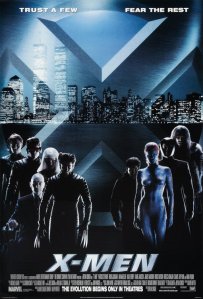 That said, 2000’s X-Men came with a bunch of challenges, not the least of which was being only three years after the absolute box office disaster that was Batman & Robin. The scar left on the psyche of movie studios was very real – superheroes were campy, lame and not in fashion as far as moviegoing audiences were concerned, and anything based on them would have to do something to address this. What’s interesting is to note that as the film was developed (over a period of several years beginning before Batman & Robin), one Joss Whedon was brought on board for a script rewrite which was ultimately rejected because of its ‘quick-witted, pop culture-referencing tone.’ Hard to imagine in the current environment. However, 1998’s Blade showed that edgy, dark takes on comic book characters would work, so is it really any wonder that the X-Men were divested of their colourful outfits, shoved in uniform black leather and given quite such a dark beginning?
The film commits to that darkness right from its opening scene, of a young Erik Lehnsherr being separated from his parents in Nazi-occupied Poland at what is unmistakably a concentration camp. The early demonstration of his power, as young Erik wrenches the gates to the camp almost off before being knocked out by a rifle butt is a great visual shorthand, and this is a theme that follows throughout the movie – with some exceptions, the screenplay doesn’t waste time having someone explain to the audience what powers each character has, preferring to demonstrate them instead. It introduces some more subtly than a first viewing might suggest as well – watch the opening appearance of Wolverine in the cage fight in a dive bar and listen for the sound effects as his punches and headbutt connect with his opponent: there’s a subtle but unmistakeable metallic clunk for each one. His healing factor too is something that gets progressively built up for the viewer, from his being unmarked from the cage fight to his healing before our eyes after going through a car windscreen, the film visually tells the audience what this character can do, while avoiding beating us over the head with it for the benefit of those who know.
 It’s undoubtedly a focused story – mostly the film (and indeed the series to follow) seems to note the nascent star power of a young Hugh Jackman, and combined with the fact Wolverine tends to be a popular character, this leaves the narrative to largely focus on Logan as a character. Again, this is no bad thing, allowing an organic way for the narrative to introduce the main players on both sides to the audience at the same time they are introduced to Wolverine. It does mean, however that Berry and Marsden are perforce slightly relegated to background roles with no real development while Jean Grey gets most of hers from her interactions with Wolverine. The bait and switch the script does around the end of the second act where it reveals that Magneto’s target is in fact Rogue and not Wolverine can’t really cover for the fact that even Anna Paquin doesn’t get much to do in her role other than be a passive plot object (surprising given her power) but then in all fairness given the time in which the movie takes place, having quite so many female characters as it does even involved in the action is a step in the right direction, albeit a small one.
However, there is one thing which struck me with regards to Grey in this re-watch, and it relates to her whole character throughout the original trilogy. Perhaps it is merely the benefit of hindsight, but it does feel like the script – in a myriad subtle ways – is already hinting at where the character may go as the series progresses. Every significant male character with whom she interacts in the movie – Logan excepted – treats Jean with a certain amount of dismissiveness, well-meaning or otherwise. Senator Kelly is patronising and overtly dismissive of her in her opening exchange with him. Professor X is teaching her how to ‘control her abilities’, Scott, her boyfriend, speaks of how Cerebro is beyond her ability and even finishes her sentences for her (and not in the loved-up, gooey way). Only Wolverine actually treats her like a person, albeit one he wants to sleep with, and despite the obvious inference of a cliched ‘she’s attracted to the bad boy over her goody two-shoes boyfriend’ which many have made, there’s certainly evidence there for a more rounded take – Jean is attracted to Logan simply because he neither fears nor patronises her. He doesn’t talk down to her, doesn’t talk over her and doesn’t once tell her what she should or shouldn’t do or is or isn’t capable of. Given the extent to which everyone else seems to (save Storm, with whom we see her actually speaking not once here – this film’s Bechdel score would be non-existent), it strikes me as not all that out of the blue at all where the character ends up going by the third film.
 Villain-wise, the movie makes one of its better casting choices with Ian McKellen’s Magneto. The gravitas of his delivery lends awesome weight to the part, but moreover there is room there for chinks in the armour of Lehnsherr’s certainty, nowhere clearer than when Wolverine tells him that he’s full of it, because were he as righteous as he claims, he’d sacrifice himself in his machine rather than someone else. It’s a shot that really lands, sold beautifully by McKellen’s expression alone, and it adds a layer of fallibility to the character that feels real. For all his proclamations of how Charles simply isn’t willing to make the necessary sacrifices, the reality is that Lehnsherr’s motivation comes from a place of selfishness and bitterness at a world that did him wrong. What seals the deal is that it’s difficult for the audience – having seen from whence that bitterness springs – to hold it entirely against him. The constancy of the friendship between Magneto and Charles also works hugely to the film’s advantage, setting it apart from other offerings at the time which would have good heroes against evil arch villains. It’s not an obvious dark mirror – Xavier and Lehnsherr being very different in terms of their powers – but the mirror aspect springs from their respective motivations: one seeks to have mutants and humans live together in peace by co-operation, the other seeks to subjugate humans through fear. The real surprise of the movie is that it doesn’t actually genuinely pass judgement on which side is right – for all that yes, Magneto’s plan is horrifying, it’s difficult in the context the film presents to actually blame him for trying it, even as it’s equally difficult to argue against the X-Men stopping him.
 Other villains vary. Ray Park appears as Toad so that he can do the odd martial arts move and spit out the occasional sardonic one-liner, but the character does very little and receives no development. Sabretooth similarly is there to look big and brutish and not much else. Mystique – clearly the most capable and trusted of Magneto’s ‘Brotherhood’ – doesn’t get as much as you might remember either. Yet again it’s a female character who doesn’t even get to speak to another female character, let alone about anything that doesn’t concern a male one, and mostly the gimmick seems to be that the film got Rebecca Romjin-Stamos to wander around naked covered in blue body paint. She does get to kick some backside, but it feels like the film rather suggests that she’s the best of her contemporaries without doing much to show it. Her fight scenes in the third act suggest all sorts of abilities the film has done nothing to set up and will then go on to do nothing to fulfil, and even her shape-shifting doesn’t feel like it gets enough use. It’s difficult of course to have an actor of McKellen’s stature and presence and not have those around him be overshadowed, but it can’t help but feel like no real effort comes from the screenplay to overcome this. While Park and Tyler Mane may not be the most gifted thespians, Romjin-Stamos has genuine talent and it feels a shame that the script wastes this in favour of what we get.
On the good guys side though, it’s not a lot better. The commitment to male characters underestimating/patronising her may be a character beat but doesn’t stop Famke Janssen’s Grey feeling sidelined by the script anyway. Halle Berry gets almost nothing to do and very few lines, and James Marsden tries his best but it’s honestly difficult to disagree with Logan’s assessment of him as a ‘dick’. Paquin gets some interesting stuff in terms of the teenaged angle of the story – using the parallel of puberty to reinforce the theme of mutants coming into their powers and learning to cope with the changes – but it’s difficult to feel, with a couple of minor exceptions, that she isn’t just a passive plot device for the most part. Her using her powers to piggyback Logan’s healing factor to stop herself dying twice is about the only decision we see her character allowed to take, and the second time even that’s a fifty-fifty given that it’s Logan’s idea and she’s unconscious at the time.
 Patrick Stewart, as Xavier, delivers equal gravitas to the role as McKellen does to his, but realistically other than exposition in acts 1 & 2 and then being a plot device in act 3 as he slips into a coma induced by… something planted in Cerebro, he gets very little to actually do. The movie invests most of its ‘good-guy’ energy and story beats in Jackman, and it’s difficult to argue that it’s not the best choice, given the energy and charisma he brings to the role. It just feels as if the film might better have been titled ‘Wolverine Meets the X-Men’.
In terms of the plot, the movie relies on heavy doses of contrivance – the coming together of Logan and Rogue coinciding nicely with Magneto’s plan to grab Rogue for his own purposes. The use of a MacGuffin machine that turns ordinary people into mutants actually feels like a solid idea, and the fact it doesn’t work and turns them into goop instead feels like the screenplay’s biggest missed opportunity. Given the setup and the chemistry between McKellen and Stewart, how much better might it have been to have Magneto realise this awful truth and elect that going ahead might not be the best idea, and then have Mystique feel so betrayed she turns against him and we get a temporary alliance of X-Men and Magneto vs his old henchmen, followed by the scene in the plastic prison at the end? How much more morally complex might that have made the story? Instead, the script wastes the moment, having Magneto essentially shrug and declare ‘oh well’ when he realises that his giant mutant creation machine is instead a giant death machine of death. Given the origins for the character the film takes great pains to show us in Act 1, this seems odd.
 So how does the film hold up, in hindsight? In many ways, better than I expected. The Jean Grey subplot is well-executed, at the cost of wasting the talents of Janssen, and there’s a lot of decent visual storytelling and subtlety to the thing. On the other hand, black leather uniforms, a ‘meta’ joke about uniforms (that I can’t help but think is one of the two Whedon lines which reportedly made it into the final screenplay) which just doesn’t land, and a sausage fest of male characters with women very much relegated to the background of most of the action. As a star-making turn for Jackman, it works. You can see from this why his Wolverine became so popular with audiences as well as – more depressingly – why the studio ended up over-using him so much. McKellen and Stewart both deliver, the latter in spite of the script giving him very little to actually do, and the SFX mostly just about hold up. It’s also kind of refreshing to go back to a time when superhero movies weren’t afraid to confine the threat to an area, rather than have it be one that threatens the whole world/universe, in light of recent offerings.
Overall though, the weaknesses do still outweigh the strengths. It has some decent ideas, some good points, but they all get bogged down in the bad. There was potential here, but it hadn’t quite evolved enough.
 Doctor Who News Star Trek News
 Sci-Fi Bulletin: Exploring the Universes of SF, Fantasy, Horror and Spy-fi!