 With The Amazing Spider-Man doing decent box office and receiving mostly favourable reviews (it remains, in box office terms, the most successful reboot of all time), it was no surprise that a sequel was quickly announced. With Garfield, Stone and Field all reprising their roles, Jamie Foxx on board as new villain Electro and Marc Webb back on directorial duties, what, wonders Greg D. Smith, could possibly go wrong?
As Peter agonises over his promise to Captain Stacy and his love for Gwen, he must also face the rise of a powerful new villain. Revelations about his father’s disappearance and the return of an old childhood friend all combine to make his life more complicated than ever – can Peter ever really have a normal life as long as he wears the mask?
 There was a lesson in The Amazing Spider-Man 2, if only Warner Bros/DC and Universal Studios had bothered to study it, and the lesson was one which could have saved all of us and them a lot of time – shared universes can’t be forced. They take time, investment and savvy. Marvel Studios built up the MCU over a period of years – Avengers [Assemble], the first film in the franchise that really pushed the shared universe idea hard beyond minor references in the background, was the sixth movie and took four years. By contrast, WB/DC tried to make a shared universe film on their second entry in the franchise, Universal tried to build the Dark Universe from film one, and whereas Sony didn’t push quite as far as either of those errors, it did overreach itself when it decided to start building a shared universe after one fairly successful entry.
Why that’s important is because aside from this weird obsession with rushing a shared Spidey-verse to market in such an indecent amount of time, what we have here is a strong movie. Excellent performances, breathtaking action sequences and real emotional investment in the characters on screen make this – for me – one of the best onscreen adaptations of ol’ webhead ever, but too often it trips over its own feet with the heavy handed referencing to a wider universe that carried no weight because it came from nowhere.
 That said, there’s a lesson Sony could also have learned from their own recent history – that too many villains packed into a movie doesn’t work. Again, look to the MCU – sure there may be henchmen and women, but there is only ever one big bad for our hero/heroes to face. If it ain’t broke, don’t fix it. Or perhaps more appropriately, if you’re copying another studio’s homework, copy the right bits.
So, first off the movie opens with a bit more background on the mysterious disappearance of Peter’s parents all those years ago. They get on a plane, which ends up being hijacked by someone who wants to kill them and take their work, but before they all inevitably die in a fiery crash, Peter’s father manages to send something on his laptop to ‘Roosevelt’. Remember that, because the movie will take well over an hour before it even bothers to bring up that name, much less anything to do with it again. When it does, it turns out that Peter’s dad was a good guy, doing research that he refused to let Norman Osborn use for weapons-related projects. He tried to destroy all the special spiders he’d created, then absconded with vital bits of his research and one secret that unfortunately asks us to suspend disbelief just a little too far – the super spiders were infused with his own DNA (among other things) and so could not be reproduced without him. Leaving aside that this would be the sort of thing you’d think might be useful to tell the people who want the spiders and have elected to kill you, before they kill you, we are expected to believe that Peter just happens to have been bitten by the same spiders his father created with Norman Osborn all those years ago so that it just happens that the venom mixes with his DNA correctly and produces a super-human being. This is the sort of thing that happens when you’re trying to rush world-building.
 But at any rate, there’s other stuff to be dealing with, starting with Peter’s newfound issue of seeing the late Captain Stacy (Denis Leary’s easiest paycheque ever) standing around looking at him disapprovingly all the time because shockingly, he and Gwen are still an item. This is actually a pretty decent storyline – Peter did after all promise Captain Stacy that he would stay away from Gwen to make sure that she was safe, but Gwen is the kind of person who a) instantly guessed that was the case and b) isn’t going to be beholden to it, dead father or otherwise because, as she puts it, she makes her own choices. Unfortunately, the film spins it out a little more than it needs to, with Peter’s agonising causing a split between the two that sees him vaguely stalking her from a distance before they reconnect later on for her to tell him she’s moving to England on a scholarship. It feels like the film tries too hard to keep this split manufactured when it’s quite clear that the real course would be Gwen telling Peter to stop agonising because she’s fine with it and her living wishes outrank those of her dead father. However, that’s a minor quibble here – the chemistry between the two of them is good, and every scene that they are in together works very well.
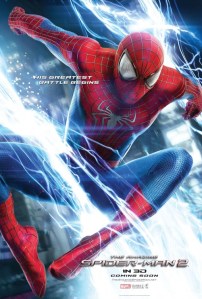
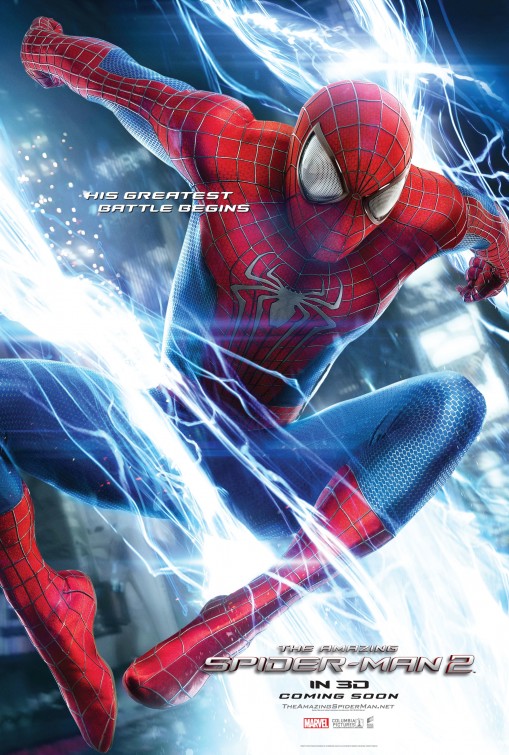
 This also applies when Garfield is onscreen solo as our titular hero. Where Maguire’s Peter spent nearly all his time in and out of the suit agonising, moping or simply drearily going about his duty, there’s a real sense that Garfield’s Peter actually enjoys being Spider-Man. Whether it’s his quips and asides to villains, his bonhomie with emergency workers or the way in which he effortlessly connects with young children, there’s a joy here that is compelling to see. Spider-Man is supposed to be a smart guy with a sense of humour, and here he’s exactly that.
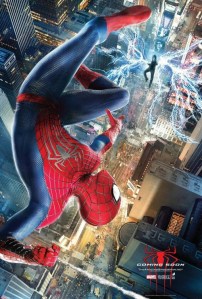
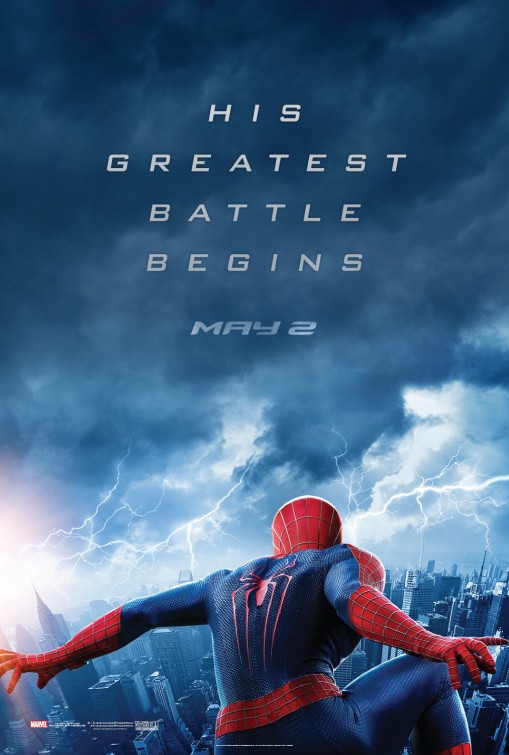
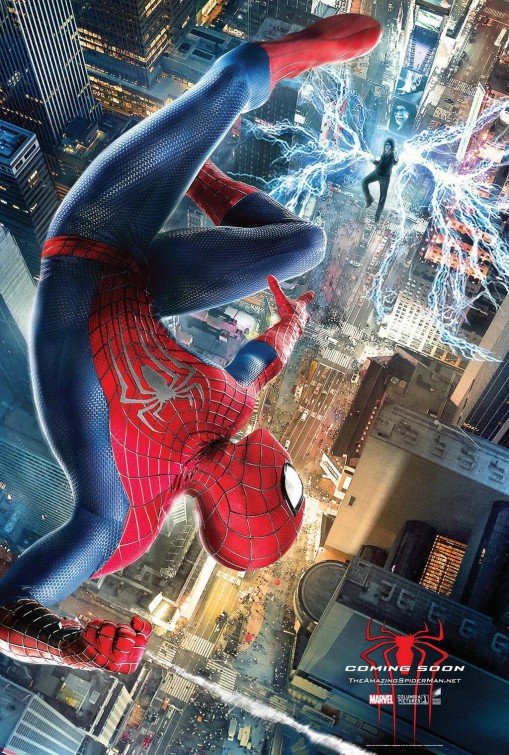
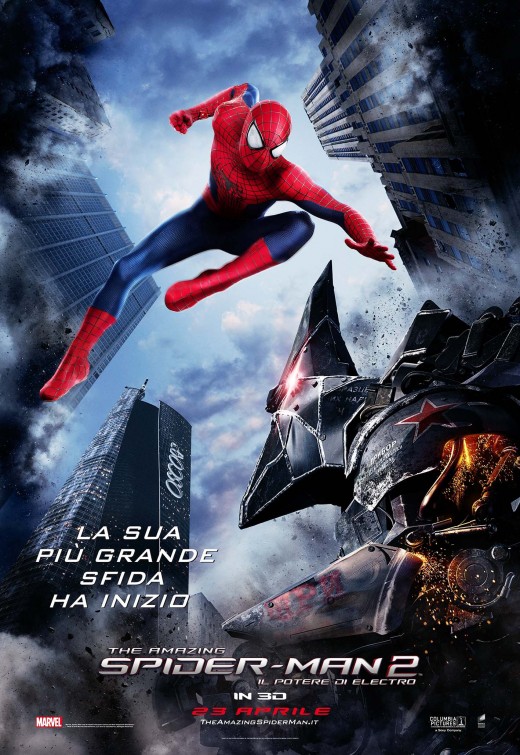
The visual effects work for his swinging around the city works so much better too. Raimi’s vision always felt a little limited – yes Spidey was swinging around the place but that was all he was ever doing, swinging and falling like a bag of sand. Webb injects a true sense of fluidity of movement here, with Spidey flinging himself from tall places and free falling like a sky diver for seconds at a time before firing a web, using his momentum to propel himself forwards at speed. Mixed in with some more point-of-view shots, it adds to the sense of pace, but also to that sense of scale which the first film had already done so well. New York in this film feels like a genuine urban jungle, a vast sprawling map of which Spider-Man is the absolute master as he flings himself around with excited precision.
 Whether it was entirely intentional or not, that joy reveals its double-edged nature in the movie’s main villain, Max Dillon AKA Electro. A classic stereotype of the ‘frustrated lonely nerd’ mould, Max is saved from being hit by a car by Spidey, who being full of the joys of the suit picks Max up, dusts him off and says he’s to look after himself as he’s his eyes and ears and Spidey needs him. This then gets rushed into an awkward bit of obsession, with us seeing Max talking to himself as if speaking with Spidey as he gets ready for work, pretending that Spidey has made him a birthday cake and so on, as they are ‘best friends’. We also get a small glimpse into his inner monologue as a fantasy plays out in his head of screaming at someone who says something derogatory about Spider-Man. In short, it’s a heavy-handed cliché portrait of the sort you’d likely expect from a comic book movie of several decades ago, but it feels a little much here. Foxx, to his credit, really pulls off the routine, complete with hunched posture, nervous tics and oddly high-pitched voice, but the script is tonally off here, asking us to sympathise with a character who it so clearly gleefully disdains in its portrayal of him. It’s a relief when he becomes Electro, and Foxx can shake off the mannerisms, straggly prosthetic hair and buck teeth and actually play a part with some bones to it. The double-edgedness becomes apparent when Spidey first confronts this new creature, Max’s anger spilling over when it becomes clear that even his hero doesn’t really see him.
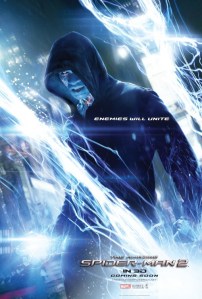
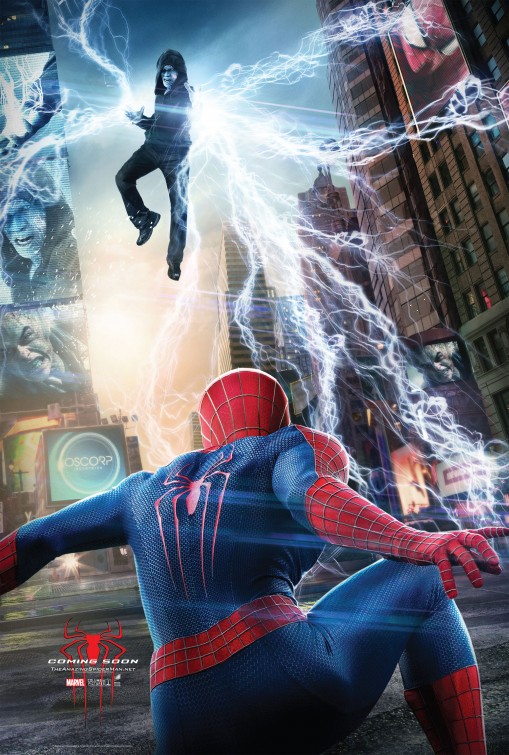
 To be clear, the angle of a man driven to the edge by his invisibility and not being appreciated by his colleagues/superiors is fair enough, but the film seems to feel that those factors alone aren’t enough. Foxx could have easily appeared more as himself, without the stupid hair, the teeth, the silly voice etc. He didn’t need to be the visual caricature the film makes him to become the character the script required. The other minor issue is that because the film has so many other plates to spin, Max/Electro doesn’t get the time to organically grow as a character – he goes from terrified victim of new and scary circumstance to angry villain intent on destroying the city and making everyone kneel before him far too quickly (essentially in the course of one confrontation) and given the talent of Foxx and the material that could have been there to play with, this just feels like a waste. When Electro re-appears, released by Harry and all-powerful, he’s a visually impressive character whose abilities and powers lead to some arresting set-pieces, but there’s nothing really there about him of substance – he’s just the shiny, explosive bad guy for Spidey to deal with in the third act finale.
 Speaking of Harry, this is where the film starts to feel a little like it’s cramming too much, too fast in. Harry Osborn doesn’t merit so much as a mention in the first Amazing Spider-Man, yet here he and Peter are best friends, separated after Harry is sent to boarding school shortly following the death of Peter’s parents. Returning to the city to see his dying father one last time and then assume control of the family business, it’s a genuine joy to see these two old friends get together that first time. There’s teasing, easy laughter, and a real onscreen chemistry that makes you forget the absurdity of Harry’s sudden appearance as the best friend never-before mentioned. Unfortunately, that one brief respite is all we get – from then on in, Harry just becomes an unlikeable asshole, obsessed with getting Spider-Man’s blood to cure himself of the family ailment that killed his father and deaf to the reasoning of Spidey on the subject who doesn’t say no, but more ‘let’s actually look into it and make sure that it won’t kill you, after all look what happened to Connors’. That’s irrelevant, however, because Harry has some scenery to chew and some villainy to be about. Unfortunately the movie then goes a whole convoluted route with him, having the executives frame him for the death of Max so he can be quietly disposed of, only to let him walk out of the door alone, whereby he has himself driven to the facility where Max is being kept, and somehow manages to free Max so that he can go back to Oscorp Tower, grab the spider venom they have on ice and use it to cure himself, then have Max make Spider-Man bleed.
 As convoluted bad guy plans that make no sense go, it’s a doozy – why not just go straight from the confrontation with the executive to the basement and grab the spider venom? Why does he require Electro at all? When he does get the venom, and injects it with predictable results, only the armour prototype which constantly monitors and heals the wearer, stored in the basement with the Spider Venom and a variety of props elbowing the viewer in the ribs about all the future stories to be told in this new expanded Spidey-Verse can save him. Thus is the most disappointing live action version of the Green Goblin born.
Don’t worry though, there’s more plot to get through – there’s the secret subway station laboratory (Roosevelt, remember?) for Peter to find so that he can get the low down on his dad. There’s chasing down Gwen before she can go to England to declare his undying love and that he will go with her because he can’t be without her. There’s the final confrontation with Electro – all this before we even mention Harry Osborn again.
The subway lab thing feels like the writers put themselves in a box with the weird, half-finished angle on Peter’s parents in the first movie and just want it tied off as quickly as possible. As outlined already, large parts of it make no logical sense whatsoever (why, for example, not just go to the authorities? There’s no suggestion anywhere across the two movies that the NYPD are in any way compromised by Oscorp) and it just serves as another distraction in a movie already dangerously stuffed with them. It’s nice I guess that Peter finds out his dad really loved him, except that he already had two loving parent figures in Uncle Ben and Aunt May so the importance of this somewhat pales. As for Peter’s mother, well: she was there. But as far as Peter is concerned, she may as well not exist. His fixation here, despite mentioning at times ‘his parents’ is exclusively on his father, and although both of them were on that plane and trying to do the thing, it’s only his father in the video letter explaining things, and it’s only his father he ever specifically mentions. Maybe Sam Raimi wrote this part…
 Anyway, moving on there’s the whole desperate chase after Gwen so that they can finally get together again like we all knew they would. Honestly this just feels annoying because there was – as discussed above – never any real reason for the movie to have split the two, other than that the script doesn’t really feel like it knows what to do with them as a couple. What’s better is that Gwen pretty much just gets on with her life, despite being in love with Peter because as it turns out – gasp – female characters can exist and not be solely defined by moping after the man they can’t have. The movie leaves us in no doubt that Gwen loves Peter, but she also gets the scholarship, carries on working at her successful career and is more than capable of getting herself into trouble with no help. Again, it’s nice that they get back together, but the timing and the way that it’s done just feels – in hindsight – like it’s done to make that ending all the crueller.
 And then it’s time for Electro’s big entrance. Taking control of the power grid, he blacks out the city and taunts Spider-Man to come to him. Thanks to Gwen being smarter, he’s able to face this challenge without his web-shooters being overloaded, and in spite of his best efforts of repeating the antics of Captain Stacy in the first film and keeping Gwen out of the action, she joins him to effect the plan which will take the bad guy down. Overloading a being made of pure electricity (again, the science here gets vague and hand-wavy – the film just assumes you’ll go with it) with lots of electricity when he’s been spending the whole film looking for more seems a bit odd, but nevertheless that’s the end game, after a good ten minutes of swinging and smashing. Foe defeated, it’s time for the grand entrance of the Green Goblin version of Harry. Maybe it’s because we’ve just had a boss fight, maybe it’s just that we haven’t really seen enough of Harry to care, but this sequence feels perfunctory at best. Its basic purpose it to edge us towards the part that any person who’s vaguely up on their Spidey comic lore (which wasn’t me the first time I saw this) knows is coming. That said, when the moment does arrive, that sickening click, the heartfelt sobbing and pleading of Peter that she not be dead, the realisation that the film has really gone there – they all hit home. It’s a devastating emotional beat, as we realise that the very fear that’s driven Peter away from Gwen all this time is realised. Thankfully, the movie has the restraint not to have Leary pop up in spectre form one last time, allowing the sadness to really sink in.
 Then the film ends on a pair of opposite points. At the bottom of a well-scraped barrel there’s the final appearance of Harry in his cell, visited by the mysterious Fiers to have a Lex Luthor-at-the-end-of-Justice-League style bit of conversation about the Sinister Six in a franchise that’ll never happen and then at the opposite end of the quality scale Aunt May and Peter having a discussion about how eventually one has to move on (this is five months post Gwen’s death and Peter has given up being Spidey out of grief). It’s one of the rare moments Field actually gets much to do and it’s an effective exchange. When Spidey reappears next to a young boy dressed as him who’s about to face off against the criminally wasted Paul Giamatti’s Rhino, it’s a genuine punching the air moment, and regardless of the moans about the film ending there with no sight of the actual battle, it’s a tonally perfect denouement which one can’t help but feel in hindsight deserved the sequel it so clearly signposted.
 The Amazing Spider-Man 2 then, is a mixed bag. It invests too much time in world-building and fails to learn the lessons of Spider-Man 3 by packing two villains and far too many subplots into its running time. As a result it under-invests in elements like the development of its villains, wastes a lot of the talent it has to play with and ends up being an incoherent mess for several stretches. However, it remains the best screen portrayal of Spider-Man himself – the climbing/webslinging sequences being easily the best we’ve seen and the sheer infectious exuberance and charm of Garfield’s take on the character making every second he’s on screen in the suit a joy. It’s far from perfect, but Garfield deserved better than he got, and as much as I enjoyed the MCU take on this classic character, there’ll always be room on my shelf for this take. One man did make a difference, but we can only imagine what could have been if he’d had help.









 Sci-Fi Bulletin: Exploring the Universes of SF, Fantasy, Horror and Spy-fi!