Review: Civil War
Starring Kirsten Dunst, Wagner Moura, Jessie Plemons Written and directed by Alex Garland A24 – in Cinemas now As civil war engulfs the nation, four unbelievably inept and irresponsible journalists […]



Starring Kirsten Dunst, Wagner Moura, Jessie Plemons Written and directed by Alex Garland A24 – in Cinemas now As civil war engulfs the nation, four unbelievably inept and irresponsible journalists […]
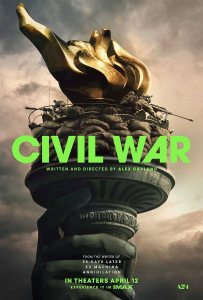 Starring Kirsten Dunst, Wagner Moura, Jessie Plemons
Written and directed by Alex Garland
A24 – in Cinemas now
As civil war engulfs the nation, four unbelievably inept and irresponsible journalists set off across America to interview the embattled president.
No, Alex Garland’s new movie, Civil War, isn’t intended as a sort of dystopian Mr Bean, and I doubt he would sum up his story in the way I have here, but it’s hard to describe what transpires on screen in neutral terms.
I first joined the BBC in 1991, thirty-three long years ago, and although I had been employed as a mere producer of children’s radio drama who would never be anywhere near a front line, it was standard practice in those days to school all producers in the basics of factual reporting – especially if they didn’t have a formal journalistic training. The course lasted two breathless weeks, covering every aspect of radio production, so there was just a couple of hours for someone to come in and speak to us on the basics of working in ‘hostile environments’ such as riots or war zones. Of course, anyone doing that job for real would be sent on at least one dedicated Hostile Environments course, which I understand now last the best part of a week. However, brief though the talk was, I have never forgotten that speaker. His advice, over those two hours, has come in useful on a couple of occasions just encountering a mildly alarming unruly crowd on a Saturday afternoon in Manchester City Centre.
The idiot journalists in Civil War clearly didn’t even get the two-hour talk. It wouldn’t matter if the story was about some domestic journalists with no idea about war reporting for whom these situations were a terrifying novelty – that would make sense – but no, Lee (Kirsten Dunst) and Joel (Wagner Moura) are supposed to be hard-bitten, battle-scarred conflict veterans working for Reuters; while Sammy (Stephen McKinley Henderson) is supposed to be an ageing war dog on what might be his last assignment for the New York Times. For unfathomable reasons they then allow an earnest 23-year-old rookie photographer, Jessie (Cailee Spaeny) to tag along, who proceeds to be a lethal liability at every turn… although frankly as any producer knows, her seniors have only themselves to blame. They richly deserve every terrible thing that happens to them.
To be fair, young Jessie does have a magic camera. For equally unfathomable reasons she is using an old-fashioned Nikon, shooting on analogue celluloid – there’s a whole, pointless scene about that – although in the height of battle she never runs out of film, despite having no more than 36 frames on any one reel, and we never see her having to reload, even when the soldiers are stopping to change their magazines. She also has what looks like a 50mm lens with a similarly magical zoom facility.
Petty detail? Well, don’t make a thing of it, if you are then going to break your own rules. It’s a sloppy, lazy distraction. And anyway, there’s a reason why press photographers use digital these days – a lot of reasons actually.
I felt personally aggrieved by the depiction of this daft and dangerous young woman, as my own daughter is a journalist and news producer for the BBC. However, aged just 22, before her formal training, she was working for a paper in Cairo during the counterrevolution of 2013. She sent me pictures (taken on her phone) of the smoke rising over Tahrir Square, and although younger than the character in Civil War, she had more natural common sense about how to avoid danger, and yet still be in contact with what was going on, than anyone in this witless film.
But it isn’t just Lee and Joel’s blistering incompetence that irks me. They are hopeless journalists. Joel is supposed to be the words man, but he seems to lack any kind of curiosity. Only in one scene does he actually stop to speak to anyone who isn’t a fellow journalist. The rest of the time he is either mucking around, drunk, or feeling sorry for himself, or talking to his colleagues. Journalists are intensely curious people. Read anything written by Orla Guerin, John Simpson, Jeremy Bowen, Kate Adie et al and a screenwriter would know that these professionals are constantly talking to the soldiers and civilians who define the wars they report on, otherwise what they are doing would be a purely selfish enterprise, and I am pretty sure that’s not Garland’s point.
Kirsten Dunst’s Lee is supposed to be a modern-day Lee Miller, a veteran photo journalist of countless bloody conflicts, and yet all she does is mope. Mope, mope mope.
But, I hear you say, it’s just a movie, why does it matter?
In the last six months of the Israel/Gaza conflict alone, over a hundred journalists have been killed. It’s an insult to their memory to depict their profession in such an ignorant and facile way.
As far as I can tell, Garland is trying to say something ‘important’ about journalism – although what it is, exactly, isn’t at all clear. The price of ‘getting the story’, or something? I have no idea, but whatever he’s groping for, he is missing the point. The movie feels as if it is compiled from re-purposed anecdotes from the days of free-lancers riding shotgun in earlier conflicts such as the Vietnam War, before the era of embedded journalists. But this is set some time in the near future, post 2024, the age of the smartphone, social media and the citizen journalist. It’s clearly established that the internet is still functioning so in the opening riot sequence it is utterly bizarre to see not one single civilian with their phone out filming things.
The issue for today’s war correspondents is about carving out their role in an age of fake news, of AI generated material, of grossly distorted echo chamber social media. Civil War plays out as if Twitter/X, Facebook, Instagram or Telegram had never been invented. Its ideas are completely redundant.
Hang on a minute, I now hear you say, surely the film is called Civil War. Aren’t you focusing on the wrong thing? It’s about a civil war, isn’t it?
If only.
Again, I declare an interest. Six years ago, I wrote a series for BBC Radio 4 called First World Problems imagining a similar conflict breaking out in a fracturing and Disunited Kingdom. My commissioning editor at the Corporation insisted, rightly, that such a drama had a responsibility to be journalistically sound; to be more than simply a hypothetical dystopian adventure. The UK was badly bruised, licking its wounds from the self-imposed pugilism of the Brexit referendum. My story needed to explore the causes and consequences of the breakdown of our democracy.
Arguably, the United States, facing a possible Trump re-election, or, just as dangerously, a Trump defeat, is far more perilously divided. It is annoying, to say the least, that Garland’s civil war is so vaguely defined. Indeed, for much of the movie, it is little more than a backdrop to Kirsten Dunst’s moping, and Garland’s woolly pontifications about journalism.
It takes a full (and surprisingly dull) opening hour before the war comes into focus, in the film’s one truly well-written scene and the arrival of the excellent Jessie Plemons as a nameless soldier freelancing in his own terrifying way, asking narrative questions of what, if anything, it means to be an American when the democratic glue has long since rotted away.
As for the final ludicrous act… luckily the risk of spoilers prevents me from ranting on for another two pages.
Verdict: Civil War is a film pulling in two directions and failing lamentably at both. It is technically competent, I suppose, and watchable if you don’t care a jot about the important subjects it claims to be exploring. Rarely has 109 minutes in a cinema made me this annoyed. 3/10
Martin Jameson
 Doctor Who News Star Trek News
 Sci-Fi Bulletin: Exploring the Universes of SF, Fantasy, Horror and Spy-fi!