 After the critical and commercial success of The Terminator, and the accelerated star quality of both director and main star, a sequel seemed almost inevitable. Studios wanted it, the director wanted it and audiences wanted it. The only things standing in the way were some messy rights issues behind the scenes and Cameron’s dissatisfaction with the VFX technology available. However, by 1991, with several other major pictures behind him, including the proof of concept VFX from The Abyss, and with the rights settled (for now), Terminator 2: Judgement Day was ready for the world. But could Cameron really recapture that lightning in a bottle from the first movie? And was there really more story to be told?
There’s an awful lot of received wisdom in the genre about Terminator 2. It’s widely regarded as one of the rare instances in blockbuster history of a sequel to an already great movie being even better. It pushed the envelope for the time of what was possible in terms of visual FX. It was the father of the modern cinematic blockbuster. All these may be true, but on my re-watch I was dismayed to find that this – one of my all time favourite action movies – is more lacking than I might have remembered. Not so much as a film in and of itself – it’s an entertaining, thrill-packed ride that literally flies through its 137 minute running time (longer if, as I do, you watch the extended special edition). But as a sequel – as a keystone in a franchise and a follow up to a film which, while it had its issues, was still narratively fairly tight, it often comes up short.
 But let’s start with the tone. Purists will often argue the first film is better because it’s a darker, scrappier thing which earns its 18 rating while the sequel goes all family friendly. It’s (to my mind) a slightly inane argument on two counts. First, in terms of actual graphic content the movies are fairly even, excepting that the second tones down its language a tad – it was more that the ratings system had relaxed by the time that Judgement Day came out as to why it ‘downgraded’ to a 15 certificate (hardly ‘family friendly’). Second, if a film appeals to a broader audience, how does that make it ‘weaker’?
But yes, there is a tonal shift in this second instalment. Arnie’s T-800 is here a sort of father figure stand in for teenaged(?) John Connor (we’ll get to that) and forms a dysfunctional family unit together with the leaner, meaner, tougher Sarah Connor as they battle against the newer, deadlier T-1000. There are jokes, one-liners, and a sense that Cameron is deliberately aiming for a more inclusive audience than before. That mash up of horror/thriller/sci-fi film is mostly discarded in favour of a straight action movie style, and for the most part, it works very well.
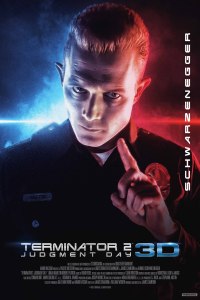 Robert Patrick, as the new villain, does some excellent work, although thanks to the fidelity of Blu Ray, I can confirm that the myth he himself often perpetuates – that he didn’t blink on camera at all as the T-1000 – is indeed a myth. He doesn’t blink much, it’s true, but it is there, and it occurs at some inopportune moments. However, his body language, manner of speech and the intensity of his stare all add up to make the T-1000 an unsettling antagonist, even before he starts growing knives and stabbing weapons from his hands.
But to return to received wisdom, one of the biggest ‘gripes’ about the movie is that its trailer was responsible for starting the modern trend of trailers which spoil pivotal plot points for their movies. It’s argued that, had the trailers (and extensive ad campaign) for the movie not explicitly stated Schwarzenegger’s character was the hero this time around, then tension would have existed on this point in the movie right up until the reveal about half an hour in as the two terminators clash for the first time with John in between them. It’s almost an article of faith among fans, and certainly something I have long held to be true. There’s just one problem – it’s blatantly obvious from the first appearance of the two.
 For starters, when the T-1000 arrives, the first thing it does is murder someone and steal their identity (ish – it’s never quite clear why the T-1000 is so inconsistent in its borrowing of the faces of those it kills) while sinister background music plays on the score. When the T-800 arrives, it walks into a bar, has a bit of fisticuffs with some bikers, then takes some clothes, sunglasses and a motorcycle and rides off into the night as ‘Bad to the Bone’ plays on the soundtrack. Add in the fact that by 1991 Schwarzenegger’s star was very much on the rise, and it’s blindingly obvious from the start who’s the good guy here.
And on this point, we come to one of the narrative beats of the movie – and quite a fundamental one – that bears no scrutiny whatsoever. At one point, John prevents the T-800 from shooting a man, then tells him to lay down the gun and they have a whole conversation about why the T-800 is no longer allowed to kill. It even argues, saying ‘I’m a terminator.’ But let us consider – to this point in the movie, the T-800 has killed precisely nobody, and it’s had opportunity. It is involved in a bar fight in which it is stabbed, hit and threatened with guns. Recall that in the first film, it kills three punks who have a flick knife between them just to get their clothes. The point is, the narrative arc of John ‘humanising’ the T-800 by teaching it the value of human life loses almost all of its impact when it becomes apparent that the T-800 doesn’t kill anyone before he meets it anyway.
 If that sounds picky, it’s just the start of my issues. Take the opening monologue – I can get behind the idea that Skynet was extra cautious and sent back two different terminators to two different points in the past at the same time. But then the monologue just does a handwavy ‘Once again the resistance was able to send back a lone warrior.’ Woah, woah, woah – how? The Time Displacement equipment was destroyed after Reese was sent through, he explicitly said so. Also, why wouldn’t he mention they’d sent back a T-800 as well? Why not send it back with Reese so he can get on with making babies with Sarah, it can take on the bad terminator and then they can all wait and prepare for however many years until the T-1000 turns up? This is the sort of narrative issue that the film starts to have a lot of, because the truth is that the original film was, as previously mentioned, a fairly drum-tight narrative, and this one tries to get around various elements that were locked in so it can make its sequel.
For example, if we assume that T2 is contemporaneous with its release year (as the first film was) then seven years have passed. Even if we take the absolute most generous idea that maybe the film takes place in early 1997 (which most of the dialogue suggests it does not) John would be at most 13 years old. Yet here he is, riding a motorcycle through the streets and behaving like someone in their mid to late teens. This gets worse when you factor in that Sarah has been institutionalised for at least a year, and that John talks of a childhood spent running guns and learning to ‘fly helicopters and blow shit up’. There’s starting the kid early, and then there’s… well, you get the picture.
 There’s also the issue of the Time Displacement rules – recall that in the first movie, Reese is limited to using ‘primitive’ weapons to try to stop the Terminator because ‘nothing dead’ will do – the only reason the terminator itself is capable of time travel because it is a metal endoskeleton wrapped in living tissue. Yet the T-1000 is composed of a ‘mimetic polyalloy’ aka ‘liquid metal’ – why is it able to travel through time? Never mind, says the movie, here’s another quip/action set piece/explosion.
Delving into the extended edition, things get even stranger – the T-800 informs Sarah and John that it’s CPU is a learning computer, but that the switch is set to ‘read only’ prompting Sarah to opine that Skynet obviously doesn’t want them thinking too much. There’s actually the kernel of an interesting idea there, but for me it’s unsettled by too many questions. If Skynet doesn’t want terminators thinking for themselves, why give them that chip at all? What good would making it ‘read only’ do, exactly? And most pressing – if we hold all this to be true, why would the terminator be aware of it, and why on earth wouldn’t the resistance experts who apparently reprogrammed it have flicked the switch themselves already?
 In one area at least, Cameron takes a bit of a step… well, sideways actually. The first film leans heavily at one point into imagery and language designed to invoke the Holocaust, which is fairly distasteful. Here, Cameron resists the urge to poke that any further, but instead seems obsessed with imagery surrounding children. The opening credits are preceded by a scene of children in a playground before the bomb hits, segueing into a several-minutes long credits sequence playing out over an inferno engulfing swings, rockers and a roundabout. Sarah’s dreams of the moment the bomb hits are always a playground scene, John’s thoughtful ruminations on the nature of humanity with the terminator occur when watching children play with guns and even Miles Dyson is saved from his early death by the intervention of his young son. It’s as if Cameron feels we the audience won’t appreciate the horror of this incoming nuclear oblivion unless he puts children front and centre of it, as if he believes his audience might merely shrug if they were to see only adults suffering. It’s one of those stylistic choices that, once you’ve noticed it, you can’t stop noticing.
If all this sounds like I suddenly discovered I hate the film, I did not. As an action movie it was a pioneer for all the right reasons, and the action, stunts and scripting on display are all excellent, forging a powerful, driving narrative that barely stops from the opening to the closing frame. Hamilton is a revelation as the new, tougher version of her character and essentially carries a large part of the film. There’s also so much technical wizardry that often doesn’t get focused on precisely because it’s so good – Cameron’s use of Hamilton’s twin, Leslie for doubling scenes with the T-1000, as well as the scene involving the removal of the T-800 chip, are examples of clever ways around problems that didn’t require thousands of dollars’ worth of CGI, and some of the stunt and camera work is widely acknowledged to be precisely the sort of thing a film couldn’t get away with today.
 It’s also definitively a better movie than its predecessor, and probably the best version of the story that the franchise has told to date. My disappointment lies not in finding it wanting as a movie in and of itself, but in realising that it isn’t anywhere near as clever as it or its fans might think it is. Cameron has a reputation in the genre for cerebral action movies, but Judgement Day really is just a big dumb fun blockbuster – think about any one of a dozen plot points for more than a moment, and the whole house of cards starts to wobble. It’s revolutionary, but not for the reasons I’d always assumed.




 Sci-Fi Bulletin: Exploring the Universes of SF, Fantasy, Horror and Spy-fi!