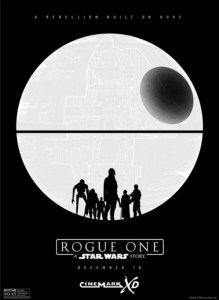
 Disney’s acquisition of the Star Wars brand came with the promise not just of the continuation of the Skywalker Saga, but also of so-called ‘anthology’ films which would explore other corners of the Star Wars universe away from the adventures of Luke and Anakin, and delving into events in the history of the galaxy far, far away which had only lightly been mentioned in passing before. The first in the series, Rogue One, would deal with something barely mentioned in the title crawl of A New Hope – how the Death Star plans had originally been acquired, and the tale of those who had grabbed them. With director Gareth Edwards having proven his large scale action chops with 2014’s Godzilla, he seemed like an ideal choice, but, asks Greg D. Smith, could a movie with no Jedi in it generate the same sort of interest and excitement as its stablemates?
As the Empire nears completion of its Death Star super weapon, the nascent Rebellion enlists the help of Jyn Erso, daughter of one of the Death Star’s chief architects, to help make contact with an old figure from her past who might hold the key to stopping the Empire’s plans. But can Jyn and her band of Rebels really do anything to stop this devastating new weapon, and what lines might they have to cross to do so?
 It may be fair to say that Rogue One had an even more difficult task before it than The Force Awakens. Abrams was continuing a well-loved saga, and had the advantage of being able to include recognisable characters and vehicles to help ease folks into the transition his film represented. The fact that the actors who played those characters were considerably older worked for him, as his plot was set several decades since we had last seen them.
Gareth Edwards, on the other hand, had to tell a story set just before the events of A New Hope, introducing us to new characters engaged in an adventure based on one line of the title crawl for A New Hope, and make it look authentic while still being good enough to keep modern audiences engaged. He couldn’t use any of the original cast, and he had to avoid the ‘sheen’ effect of the prequel trilogy, whereby technology, spaceships, weapons etc looked bafflingly better and more advanced than stuff we had seen in the setting several decades after. And as if that weren’t enough, he had to tell a story involving no Jedi, no use of the Force and no Skywalkers.
All things considered, he did the best job possible.
 Aesthetically, Rogue One is a towering achievement and a showcase in attention to detail. By using Ultra Panavision 70 lenses – literally the sort used in the late 60s and early 70s – combined with state of the art 6k digital cameras, Edwards managed to achieve pin-sharp detail with just the right tone and filter to feel like the original movie. In addition, huge efforts were made with the costuming and makeup, ensuring that the colours were muted by just the right amounts, and that 70s style hair and facial hair styles were used to keep everything just so. This also allowed Edwards to splice in ‘pilot footage’ shot of the Red and Gold Squadron pilots from A New Hope, further enhancing the sense that this film directly preceded that one.
There’s plenty of callbacks and referencing here too – so many in fact that it actually starts to get a little distracting. From blue milk on the counter to a run in with Doctor Evazan and Ponda Bobba, it feels like there’s something or someone squeezed into nearly every frame for the film’s opening hour to make the dedicated Star Wars fan go ‘Yes, I understood that reference!’, Steve Rogers style. And that’s where the first issue with the movie starts to rear its head.
 It’s great that we now live in an age where people who grew up watching the original Star Wars trilogy are of an age and position that they can become involved in the making of more Star Wars movies. It’s a property that demands (and indeed deserves) passion in its creators, much as Lucas had all those years ago when he made A New Hope on a tiny budget. But there’s a line that always risks being crossed, where such a creator runs the risk of levering in a few too many references to show off their knowledge of the franchise. I heard one reviewer at the time the film released describing it as not so much a film that had Easter eggs in it, and more of an Easter Omelette of a film, and that’s about as good a metaphor as you’ll get.
And why this is an issue, especially for the first hour or so of the film, is that it definitely does act as a detriment to the movie as a narrative story. The first hour is painfully slowly paced, with nothing much of consequence happening after the initial scene introducing us to young Jyn as her mother is killed and her father kidnapped. The film relies heavily on the distraction of all of its referential material to hide the fact that plot-wise, it does very little, and the result is that if you’re a fan who gets those references, you’ll be adequately entertained, whereas if you’re a more casual fan, or just someone looking for a decent genre flick, you’ll likely be very bored.
 Partially of course, it’s a natural result of a film based on such a flimsy premise. Rogue One has to stretch two hours of movie out to cover a plot concept expressed in one sentence. Padding was inevitable. Additionally, one could argue that of course this is a film for fans, and that those who haven’t seen the rest of the saga would be unlikely to care anyway, but to that I would say – is it not possible to thoroughly enjoy The Empire Strikes Back or Return of the Jedi on their own merit? In my view, the answer is yes.
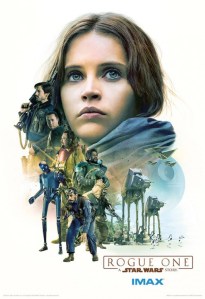
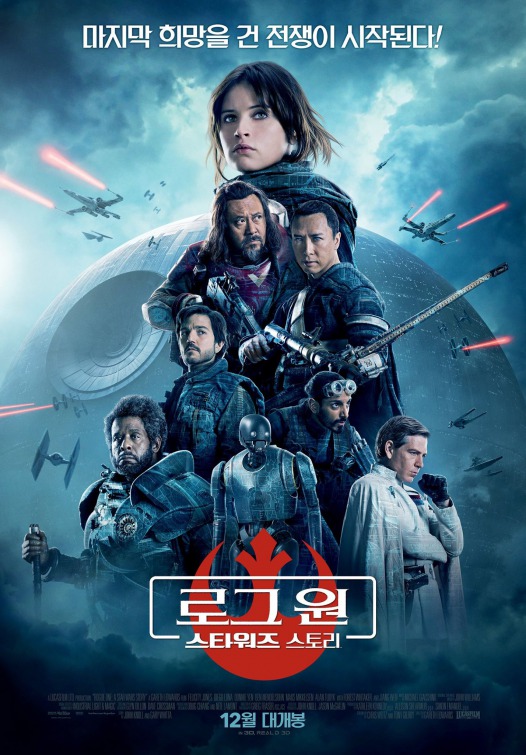
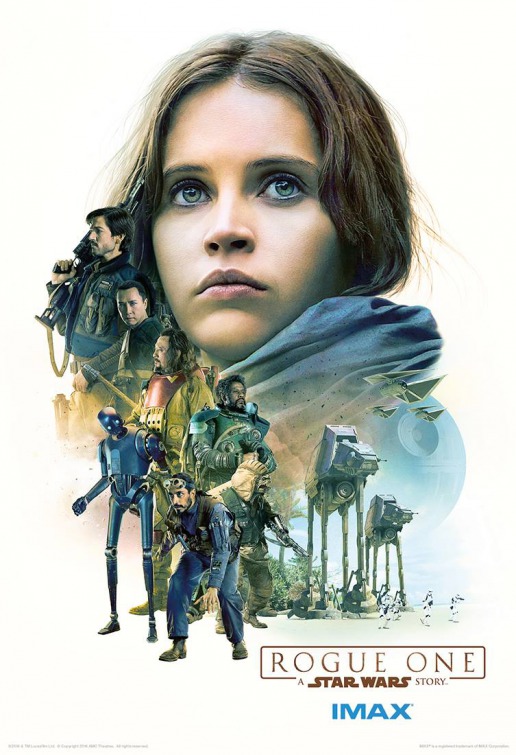
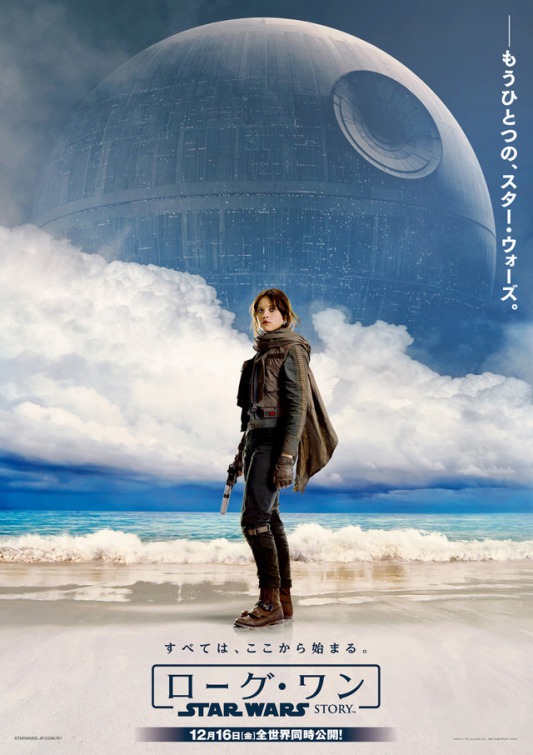
And so we move onto the cast themselves. Our main protagonist is Jyn Erso, rebel without a cause who isn’t actually a part of the Rebellion until co-opted, having been rescued by them from Imperial custody to help them get to her father, by way of unhinged (and excommunicated) Rebel leader Saw Gererra. Felicity Jones is a talented young actress, with a growing body of excellent work to her name, and it’s certainly nice to see another young female character take centre billing in a genre movie. Unfortunately, she’s let down by bland dialogue and what I can only imagine were very specific instructions to mostly wear the exact same expression for most of the running time of the movie. On a second cinema viewing, bereft of the initial wow factor of the aesthetics of the piece, I couldn’t help but notice the same vaguely annoyed pout was practically nailed to Jones’ face for at least ninety per cent of the run time. It’s so static as to be noticeable and distracting. Jones valiantly does the best with what she has, and even manages to get the odd zinger in when talking to K2-SO (easily the highlight of the cast) but mainly she’s just moping from scene to scene, that same pout fixed on her face like a rictus, looking for all the world like she’s just switched off internally and is going through the motions.
 Opposite her we have Cassian Andor, played with roguish charm by Diego Luna. Unfortunately, Luna’s script lets him down simply by making him an entirely inconsistent character, happy to murder a complete stranger in the opening scenes to avoid being captured but reluctant to fulfil his mission to assassinate the chief architect of the Death Star because said man’s daughter pouted at him a bit. There’s a stab at making Andor a sort of tragic antihero with a bit of expository dialogue wherein he laments the awful things he’s been forced to do in service to the Rebellion. To his credit Luna delivers the line well, and with feeling, but this sort of forced ruthlessness that’s supposed to underpin his character is somewhat let down by the easy camaraderie he shares with the rogues’ gallery of heroes that assemble to power towards the final act. To say nothing of his burgeoning friendship but not (quite) romance with Jyn. I suppose you could argue it’s the character’s arc, but for me it’s too clumsy and moves too quickly and too far from the one thing to the other to feel anything other than flung together.
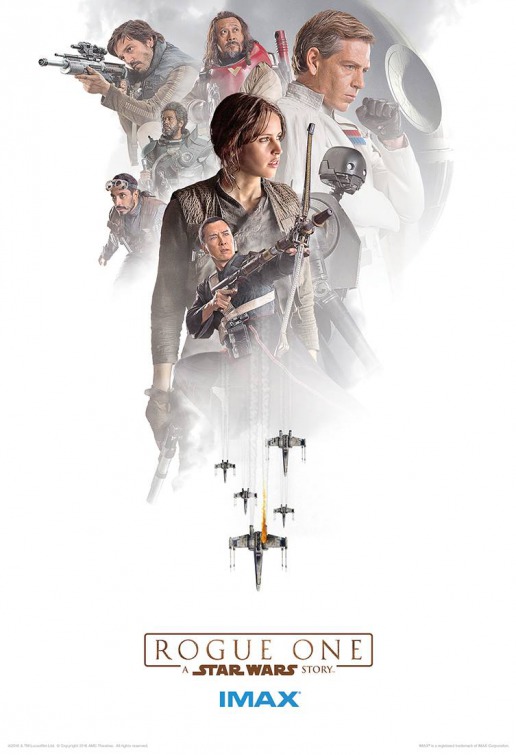
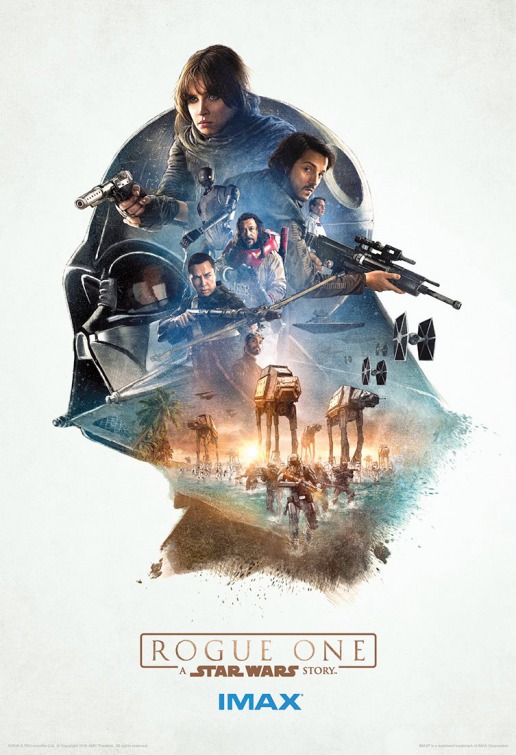
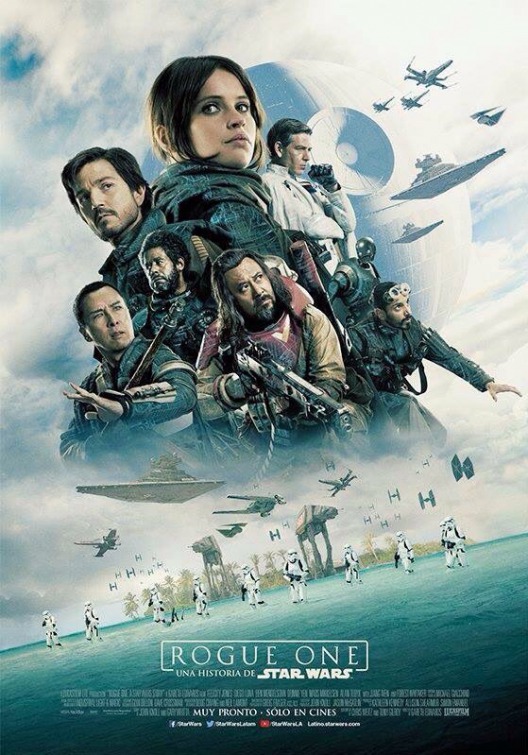
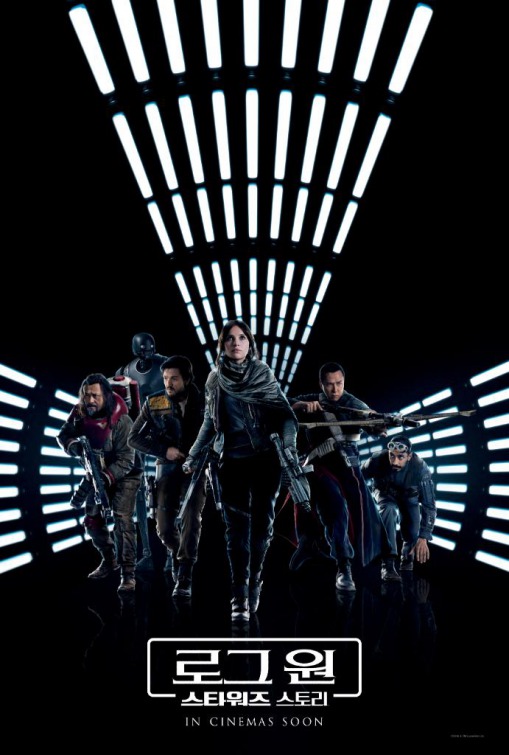
The rest of the heroes mainly are sort of there. It’s not that they aren’t fun – Donnie Yen’s blind monk who isn’t a Jedi but sort of uses the Force, Chirrut Imwe is a blast for the three scenes where he actually gets to do his ‘blind guy fighting really well’ schtick. Alan Tudyk gives great sass as K2-SO, the droid who has more personality than the rest of the gang put together. Riz Ahmed is actually convincing as traumatised defecting Imperial pilot Bodhi, and Jiang Wen gets to look stoic, make occasional profound pronouncements and shoot a big gun once or twice as Baze Malbus. It’s not that anyone is delivering bad performances (Jones’ weird mono expression aside), it’s just that nobody really gets the chance to do much beyond being where they need to be to advance the next bit of plot, making it all feel a little soulless.
 This isn’t helped any by the cast of villains against which our heroes find themselves. Ben Mendelsohn cuts an impressive figure in his distinctive white uniform and cloak, but Director Krennic never really feels like anything other than a middle manager. His performative ordering of the execution of people by his ‘Death Troopers’ (one of three new Stormtrooper variants for this movie) always feels like the sort of thing a supervisor in Team Evil would do in a vain attempt to get respect from his co-workers, and it doesn’t help that the script largely has him whining like a petulant child to both Vader and creepy CGI Moff Tarkin. I keep expecting him to literally drop to the ground and start beating his fists on the floor as he wails ‘BUT IT’S MY DEATH STAR!’ and unfortunately this all serves to undermine him as a threat.
Tarkin’s inclusion goes further than it should. We all knew that somehow the movie would have to incorporate him, and the first shot, with his back to camera and a vague reflection of him in the window he stares out of, seems like the perfect way around it, right up until he turns to face camera and has a five minute exchange with Krennic. The Uncanny Valley effect is still very much with us, and means there’s an extra level of distraction during his scenes. You can argue that the same technique used to give us a young Leia in the dying moments of the film is worse, and from an aesthetic point of view, it certainly looks less convincing, but the shot gets away with it by only giving us a handful of seconds seeing it and one line delivered. Tarkin gets entire conversations, and it never quite works.
 And then there’s Vader. Dave Prowse brought an awful lot as a physical performer to the role, and it seems to me that anyone seeking to take it over might have studied those performances and tried to emulate that physicality and presence. Daniel Naprous (Spencer Wilding is credited but most of his scenes, including one from the trailer were cut) doesn’t seem to have done so. This Vader almost swaggers along as he delivers a pun to Krennic (of itself, an oddity) and then half jogs through the corridor in the climactic scene near the end. There’s none of the sense of power, intensity or menace that Prowse managed to convey, and to be honest I found the physical performance far more distracting than James-Earl Jones’ raspy delivery of his lines. Yes, the final corridor scene with all of its red lightsaber murder is an awesome piece of cinematography, but it doesn’t look like Vader, and it feels like an out of place scene anyway, especially in a film we were specifically told originally would operate outside the Skywalker Saga and feature no Jedi or Force powers.
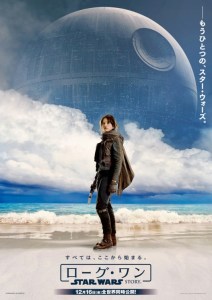
On the positive side, the final act delivers some of the most gorgeous visuals in the entire Star Wars saga. The battles in space over Scarif and on its gorgeous beaches are visually stunning work, and the mixing in of the old pilot footage just cements the feeling. The techniques used to shoot this are nothing short of magical, and future directors playing in the sandpit of this era of the galaxy far, far away should probably take note.
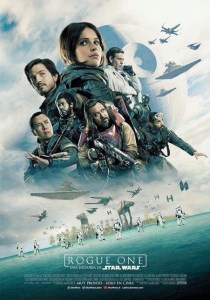 It’s not just the visuals though – in its final third the movie really picks up its pace considerably. Rumours at the time had the first cut of Rogue One panicking Disney execs who saw it, who felt it was too dark and too like a war film for the franchise. The endlessly talked-about reshoots were allegedly in part to fix this, and what is clear is that whatever was done to it, Rogue One was going to be an awkward beast.
Rogue One is the most conflicting of all the Star Wars movies for me. As a fan, I appreciate the little nods to the wider franchise, the effort made at maintaining an authentic look and feel to proceedings, and the expansion of a tiny part of the history of the whole saga. As a critic, I am forced to acknowledge that it delivers a turgid first act, some terrible dialogue, and a cast of damned fine actors given far too little to actually work with. It also has to be asked, from an objective standpoint, whether this movie even needs to exist – it’s a thin concept stretched over a two hour run time, and there was only ever going to be so much that could be done.
 Still, that final act is a thing of beauty to behold, and well worth the wait getting there. In the end, it’s basically one Star Wars fan’s love letter to the rest of the fandom. If you resign yourself to that going in, there’s much to enjoy here. But if you aren’t a fan already, this won’t convert you.




 Sci-Fi Bulletin: Exploring the Universes of SF, Fantasy, Horror and Spy-fi!