 With Jurassic World: Fallen Kingdom set to roar into cinemas next month, Greg D Smith takes the opportunity to revisit the previous films in the Jurassic franchise. Do they all still measure up? Were any of them unfairly maligned? And just what is it about this series which gives it lasting enough appeal to be giving us sequels twenty five years after the original movie debuted to rave reviews and box office-breaking numbers?
When eccentric billionaire John Hammond brings a selection of experts to certify his latest island-based theme park as being safe for the public, his guests get a lot more than they bargained for. And that’s before a series of events conspire to let his attractions – real, live dinosaurs – loose in the park.
Where do you even begin to categorise Jurassic Park? Wikipedia will tell you it’s a Science Fiction Adventure film. IMDB that it’s an Adventure Sci-Fi Thriller. Most people will quantify it as ‘the one with all the dinosaurs’, and, inevitably, ‘The best one’. For me, it’s always been just part of the mystique of the 1993 blockbuster – in fairness, it defies easy categorisation. There are science-fiction elements to it, both in the way that the film has dinosaurs being recreated in real life from DNA harvested from mosquitoes trapped in amber to the actual existence of the dinos themselves. But then you could also argue for the thriller angle – there are plenty of tense moments, dramatic deaths and injuries and jump scares that would qualify. Or how about monster movie? As intelligent as the film and its premise are, people came to see big dinosaurs roaming across the screen and occasionally eating folks and that’s what they got. Or how about family adventure film? Despite one or two moments of gore and the occasional profanity, it’s clearly a movie aimed at kids, to the extent that it has two involved as key protagonists, and they end up hanging out with a sort of dysfunctional father figure who gets to learn that maybe he’s not quite as terrible with children as he thinks he is.
 The fact is, Jurassic Park wasn’t a film that easily fell into any category but one: it’s a Spielberg film, one from the man at the very height of his powers, when the mere mention of his name would pretty much guarantee big box office. Spielberg in his prime had an acute sensibility for blending elements of many different genres (some unexpected) into his tentpole films – look at ET and tell me it’s a simple alien film, look at Hook and convince me that it’s a simple retelling of the Peter Pan tale. Jurassic Park could have just been another big monster movie – what it is, is so much more. And it begins with its characters.
First there’s Alan Grant. Palaeontologist and grumpy middle-aged man. Grant himself is somewhat regressive, hating technology (and having it always go wrong around him), determined not to have children (or be anywhere near them if possible) and firmly stuck in the mindset that his job is the preserve of people like him physically digging and scraping away at bones in the rock. Grant is unreconstructed – though he is in a long-term relationship with Ellie Sattler, it’s clear that he has certain fairly regressive ideas about the world and women’s place within it. He’s confused by a world changing around him faster than he can keep up with it, and keenly aware of his vanishing relevance within it. He’s also a decent man, brave, kind when he needs to be, and honourable. The subtext isn’t even subtext here – Grant is a dinosaur, and the world with all its advancements and new ideas is a meteor intent on either making him evolve quickly enough to avoid it or making him and his kind perish beneath it.
Then there’s Ellie – a palaeobotanist who the movie allows to be a leading female character without having to slap itself on the back about it. Ellie Sattler was the Strong Female Character in cinema at a time when Ellen Ripley was no longer around, and if she’d seen that phrase, she would have laughed at it. She’s brilliant in her field and in general, fiercely intelligent, capably independent and absolutely not here for your crap. When she wryly observes that ‘Dinosaurs eat man, woman inherits the Earth’, or ‘We can discuss sexism in survival situations when I get back’, it’s not in the furious tone of an incandescent ballbuster, nor the sneering tone of the harridan man-hater trope character. It’s simply a woman telling a man, ‘I’m here, I’m capable and maybe you want to pipe down a bit’. As if to reinforce this, she’s also quite happy to flirt with Ian Malcolm, obviously would quite like children of her own, and isn’t afraid to show her softer side. Ellie Sattler is everything I feel that female characters should be in mainstream cinema, with no fanfare or earnest promotion required.
 Richard Attenborough turns in one of his more memorable performances as John Hammond, an eccentric entrepreneur who has made billions in his lifetime and is now sinking everything into this latest venture. The key here is complexity – Hammond is a likeable old rogue of a man, with a quick wit and a charming demeanour. He’s also a razor sharp businessman, with the cutthroat instincts that go with that. The fact that neither quality quite manages to outshine the other is what leaves him losing out eventually. He isn’t quite ruthless enough to leave people to die or to be unmoved by the horror of what he’s unleashed, and he isn’t quite nice enough to get the message quick enough, nor to have prevented any of the calamities of the movie from happening when he loses a staff member to a raptor attack early on. Hammond is a character balanced on a fine edge, and the slightest tip over in either direction would have seen the character simply not work.
Jeff Goldblum’s Professor Ian Malcolm is pretty much exactly what you except from a Jeff Goldblum ’90s performance, but his blend of halting, distinctive speech pattern, kooky humour and sense of fun combine to make the character a lot more interesting than might otherwise have been the case. What’s more, for all his obvious flaws (a veritable laundry list of ex-wives and children to his name, an incorrigible desire to flirt with any female he finds and an obvious love of the sound of his own voice), he’s also a decent man – his first concern when the T Rex appears is the safety of the children, which he risks his own life to ensure, and he has a genuine ethical concern about the park long before any of the others are truly awake to the threat it presents.
The children, Tim and Lex, may well have been there partly to give children in the audience something to relate to, but they also function as important characters in their own right. Clearly the product of a marriage in the middle of failing and brought to the island by their grandfather as a treat, they’re a scrappy, likeable pair and it’s easy to see how their charms eventually wear Grant down. Lex may as well be a prototype Ellie, with her insistence that she’s a hacker, her easy capability with technology around her and her general air of intelligence, while Tim is clearly a parallel(ish) Alan, wound up by his sister, obsessed with dinosaurs which he spends hours reading about and with a sense of adventure. His own ease with technology divides them, but maybe that’s just part of the trick – showing Alan what he could have evolved into if he’d had an earlier start?
 Various other characters complete the effect in their own way – Nedry is a greedy, venal coder hired by Hammond to get the park up and running at what one suspects was a cheap rate. One of Samuel L Jackson’s early turns in a blockbuster as Ray Arnold, another technical bod with very little time for Nedry, doesn’t get to do much beyond establish a catchphrase and then die rather horribly, and Bob Peck is phenomenal as Robert Muldoon – a role he plays completely straight faced and with appropriate gravity to make it work. Muldoon’s brooding nature and obvious wisdom and courage help the audience forget that what we have here effectively is a hunter (who would usually be a villain in this sort of film) although not so much that the edge isn’t retained when he discusses raptors – Muldoon’s respectful fear of the creatures being that of a fellow hunter knowing he’s met his match.
The real stars though, are the dinosaurs, and these were absolutely magnificent, both then and now. 1993 was a time when Computer Generated Imagery was still very much in its infancy, with the result that films of that era, including this one, used a mixture of CGI and practical effects to achieve the shots required. What makes Jurassic Park stand out is how seamlessly these two elements were blended together. Nobody will forget the herd of Gallimimus and their sweeping turn over the plain, nor the claustrophobia of seeing up close Grant, Tim and Lex trapped among them. Nor is anyone likely to soon lose the memory of the Tyrannosaurus rex’s first introduction in the movie, as it demolishes a car in the pouring rain. To this day, the wide-eyed look of terror on the young Ariana Richards’ face as the Rex’s head appears next to her at the window and its pupil dilates in the beam of her torch is an instant classic. Small wonder that the ‘ripples in the water’ that start the scene was such a staple of spoofs, imitators and tributes for years to come – it’s an iconic moment that introduces an amazing scene.
What really brings the dinosaurs to life in the movie though, is not simply the fact of the methods used to recreate them, but the way in which they interact with the cast. Unlike traditional monster movies which preceded it, the dinosaurs here are not simply all raging monstrosities out to devour all the humans they can get near. The prolonged scene with the triceratops, Grant with a beatific smile in his face as he listens to it breathe, Ellie squeezing pimples on its tongue as she tries to discern what’s wrong with it, is a perfect example. Here we have a massive animatronic prop with very limited movement, but the presentation of the scene and the performances of the actors give us a living, breathing creature with which we feel empathy and which we want to see get better. Later, when Grant and the children encounter a brachiosaurus, it’s again just a large animatronic head that does very little, but it’s done in such a way, at such proximity, that it feels real.
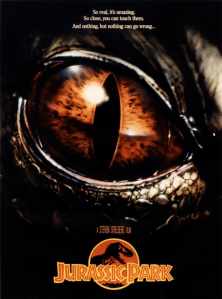 In giving us the balance – both predatory beasts like the raptors and the rex, as well as herbivorous plodders minding their own business, Jurassic Park gives the viewer a real snapshot of a living, breathing ecosystem. Sure, the raptors are the wrong size (as is the dilophosaurus) and the science part of the science-fiction is beyond far-fetched (forget the difficulty of extracting viable DNA from millions of year-old amber, how on earth would you even begin determining which DNA was which, and how indeed could you be sure that you hadn’t just found mosquitoes who had all feasted on the same creature) but as long as you’re willing to put minor niggles like this aside and just enjoy the ride, this movie gives you a wonderfully vivid reality in which to lose yourself.
And Spielberg makes that putting aside very easy with the tale he weaves. Paced almost to perfection, Jurassic Park knows exactly what it has in the toolbox and exactly when to deploy it. No slow or emotional scene is allowed to drag on too long, and they are all followed by some sort of humorous or action-based shot. None of the emotional beats feel cloying, but they land hard enough to have the intended impact. None of the action or violence feels gratuitous, and every single dinosaur shot gives exactly enough to make it compelling and exciting without going overboard so that the viewer gets used to it or becomes bored. The T Rex in particular, arguably the highlight of the whole movie, gets barely a handful of minutes of screen time. When it arrives at the end, snapping up the raptors surrounding our remaining heroes and allowing them to escape, it’s a triumphant moment deserving of the shot of its exultant roar as the banner depicting the park’s logo flutters to the ground in front of it. Our main ‘villain’ becomes the hero of the piece, standing astride his kingdom as the film winds down to its close.
 And perhaps that’s the greatest part of the film and why it has endured so long. Some monster movies sell us creatures which only seek to destroy us, others simplistic narratives of misunderstood beasts who have hearts of gold beneath their hideous exteriors. Jurassic Park lived solidly up to its name, giving us a park full of living, breathing, believable animals, into whose midst our heroes had been unfortunate enough to wander. There’s no sense of any dino in the film being ‘bad’ or ‘good’ – rather, like a nature documentary we simply see life in all its varied forms. There are few ‘boundary breaking’ special FX movies which still stand up as well as they did on release after two and half decades have passed, without some serious retouching, remastering and cleaning up. Jurassic Park is one of them, with its spot on blending of old technology and new, and more importantly its heart. Others will cite Close Encounters, ET or Raiders of the Lost Ark, but for me, this is the greatest of Spielberg’s works, from the peak of his abilities. The dinos may be what people think they remember, but it was the life in this movie that found the way.




 Sci-Fi Bulletin: Exploring the Universes of SF, Fantasy, Horror and Spy-fi!