Review: The Most Dangerous Game (Masters of Cinema)
Eureka, out now Who makes the best prey? Based on the 1924 short story in Collier’s Magazine by Richard Connell, this 1932 movie adaptation by RKO was a huge success, […]



Eureka, out now Who makes the best prey? Based on the 1924 short story in Collier’s Magazine by Richard Connell, this 1932 movie adaptation by RKO was a huge success, […]
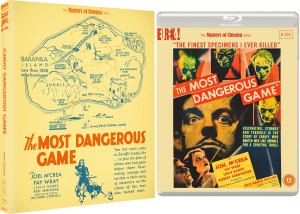 Eureka, out now
Who makes the best prey?
Based on the 1924 short story in Collier’s Magazine by Richard Connell, this 1932 movie adaptation by RKO was a huge success, and so influential that it has been remade and adapted – both officially and unofficially – many times in movies (all the way to a low budget Tom Berenger remake of this version this year!). It’s remarkable that this is still the best version, 90 years later.
The plot is really simple: big game hunter Robert Rainsford (Joel McCrae, best known as a star of Westerns) is washed ashore after a shipwreck, and finds himself on a private island owned by the exiled Russian Count Zaroff (Leslie Banks, a stage actor who would go on to be the lead in The Arsenal Stadium Mystery), along with a woman (Fay Wray of King Kong fame, sans the blonde wig) and her intentionally annoying drunk brother. It turns out that Zaroff is also a big game hunter, but one with ennui over hunting animals, and who has discovered that humans – whether other challengers or mariners lured onto the rocks of his island – are the better challenge: the most dangerous game to hunt. Before long, the brother is murdered, and McRea and Wray are introduced to Zaroff’s trophy room, containing human skulls and heads.
Assisted by his other Russian and Chinese servants, Zaroff offers them a choice: be hunted to win their freedom, or be killed immediately in McCrae’s case, and trapped in Zaroff’s clutches in Wray’s. Naturally they choose option A, and so begins an exciting and tense battle of wits between the two hunters, throughout King Kong’s jungle sets, as both movies were being made at the same time by the same crew and many of the supporting cast.
The cast work well together, though McCrae seems too personable to have ever faced off against hungry tigers or the hazards of a jungle, and Robert Armstrong as the drunken brother is both an example of the typical end-of-Prohibition era screen drunk, and a proselytization against the glamourisation of alcohol in other films. Fay Wray is not yet quite the archetypal damsel in distress, though she does scream a lot, but rather pleasantly manages to hold her own for most of the runtime by means of being the smartest character – she’s the one who has figured out what Zaroff does on this island. The highlight of the whole thing is Leslie Banks’s performance as Zaroff; a surprisingly charming psychopath who is so much more complex than his literary origin, and who would in hindsight be the mould for so many screen villains ever since. The urbane but deadly goateed antagonist who is as sharp with words as weapons, and accompanied by assorted henchmen and hounds. Blofeld, the Master, Ming the Merciless… They all started off with Banks here. The directors also make the best use of Banks’s disfigured left eye, a result of a wound in the First World War, and which would surely have got him typecast if he’d stayed in Hollywood.
That’s directors plural, yes; Irving Pichel directed most of the dialogue scenes, and Ernest Schoedsack most of the action, while working on King Kong. The direction is really nice here, with some lovely touches such as the Pichel’s tilting camera on the shipboard scenes, and use of the Kong sets from different angles. Plus, of course, some great action sequences with real knife-throwing at the actors. The editing is excellent, with nary a shot holding things up, while Max Steiner supplies it with a vivacious early score. Make no mistake – this is no B-movie or cheapie; it’s cleverly budgeted and fully focussed on telling a solid tale as best it can be told.
It improves considerably on the famous short story by Richard Connell (whose other story, A Reputation was filmed by Frank Capra as Meet John Doe), by giving Zaroff a more interesting character, adding a female character, and showing a proper confrontation between hero and villain, though it remains kind of difficult to empathise that much with a leading character whose favourite thing is to go and kill rare animals – that’s very much a product of its era.
It’s a landmark film in many ways, not just for Zaroff and the crisp pace and creation of the human-hunting subgenre of horror film – though this itself isn’t actually a horror film, it’s an adventure drama with a central horror sequence, as is, say, Raiders Of The Lost Ark – or the clever ways the audience are drawn in, such as with that camera tilt aboard ship, but it even has a different take on racebending, with a black actor playing Cossack Ivan in heavy makeup, and a Mexican actor playing a Chinese henchman. Definitely food for thought and discussion.
This is the most complete version available, though not totally complete as per the preview version. It zips along nicely for an hour and two minutes, but the preview version had a much longer trophy room sequence in which Zaroff gives his prey a grand tour of more heads and stuffed and posed bodies in a wax museum type of scene. That version ran 78 minutes, but the fifteen minutes excised for the general release version no longer exists, as far as anyone knows. The film has been censored further in the UK and other releases before, but this release has no such further cuts.
The transfer is a nicely restored 2K print in 1080p, and looks really good for its age, especially when you consider that most other versions have been duped from public-domain prints and hacked around, some changing the title to Hounds Of Zaroff (also an alternate anthology title for the short story. The titular hounds here are actually Great Danes made up to look like Dobermans, and belonged to silent comedy star Harold Lloyd). The sound is also improved somewhat – there’s still a background rustle but the mix reduces that and makes the dialogue a little clearer, and you can compare versions by listening to the restored or unrestored versions from the menu. It’s a noticeable but not that massive difference.
Extras are a gorgeous selection on this. Kim Newman and Stephen Jones give what may be their best commentary for the label yet, packed with fun trivia, serious behind the scenes stuff, and all manner of geeking out about the subject. Quite an unmissable track, in fact. Kim also has a to-camera piece about the original story, and its influence on genre films, which is well worth it. The other to-camera piece is from Stephen Thrower, giving us a nice talk though the production of the film.
Given the short runtime, Eureka have also managed to add some real gems in the form of three of the four Old Hollywood Radio adaptations of the story from the 1940s, only missing the sadly-no-longer-extant version with Rex Harrison as Rainsford (try to wrap your head around Dr Dolittle as a blood-soaked big game hunter!) and Basil Rathbone as Zaroff, which must have been awesome. As it is, we get two versions of a script by Jack Finke from the Suspense series, which tells the story as a flashback while Rainsford is waiting to ambush Zaroff at home. The first has a distinctive Orson Welles as Zaroff, with Keenan Wynn as Rainsford, while the second has Joseph Cotten as Rainsford and J Carroll Naish vamping it up in an obvious Lugosi impression as Zaroff. Both are OK, as is the third, from the Escape radio series, starring Paul Frees (the voice of Boris Badenov) as Rainsford, and Hans Conreid (Captain Hook from the animated Disney Peter Pan) as Zaroff. All are worth listening to, especially if you’re a fan of Old-Time Radio as well as Old Hollywood.
There’s also a German trailer for a 1950s release, as the original 1932 trailer no longer exists, and some clips from a telephone interview with Merian C Cooper in the 1970s. Off-disc, there’s a nice informative booklet about the story and film, from Craig Ian Mann, which is a good companion to Thrower’s piece on camera. The first 2000 copies as usual have an O-card slipcase, which here shows a nice little map of Zaroff’s island, while the sleeve art is a rather Orwellian-feeling photo montage.
Verdict: A fantastic genre-inventing movie with the prototype genre villain, which is short but perfectly formed, combined with a glorious collection of ideal extras to contextualise and celebrate it 90 years on. 10/10.
David A McIntee
 Doctor Who News Star Trek News
 Sci-Fi Bulletin: Exploring the Universes of SF, Fantasy, Horror and Spy-fi!