Review: Saint Maud
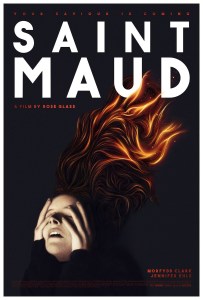
Starring Morfydd Clark and Jennifer Ehle Written & directed by Rose Glass StudioCanal, on DVD, Blu-ray and digital release now In a seaside town that appears at the end of […]



Starring Morfydd Clark and Jennifer Ehle Written & directed by Rose Glass StudioCanal, on DVD, Blu-ray and digital release now In a seaside town that appears at the end of […]
 Starring Morfydd Clark and Jennifer Ehle
Written & directed by Rose Glass
StudioCanal, on DVD, Blu-ray and digital release now
In a seaside town that appears at the end of its days – Scarborough, but let’s not get personal – Maud, a palliative care nurse becomes obsessed with saving her charge’s soul.
Saint Maud is already canonized so my opinion on the matter seems irrelevant. Certainly, in a genre that is always crying out for female voices – a genre? Hell, a medium – the ascendence of writer and director Rose Glass on the back of this, her debut feature, will always be a worthy miracle. It’s a shame that in this house of heathens, Saint Maud failed to reach the heights of ecstasy it has amongst its many believers.
First, the divine: there are many moments of beauty onscreen, the camera nuzzles into the dark corners of Maud and her patient, Amanda’s life with the omnivorous enthusiasm of Nancy the Cockroach (a credited cast member). Morfydd Clark (Maud) and Jennifer Ehle (Amanda) possess their characters perfectly, channelling the potential toxicity of devotion and death. The score and sound design clings to each frame as the smell of bleach must in Maud’s bedsit kitchen. In short, you never really doubt the reality of Saint Maud’s world.
But we always know where it’s going, of course we do. Tragedy demands blood and that’s not a problem in itself — the inevitability of one’s narrative journey, the fear of our destination, can be one of the most brutal weapons in horror cinema – but it does mean that the details of the journey are key. Saint Maud features a second act, a Last Supper one might say, that flounders. The reality of this world is unquestionable, yes, but the fantasy? I wished for darker, dreamier, more disturbing. I wanted to touch the divine. Or, if all ese failed, the demonic. Indeed, why not both? I wanted to feel rudderless, to be as torn from the salt-stained simplicity of this seaside drudgery and taken to the heights of religious fervour. Instead, somewhat like one’s attention during a overly long sermon, I became lost in a succession of details that added up to less than they might. I wanted cinematic transubstantiation, but it remained a tasty table wine on the tongue.
As much as it may be unfair to evoke the Holy Ghost of Bergman’s 1966 movie Persona, in a story where a nurse attends an ill theatrical and they each threaten to become undone, Saint Maud has big sandals to fill. But, yes, it is unfair to ask the earthly child to live up to its celestial parent. Forgive me.
Is Saint Maud good? Yes, but being sainted comes with its own performance anxiety, it never ascends quite as hoped. For me, its bleeding feet remained rooted on the earth.
Verdict: Can one ever really judge a saint without fixating on their trespasses? 7/10
Guy Adams
 A young nurse becomes carer to a terminally ill choreographer…
I was determined to see one more movie in my local Cineworld, and was lucky enough to catch a screening of Saint Maud – a low budget psychological horror debut feature, written and directed by Rose Glass – before they closed their doors for the foreseeable future.
Set in a damp, viscerally chilly, off-season Scarborough, we are drawn into the suffocating world of Maud (if that is really her name…?) a lonely nurse with a questionable professional history, driven by religious zealotry, as she takes up a new post as the personal carer to a terminally ill retired choreographer, Amanda, played with pitch perfect acrid atheistic despair by Jennifer Ehle. You know it’s not going to end well (not a spoiler) but the journey to its arguably inevitable conclusion feels fresh. It’s told with blissful economy – leaving most of the back-story to the viewer’s imagination – and doesn’t let go of your lapels until after the final frame (literally).
In some ways it’s not really horror at all, more a study of mental illness, loneliness, depression and religious psychosis, built entirely around a terrific central performance by Morfydd Clark who is in pretty much every shot. Clark is riveting as the disturbed young woman at war with herself and her inner demons – and pulls off an amazing trick of subtly peeling back layers in her performance to suggest a distressed soul who has tried and failed to reinvent herself on more than one occasion. While there are passing references to The Exorcist, it actually owes more to Sunset Boulevard and Whatever Happened to Baby Jane? but absolutely ploughs its own furrow, and its scares come from genuine psychological insight rather than gratuitous use of VFX.
If you enjoyed The Babadook, then you’re in similarly intelligent horror territory.
Verdict: It’s not quite a game changer but it is rather good. As debut features go this is definitely up there, a confident marker for great work to come from Rose Glass. 8/10
Martin Jameson
 Doctor Who News Star Trek News
 Sci-Fi Bulletin: Exploring the Universes of SF, Fantasy, Horror and Spy-fi!