Review: Frankenstein (2025)
Starring Oscar Isaac, Jacob Elordi, Mia Goth, Christoph Waltz, David Bradley, Charles Dance Written & Directed by Guillermo del Toro Netflix, in cinemas now and streaming from November 7th A […]



Starring Oscar Isaac, Jacob Elordi, Mia Goth, Christoph Waltz, David Bradley, Charles Dance Written & Directed by Guillermo del Toro Netflix, in cinemas now and streaming from November 7th A […]
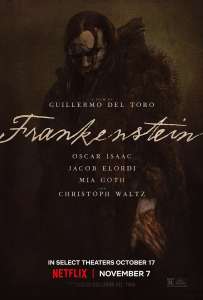 Starring Oscar Isaac, Jacob Elordi, Mia Goth, Christoph Waltz, David Bradley, Charles Dance
Written & Directed by Guillermo del Toro
Netflix, in cinemas now and streaming from November 7th
A brilliant but egotistical scientist brings life to a creature constructed from cadavers, but who is the real monster?
Let’s get some basic critical ‘housekeeping’ out of the way.
First things first, in purely cinematic terms it’s nigh on impossible to deny that Guillermo del Toro’s Frankenstein is anything other than a remarkable achievement. In fact, ‘remarkable’ might not cut it, so reach for your thesaurus and insert your own superlative. It’s visually sumptuous, with immaculately conceived artistic detail exuding from every pixel. GDT has long hailed the project as a life time ambition, and you can feel his love and passion dripping from every frame.
Secondly – and this is full disclosure – I’m not good with gothic. I couldn’t be doing with Robert Eggers’s Nosferatu last year, and while I’ve nothing against vampires per se, traditional Draculas with their frilly shirts and candlesticks leave me completely cold. It’s not a world I engage with easily, so that might explain why, despite its obvious and admirable excellence, I was ‘impressed’ by Frankenstein rather than ‘transported’. The only time I’ve been truly absorbed by the Frankenstein story was at the sight of Peter Boyle’s creature performing Putting on the Ritz with Gene Wilder in the Mel Brooks spoof.
But are there other reasons why the movie doesn’t quite land in places?
The cast are mostly great. Oscar Isaac as the titular Victor F is suitably mercurial, utterly committed to the amount of sweaty gothic intensity required to own the screen in a film on this dramatic scale. Arguably, however, he has the movie stolen from under him by Jacob Elordi’s Creature. It’s an astounding performance, mostly conducted in a mournful whisper, pitching delicacy and vulnerability against a towering and monstrous appearance.
I’m a huge fan of Mia Goth, who, on paper (nominal determinism aside) ought to be perfect casting for Elizabeth, the love interest of both Victor and his creation. Perhaps it’s a failing of the script, but there’s frustratingly little for her to do, and what there is leaves equally little room for her natural talents as a screen presence, and the niche she has carved for herself brilliantly (but perhaps unfashionably) as a highly sexualised female horror film protagonist. A few notable scenes aside between Goth and Elordi, the character has become hopelessly lost in the mix, because in the end, GDT is really only interested in the love story between the two men.
In this respect, there’s no doubting del Toro’s ambition for the script – to eke out new meaning from well-worn source material – but in pursuit of that, inverting some key plot points from Mary Shelley’s original, he’s managed to create something of an intellectual stew. The love/hate, father/son, god/man dynamics work pretty well, but then we’re taken down a cul-de-sac about immortality. It stops being about the arrogance of godhead and more about the Creature having a superpower it doesn’t want. There isn’t room in the movie for that as well. Similarly, the key idea of a bride for the creature comes over as nothing more than a momentary aside, a narrative dead end, akin to Mia Goth’s character. In overloading the script with philosophising, there’s a sense that every few pages Guillermo has said to himself: ‘Oh! Damn! I forgot! It’s a monster movie!’ So the rhythm of the film becomes ‘chat, chat, chat, roar, dismember, chat, chat, chat, roar, dismember’ on repeat.
Where the film really triumphs is not in the philosophical chin-wagging, but in del Toro’s brilliant realisation of the nuts and bolts and festering viscera of making a creature out of corpses. Never has the creation of Frankenstein’s monster been rendered so convincingly, although my one reservation with regard to the eschewing of CGI for certain sequences, is that the use of models looks amusingly Thunderbirds in places.
Verdict: Caveats aside, Frankenstein is a big screen all-you-can-eat banquet of movie loveliness – so make sure to see it in a cinema before its premature relocation to our puny little telly-boxes in November. 8/10
Martin Jameson
 Doctor Who News Star Trek News
 Sci-Fi Bulletin: Exploring the Universes of SF, Fantasy, Horror and Spy-fi!