Songbird: Interview: Adam Mason
Songbird is released today to select cinemas and on VOD. The first movie filmed in Los Angeles during the COVID-19 pandemic, it’s set in the city in four years’ time, […]



Songbird is released today to select cinemas and on VOD. The first movie filmed in Los Angeles during the COVID-19 pandemic, it’s set in the city in four years’ time, […]
 Songbird is released today to select cinemas and on VOD. The first movie filmed in Los Angeles during the COVID-19 pandemic, it’s set in the city in four years’ time, where a mutated COVID-23 has meant everywhere is locked down, everything is UV-sanitised and only those immune – such as courier Nico – can travel outside. There’s a flourishing industry in “immunity bracelets” which give safe passage… Co-writer and director Adam Mason chatted with Paul Simpson about the challenges of making a film in 2020…
I was always in two minds about making a movie about the pandemic but for me, it was quite a personal film in a lot of ways. I’m in L.A – I’ve been here for about ten years – and my parents are back in England, so when the lockdown hit I was feeling extremely isolated from them and my friends and family back in England, and scared like we all were. It was the only time in my lifetime that literally everyone in the world has been going through the exact same thing at the exact same time. Creatively I was just really driven to channel that into this script.
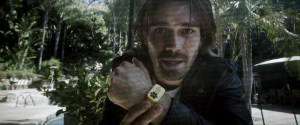 On the first day of lockdown, my writing partner and I just put together this project but it wasn’t like we were looking for a budget to go and make it – we were just going to make something like we used to back in the old days, for literally nothing. The themes of what was going on around us just fed itself directly into what we were writing. But very quickly we wanted to make something that was a hopeful life-affirming movie that was old-fashioned. We didn’t want to make something that was cynical in any way.
I’m as influenced by movies like The Notebook or Titanic or Baz Luhrmann’s Romeo + Juliet as I am by anything like A Quiet Place or any of the genre movies that I love as well. We were trying to combine those two things – having a scared world but ultimately having a very hopeful message about love and the power of love.
And it mutates around the third act and almost becomes a chase thriller as well. Was that always part of it, that Nico would have this darker version of “Hugh Grant rushing to the airport to stop his true love getting on the plane”…
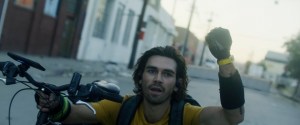 I can see that, yes. We wanted to have a ticking clock in the movie just because we knew that we would have such limited resources to make the film, that it was all smoke and mirrors, so consequently we wrote a lot of intercutting storylines. We were trying to emulate that thing that Chris Nolan does so brilliantly of having constant intercutting set pieces; this was the low budget version of that in a lot of ways. It is an illusion…
The movie’s exciting, I think, because it feels like there’s a lot going on, but actually if you break down the scenes into what they are, they’re all quite inherently small moments that are character based moments. So Nico trying to get the immunity bracelet was just a way of adding in this ticking clock, to make the movie a thriller.
There’s also a Casablanca feel to it as well, with all of the underground movements for getting the bracelets, the forged papers and the doomed love…

Yes, Casablanca was a huge influence on the movie. We had a lot of discussions about making this movie while we were all living through it essentially. It was a really fun experience, creating the rules of that world even though it’s something that’s just around the corner from where we are today essentially. It was a worst case scenario of what it would be like if this didn’t go away and we were still stuck in our homes four years from now.
Weirdly it was Casablanca and then Love in the Time, of Cholera, the novel, was a big influence on me, as were John Cassavetes’ movies, peculiarly and Robert Altman, which is a lofty mix, I guess.
Michael Bay getting involved made it that kind of blockbuster type of movie but I come from an indie world of loving Cassavetes and Altman and those kinds of directors. A lot of the intercutting narrative stuff came from those influences.
How much did the movie alter once Michael Bay was involved, in terms of the script?
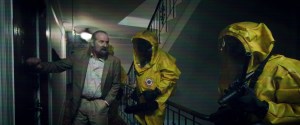 Script wise I don’t think it altered at all but once we got into filming he became extremely involved. He was on set a lot and was actually filming quite a lot himself.
And then in post production, he took on a real mentorship role with me, which wasn’t something I was necessarily expecting. I was extremely humbled by it actually: I basically had five or six months of the Michael Bay film school. That was really incredible, I learned so much.
I think that the movie was fundamentally changed by his involvement, just watching how he worked and getting a glimpse into his mind and how he creates these huge action set pieces. His way of dealing with character and pacing and all of these sorts of things – it was quite incredible to watch. He would send me sketches of edits and scenes that he had done and it would just be completely outside of the box of anything I had considered.
It was quite amazing and seeing him on set was pretty amazing as well. The drive behind that man, I’ve never seen anyone with more energy in my life.
Do you think that for him, this was a way during the pandemic to be doing something that he loved in a way that was different from sitting on a Transformers set? On something where probably the crafts services budget would have been less than you were making it for.
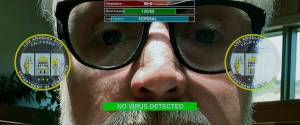 You’re right, it was an extremely low budget movie but getting to know Michael a little bit, I don’t think I’ve met anyone who loves film more than him. His whole life is film and I think the lockdown had a really stifling effect on him. All of his energy is channelled into his art so I think he was extremely interested by the concept that we were going to go and make a movie because it’s something that seemed impossible to most people at the time. We were the first in Hollywood to be back at work so I think for him it was the joy of being able to make a movie again.
How challenging were the Covid protocols, in terms of actually directing?
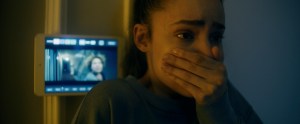 On the one hand, even the smallest scene was challenging in ways that are hard to even begin to describe, but on the other hand it was extremely rewarding because it removed so much of the ego and bullshit that is normally so present on a film set. There was just none of that; everyone across the board from the cast to the crew to the producers to Michael Bay, everyone was just so happy to be able to make something again. There was such a spirit of togetherness across the board and everyone was so up for the challenge of making something that quite frankly seemed impossible when we were in the pre production stages of the movie.
We shot the film in seventeen days which by anyone’s standards is incredibly fast, especially for a movie with this scope and scale.
It’s almost television speed to film 85 minutes in that time?
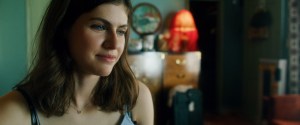 Yes, but the first cut of the movie was two and half hours. The script was 143 pages, so there was a huge amount of material that was cut. We were basically shooting ten or twelve pages a day every day and because there was so many phone calls and Facetime calls in the movie, we had to shoot both sides of them. We’d have to shoot on one location and then shoot it again on the other, so one page of script material ended up being more or less two. That was very challenging and something I kicked myself for thinking of afterwards because it meant we had double the amount to film.
But when it came down to being on set, the lack of crew and the lack of equipment, everything was extremely stripped down. That’s why I was referencing directors like John Cassavetes. There was a real sense of cinéma verité in the style that we shot the movie which I don’t suppose you’d probably pick up on from watching it because it’s so colourful and beautiful to look at.
There’s a guerrilla filmmaking feel to it certainly. The scenes of Nico on the bike and things like that going through the crash barriers and those sorts of things. You almost feel like it’s a ‘Stop the road for five minutes, get it!’ as opposed to there being no traffic.
 It was like that when we shot Nico playing basketball on the bridge in downtown L.A. Because it was lockdown, there was really no one around so we literally just wheeled out the hoop, did the shot and we did that whole scene in five minutes maximum. So there was that real guerrilla filmmaking approach to making the movie and in terms of being on set, just not having the lights and the equipment, there was no Steadicam or dolly, none of that stuff that you would normally have.
All of the focus went on the performances and the actors in a way that I just really loved. There were never any marks; an actor never had to hit a mark, there was no real continuity between different takes. If an actor wanted to go one direction in one take and another in another take then I just let them go with it, we just rolled and rolled. We’d do a series instead of slating every take because we didn’t want to have so many crew members on set.
So really, although we only had 17 days, it felt like I had a wealth of time which is why I was able to make a two and a half hour movie in those 17 days. We’d find the scene as we were shooting it which was, and I think the actors would tell you as well, a wonderfully creative process.
Were the actors, within the constraints of the scene requirements, able to improvise?
 Yes totally, everyone had complete freedom. The movie that we made was very much the script but within the structure of the script the actors had complete freedom to do whatever they wanted at any time.
That is something I’ve done throughout my career: I’ve always loved theatre and I’ve taken an almost theatre approach to most of the movies I’ve made. I love rehearsal and I love working with actors but somehow because of the restrictions of the pandemic and the lockdown, it lent itself to that style of filmmaking.
I think if we’d done it in 2019 instead of 2020 so many other people would have gotten involved and would have not wanted us to do it in that style but because we were forced to do it, I took the gamble and I ran with it really.
If you’d been working on this idea in 2019, would you have approached it completely differently?
I think I would have felt the pressure to approach it differently but my natural sensibilities as a director lent themselves 100% to the approach we took of filming it this year.
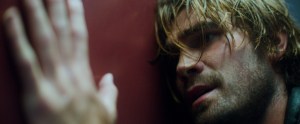 I think I would have felt pressured into having to use a bunch of different equipment and so on like cranes and Steadicams and dollies and all that stuff. The DP, Jacques Jouffret, is one of the greatest camera operators of all time, he’s been Bay’s operator for years and years, he’s DP’d for a bunch of great movies and he said to me, ‘Movies these days there’s a cut every two seconds. Unless it’s Martin Scorsese doing a scene in one take in one shot, you can’t really tell if it’s a Steadicam or a crane or if it’s handheld.’ He taught me that all I needed was him and a camera and that was something that ultimately, I don’t think the film feels any smaller because we shot it in that style. In a lot of ways it felt like it gave us the opportunity to seize moments as the opportunity arose. We didn’t have to suddenly grab a camera and stick it on a crane and it takes 20 minutes to get a shot. We’d literally say, ‘Oh, dive over, Jacques and get that shot’ and the whole process was like that. When things get back to normal, I hope I get to make another movie and I hope I get to make another movie in this style.
Originally we were talking about making the movie on cell phones and Zoom calls and Facetime and all those kinds of things. The technology that allowed us to communicate, like I’m communicating with you now – I talk to my parents every day and my mates – has also allowed us to create these cameras that are like cinema quality cameras that are much smaller.
 Jacques the DP had shot a commercial with J Lo using a prototype Red Camera called a Komodo that Michael Bay directed just before Songbird. He told me about this cameras and he thought if we could get this camera for the movie, it would allow us to shoot a movie that looked like a traditional Hollywood movie but without any of the bells and whistles that you normally need.
The CEO of Red very graciously got involved and let us use a couple of prototype cameras and that really opened up the playing field for us in terms of making a movie that looked like a traditional movie, with all of the restrictions of the pandemic.
It was also the 28 Days Later thing of having a city that was under lockdown so because we were able to get out on the streets with a camera that could record images of that quality, we had this inherent production value that was just out there. We had so many shots of the military in the movie, but Sunset Boulevard was shut down with the military out on the streets. Many of the shots were just me. I’d go out at 5 o’clock in the morning with my drone, my camera and I’d just capture that shot of the bridge at the beginning, for example. These were all real shots.
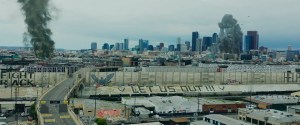 What about the freeway shots? Were they adjusted?
We aged them up but I was able to go out and get those shots. L.A. was essentially in lockdown and seemingly abandoned.
Is there one particular scene or shot in the movie that you’ll look back on in 20 years time and go ‘That sums up Songbird, for me’?
 The first one that comes to mind is the shot of the abandoned freeway at the beginning because that was me at 6 o’clock in the morning with my $900 drone, completely by myself out doing this shot that then became the first shot of Songbird. The fact that, I could get that shot and that one of the biggest cities in the world felt completely empty brought a sense of loneliness. I felt lonely doing that shot, weirdly. As I was doing it I thought, “What am I doing? I’m out here making this film.”
So many emotions were wrapped up in that one shot and the fact it ended up being the first shot of the movie, it’s probably the shot I’ll remember most.
Thanks to Megan Dobson at DDA for assistance in arranging this interview.
SONGBIRD is releasing to UK cinemas and to VOD on 11th December’
 Doctor Who News Star Trek News
 Sci-Fi Bulletin: Exploring the Universes of SF, Fantasy, Horror and Spy-fi!