Repeat: Interview: Richard Miller and Grant Archer
Richard Miller and Grant Archer’s new movie Repeat is out now on digital, starring Charlotte Ritchie and Tom England in a tale of a scientist who believes he’s found a […]



Richard Miller and Grant Archer’s new movie Repeat is out now on digital, starring Charlotte Ritchie and Tom England in a tale of a scientist who believes he’s found a […]
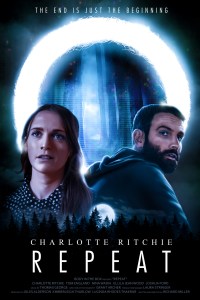 Richard Miller and Grant Archer’s new movie Repeat is out now on digital, starring Charlotte Ritchie and Tom England in a tale of a scientist who believes he’s found a way to communicate with the dead – and later has to deal with the disappearance of his daughter and the effect that has on his marriage. Shortly before the film was released, Miller and Archer chatted with Paul Simpson
Where did the initial idea for Repeat come from?
Richard Miller: It was around speaking to the afterlife; that was the original seed that it came from and everything really branched off that. I think it was an evolution of the story, it wasn’t something that started fully formed in our heads. It was something that went from a very small idea and then came out from there.
Obviously, there’s almost two ideas to it, there’s the one we think the film is about and then there’s the one that the film is actually about and without getting into spoiler territory, which came first? What we see a lot of or what we end up realising?
 Richard: I’m not going to pretend to be super smart, it definitely was what you think you’re watching (laughs) but what we also didn’t want to do is cheat the audience. From the opening scene all the way through we are definitely giving the audience a chance to be involved in what’s actually happening. Even though a lot of it changed, it was changed throughout the script. There was a lot of rejigging.
What prompted the changes? Were there things that you saw in the draft script and went, ‘Not sure we’re going to be able to make that work’?
 Richard: I was quite enjoying where it was going but I thought the story was too passive. Obviously there’s the emotional ties in there but we wanted to take the viewer on a journey as well that for me was just a bit too linear from the start.
One night it just came to me, the basis of that and the consequences we see at the end probably didn’t come to me until quite late on.
To be completely honest, we did a couple of read-throughs with some guys I know and they said ‘So that happened because of this, this and this’ and it was like, ’Oh shit, yes that’s right.’ So we put more in there around what the consequences of what Tom’s character has done, and what impact that has,
Once you’d actually worked out who the characters were, how much did Ryan and Emily alter how the story is told? They’re both strong characters in their own right; it’s not ‘The Wife’ and ‘The Scientist Husband’.
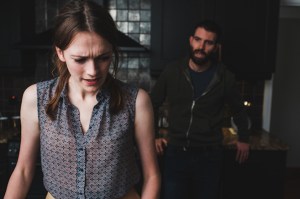 Richard: That’s a really good point because one of my favourite films of recent times is Prisoners and in that you’ve got a wife that just dissolved into the background, around a very similar sort of story set up. We wanted it to be a story about two people with very differing ideas of the current situation. That then created the conflict in the film and every character you come across has got a reason for their actions – his boss, Laurie, for example, has a certain view of what Ryan is doing.
So we wanted to make sure that their motivations brought the words out of their mouths. Rather than just writing dialogue to be delivered just to give some exposition, it was all with intentions.
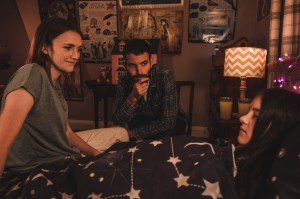 There’s a good rapport between the two of them – with the flashback sequences they’re not just creating the antagonistic version of the relationship, you’ve got the non-antagonistic version as well. The body language there was really nicely done.
Richard: That was very well thought about beforehand and we wanted to make sure there was a clear difference. We don’t say, ‘Oh, you’re in a flashback’ but we wanted to make sure that it was clear, not just because certain characters appear that couldn’t be there but also the way that Emily and Ryan interact with each other. You’re spot on, that was a key thing, there were two relationships, before and after.
On a practical note, what was the biggest challenge in terms of creating the look of the film?
Richard: Time!
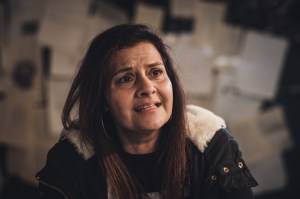 Covid was the biggest challenge because we could only have a certain amount of people on set. Nobody would believe how small the budget on this film is because we managed to get Charlotte and Nina [Wadia]. They were not a big part of the budget: they were involved in the film because they believed in the script.
The budget was very tight. I don’t think we would change that because it made the film what it is, but what it did do is make Grant’s job be three jobs.
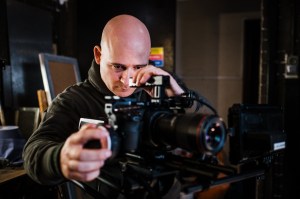
If you look at the credits you can see how many jobs my job was and again, same for Laura and Kim, my partner who did multiple things. So we had five people working on a feature and a couple of people in post.
Budget and time were the main challenges but also they were also probably a massive plus point in the end for how the film turned out.
Grant, in terms of the cinematography there’s a very distinct look to everything that is within Ryan’s workshop and everything outside has a different feel to it. How did you achieve that? Was it purely through lenses or tightness of shot etc?
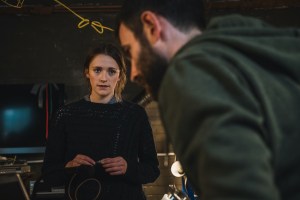
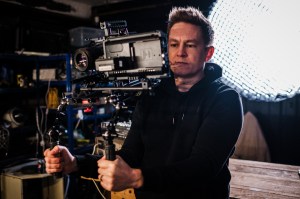 Grant Archer: Yes, certainly for the lab we wanted it to have a slightly science fiction sort of feel so for most of the shots in the lab we used anamorphic lenses to give different flaring, lots of practical lights to give pools of lights and give it a real sense of atmosphere. That was the main objective for the lab scenes just so it did register on the screen as being a realistic science and technology space. I’m so glad that you picked up on that.
And then for the real world externals, really the main driver here was the relationships between the characters and trying to show the closeness as well. We often found ourselves shooting quite tightly but making it feel very naturalistic, very real world, very realistic. Despite it being a sci-fi film, we purposely didn’t want the effects and the look of it to distract the audience but just to add to it, so it was very realistic, real world believable but clearly with an edge.
Richard: What we didn’t want to do was make it documentary style; we wanted it to look like a film. That’s the other thing we could have done.
Did you have a visual effects budget to do stuff in post or were you doing the majority of it practically? It looks like a lot of them were practical effects but were they boosted in post?
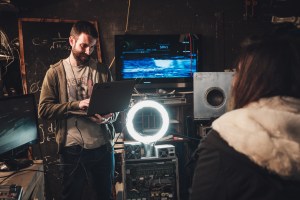 Grant: The machine, obviously the lighting that displays we utilised that to give a practical light but then the extra flares and glows, they were added in post.
Richard: The amount of times we used a leaf blower on somebody’s face…
Grant: (laughs) Oh yes, of course. Hard to do wind in post.
Richard: And then as you said, we just escalated that with some flares and especially on some of the machine parts, the bigger machine that we see later on, just making it not look like a string of lights, making it look more sci-fi.
Grant: Yes, try to catch as much as we can in-camera and just add to it.
There is the potential to expand this, probably another fifteen twenty minutes. Would you want to go back and do more with it? Or is this as it is, what you want to tell with that story?
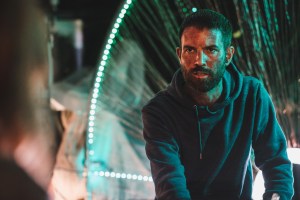 Richard: That’s a really interesting one because our composer said, ‘This could be a little Netflix series.’ This could easily fit into being a much longer narrative story but what we wanted to do, again, was make it as accessible as possible. So it’s 95 minutes and as tight as we possibly could make it because we want as many people to watch it as possible. I know if I’m flicking through Netflix or Amazon, if I see anything that goes over 100 minus I start to think about that.
If we were to do anything longer with it, it would probably be a series because I don’t think we could have added much more in an extra fifteen minutes. I’d probably want to make a three episode series or something like that.
Would you take it beyond where the movie finishes? Because there is obviously the neat conceit of how the movie ends, but there are one hell of a lot of consequences to play out. Do you think there’s more within what we see – such as the police investigation – or would you want to take it further on and see how Ryan and Emily cope with what they learn at the end of the movie?
Richard: I quite like it’s a full stop. I quite like that we’ve given enough that the audience then thinks about it afterwards. Throughout the film we’ve tried to leave gaps that the audience have to fill with their mind and I think if we added extra then it starts to take that away and starts to diminish the film, for the viewers processing of it, without being too arty farty.
Did you lose scenes in the edit?
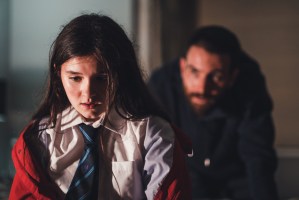 Richard: You’ve already highlighted one and I apologise to Angela Hazeldine, who plays the copper, because she had an absolute corker of a scene that we couldn’t get into the film because when we watched it back it didn’t progress the story. It was a really good fun scene with some great dialogue and it linked back to other things that we had in the story but we just had to keep it as tight as possible. The film was probably another ten minutes but it was adding nothing and that’s my fault for not seeing it from a script perspective.
But I think once you watch something as a whole you go, ‘Well, from that part to that part, are we actually adding anything from having that scene inbetween?’ And we weren’t. So we took a lot away.
Just from that scene on the page you would say ‘You would have lost something from that coming out of there’ but from a viewing perspective it was very different.
When did you involve the composer?
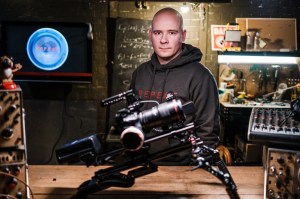 Richard: We started talking about the film with some really crappy concept art early last year before we engaged the actors. That’s how we got all the actors on board – a lot of adverts on Twitter etc.
Thomas George contacted me because he basically is a massive sci-fi nut and he wanted to work on a sci-fi film. I’ve worked with brilliant composers in the past that I’d liked to have worked with on this but he said, ‘If you give me a chance I’d like to send you some tracks.’ So he sent three tracks over to us and we just had to have him on board at that point because he just absolutely nailed what we wanted to do. So before the film was made Thomas was involved in it and he’s been very heavily involved in the whole process.
Did you send him the script and he created, effectively, ‘mood music’ from that? Or did you discuss more specifics with him?
Richard: Yes, we gave him some feelings that we wanted to match. Moon was one of them – we wanted something along the same sort of feeling of that hollowness – and he came up with some concepts. Then we sent him scene by scene and he composed scene by scene then once the film was together we adjusted those tracks to fit.
He didn’t really do it off script, he did do it to visuals because I think that’s how we preferred to work. He did some concept stuff up front, but I don’t think we used much of that because it never really fit some of the scenes although the tone of it did.
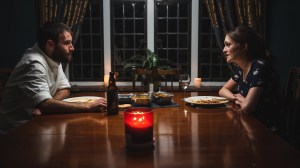 It wasn’t writing to locked picture, he was writing to early cuts,
Richard: That’s absolutely right, so it was fun for Tom.
Would you want to do something else in this world next or are you working on another project, similar?
Richard: I’d like to do something that feels like this world, I don’t think it will be this world so we’re talking sci-fi horror, that sort of thing – maybe a mixture of sci-fi and horror – but I think we will keep the same sensibilities of having a story that engages the audience’s mind, hopefully. I don’t think we could just churn out a slasher film or anything like that or anything that doesn’t engage…
Grant: That’s thought provoking, yes.
Richard: That’s the word for it, Grant, you should do the writing!
Those ideas are quite far removed from trying to get them together. It takes a long amount of time but I think we are ready to be rolling, we want to do it as quickly as possible.
Looking back on it on the final film now, what do you wish you’d known going into it?
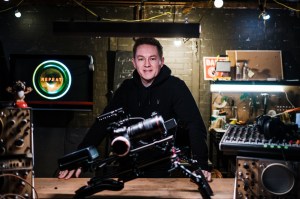 Grant: The obvious one is time, as we’ve discussed. Just having an appreciation for how much time is really needed in some of the scenes just to fulfil what we had in our minds prior to the shoot. In terms of variation and also the shots that we did capture, I think we were constrained in some cases, having an appreciation for how little time we’d have. It was a bit of an eye opener, trying to shoot on this scale in the timeframe we had; some good learning from that for us, that we’ll take forward into the next one.
Richard: I think we had a really good schedule, because it had to be for what we were making, but towards the end we would probably move some scenes around to how we did it. We filmed the school scene on the same day that was offsite and that put pressure on us. So I guess it’s mainly time and schedules – there’s probably lots and lots of micro things that we would just naturally change the way that we do but not something that sticks out.
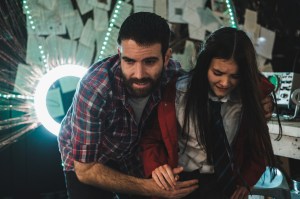 I think we’re quite happy that we’ve got a good way of working but that just evolved from day one because day one everybody I’ve spoken to, regardless of the size of the film, says that ‘Unless you’re just coming off the back of something else, you’re very rusty on day one’ and we were super rusty on day one.
We would love to have had a week with all of the actors upfront. We had Charlotte and Tom for two days before and that was an absolute blessing, but being able to have more time with them upfront would have been great and Covid limited that. I think we’ve learned that as well.
Repeat is out now on digital from Trinity Creative.
Click here for our other coverage, including an interview with Charlotte Ritchie.
 Doctor Who News Star Trek News
 Sci-Fi Bulletin: Exploring the Universes of SF, Fantasy, Horror and Spy-fi!