Occupation Rainfall: Interview: Luke Sparke
Luke Sparke’s new SF movie Occupation Rainfall sees a fightback against the invaders from the original Occupation movie. It’s a much bigger canvas the first film, and Paul Simpson chatted […]



Luke Sparke’s new SF movie Occupation Rainfall sees a fightback against the invaders from the original Occupation movie. It’s a much bigger canvas the first film, and Paul Simpson chatted […]
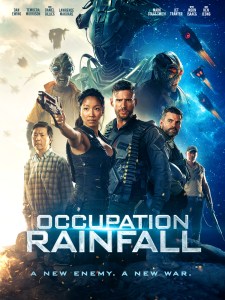 Luke Sparke’s new SF movie Occupation Rainfall sees a fightback against the invaders from the original Occupation movie. It’s a much bigger canvas the first film, and Paul Simpson chatted with the writer/director about its challenges.
Unlike many sequels, it doesn’t feel as if you need to have seen the first Occupation film to enjoy this.
Yes, I designed it that way, I knew the first movie was a lot smaller and it didn’t reach as many people so I went into this one knowing that that would be the case. I wanted to start with a bang but also feel like it could stand on its own two feet.
What lessons did you learn from the first film that you applied to writing and directing this one?
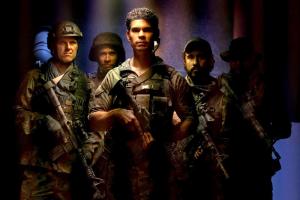 That’s a good question. Obviously I read all the critical reviews, both the good and the bad ones, and you have to listen to them, in a way. I try to take on board as much as I can if it’s a proper critique.
It’s a bit different because the first movie was like a character driven piece where it was following different lives of people, all coming together. This movie was crazy action so nothing really applied from one to the other.
The only thing that I did do is I let the actors have a lot more freedom with the script because I was focusing on world building this time. I really wanted to create the world and worry about the larger aspects. I had to let the actors really feel their characters and go with their gut. I had to go with my gut a lot more on this movie and I let the actors go with their gut. It was all about taking risks and chances.
When you’re writing something you’re going to be directing yourself do you, as you’re writing it, go ‘How am I going to do that?’ or it is more ‘To hell with this, I’m writing what I want to write and that bloke can deal with it later.’ And then you swear at yourself when you realise what you’ve done?
 That second one most of the time. I’m always cursing the writer of the show, which is me but usually in the back of my head, because I’ve grown up on film sets and been around behind the scenes a lot. I have an idea of how I can do it. I have to go and explain it to the people who are paying for all the films, all the investors and buyers so I usually have at least enough to say, ‘We’ll do this one location’ or ‘We’ll do this shot in a studio’ or ‘Don’t worry we’ll use something and do it this way’.
So I usually have some sort of idea when I do it, I don’t think there’s ever been a scene where I’ve gone ‘How the hell am I going to do that?’… yet.
Did you have an idea how the world was going to expand when you first started working on it or were you concentrating far more on just telling that first story?
Well, I didn’t want to become The Amazing Spider-Man 2 where the whole thing is a sequel set up. I really don’t like those movies. But having said that, I wanted to make sure that there is enough worldbuilding in this one to do that.
I also wrote, without spoiling, a very large story after Occupation 1 that basically tells where these characters end and I always had that in the back of mind.
Once I was in post production, funnily enough, I was able to really expand on it; I came up with different alien races and tech. All that kind of stuff we peppered throughout post production that wasn’t even in the script. I was coming up with ideas even up until the last months of delivery. I was pushing my guys to put more in to make this world as big as I possibly could.
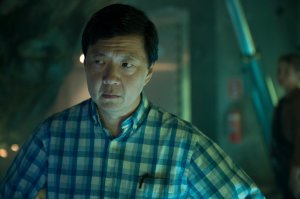 Did you share what’s going to happen to their characters with the actors?
No. They sure did want to know and maybe I told one or two aside privately but usually I kept it quite quiet because anything in the future – as much as it’s either in words or in my head – is always still a moving beast and it can always change. So as much as I know where they’re going to end up, the road to get there is always interesting.
Were there things that the actors did on set or discussed with you that gave you a different insight into the character that you just weren’t expecting?
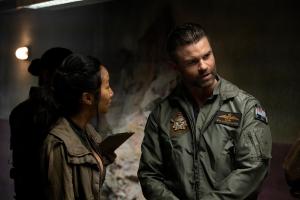 Yes, the main one would be Daniel Gillies: the Wing Commander Hayes character was written probably to be an older, grizzly general and when we got Daniel from The Vampire Diaries we had lots of discussion. He’s a real method actor so on set, this commanding presence as the officer in charge, he would always be coming up me with interesting, exciting ways of how to achieve that character and really make sure he wasn’t a cliché bad guy, but someone who at least had the motivation behind him of why he’s doing what he’s doing.
I spent a lot of really intense work days with Daniel to get that character and all the other actors could feel it and everyone upped their game. Those were intense days but really interesting when I look back on them.
Also Gary the Alien, we had lots of discussions around him and how he has to be the soul of the movie in a way. If he works a lot of it will work. It started off as an almost mechanical voice where he’s like a Siri computer talking but then it became this interesting other way of speaking.
Even in the first twenty/thirty minutes of the movie, if the audience isn’t empathising to an extent with his viewpoint then you’ve lost a good part of the drama that follows.
Yes, exactly.
Obviously there’s quite a bit of attention on Jason Isaacs coming in as your film loving alien. How did you get him?
 I’m a big film nerd myself, I love it, I live it and he was at the top of my list of interesting people that could do it. There’s the obvious choices like Alan Tudyk who was on the list and I think I even spoke to him at one point about it but he was busy doing something else. But Jason was at the top of my list all through that time and we just approached him. My twenty minute conversation with him turned into two hours because we were talking about Harry Potter and Armageddon and all the other movies he was in which was to me, a great moment.
I gave him the backstory and he went away and came up with the voice. He had to match in with the actor’s on set movements as well which was difficult in a way because sometimes we were thinking he could be talking a bit more stoned, but the actor’s manic movements had to be used to create the character as well.
All of your post production has been during the pandemic. What’s been the biggest challenge of that?
 For us, the visual effects side of things actually opened up more doors when the pandemic hit because Marvel and other studios put people on hold. Shows were pushed back and suddenly an influx of people were ringing us and saying ‘Hey, I heard you’ve got a cool show going on, I was working on a Marvel show and I want to work with you’ and I said ‘Great!’. You take the winds when you get them I guess.
There weren’t any huge dramas. I guess for me the biggest hurdle was the sound design because normally I would fly down to Melbourne and use facilities down there with the Dolby Atmos. I’d spend weeks and weeks watching the film on the big screen so I could see how it was going to be in the cinemas and obviously that went away.
So they were having to buy and ship out big screen TVs to our office and shipping out Dolby Atmos speakers that we were trying to set up in our biggest room in our office which wasn’t very big. So there’s Dolby Atmos speakers blasting us in the ears and our sound engineers are setting up Skype links and connecting all this weird mumbo jumbo stuff that I don’t know anything about.
So that was probably the most interesting hurdle, to try and make sure that I could hear it like I would in a cinema.
 Have you had a chance to see it in the cinema yet?
Yes, the premiere was the first time I saw it in the cinema which usually, it wouldn’t be that way. I was watching at the same time as everyone else thinking, I hope this works.
I haven’t heard it in a Dolby Atmos suite in a cinema,
When you saw it that way, have you tweaked it subsequently?
Unfortunately it was all locked off by that point in time and had gone out into the world so I wasn’t even thinking about changing anything. It wasn’t even in my head, it was what it was. It’s like nothing’s that bad to me, so that’s good.
 There’s a lot of practical effects on set, in terms of costumes and aliens. Were they augmented in CG?
There’s some augmentation. Most of the stuff that’s practical is practical, a little bit of augmentation here and there. Nearly every shot in the film has some sort of visual effects element to it, whether it’s an augmentation to the sky or Gary himself.
So what’s the score on a potential sequel?
Luckily the film went well in America when it came out. It opened in the top 10 VOD releases over there and once that happened I was able to tell people. The producers all said ‘Yes we’re going to do another one.’ We’re casting at the moment and hopefully I’ll be shooting it next year or something like that.
 And you’ve also got your TV series as well; what’s the latest on Weapons of Choice?
It’s based on John Birmingham’s books. It’s a great trilogy and I’m shooting the pilot for it in August. We’re in pre-production now. It’s time travel, it’s really relevant at this point in time in our society, it’s got racism and sexual overtones and all this kind of stuff. A microcosm look at who we are.
I think it’s great and I’ve been working on it every day for the last couple of months. I’ve been working on it for seven years with John to get it to this point so it’s going to be a good one, really exciting.
Signature Entertainment presents Occupation Rainfall on Digital from 9 July
 Doctor Who News Star Trek News
 Sci-Fi Bulletin: Exploring the Universes of SF, Fantasy, Horror and Spy-fi!