A Glitch in the Matrix: Interview: Rodney Ascher
Rodney Ascher’s new documentary A Glitch in the Matrix, out now from Dogwoof, looks into the question of whether we are actually living in a simulated reality. Interviewing those who […]



Rodney Ascher’s new documentary A Glitch in the Matrix, out now from Dogwoof, looks into the question of whether we are actually living in a simulated reality. Interviewing those who […]
 Rodney Ascher’s new documentary A Glitch in the Matrix, out now from Dogwoof, looks into the question of whether we are actually living in a simulated reality. Interviewing those who believe we are – including some who have taken shocking action as a result – Ascher has created a fascinating piece, using digital avatars for some of his interviewees, and presenting them along with footage from both the real world and movies like The Matrix and The 13th Floor that have tackled the topic. Paul Simpson chatted with Ascher over Zoom…
Where did your own interest in this topic come up?
I was first into it as part of fictional stories, science fiction stories whether we’re talking Total Recall, The Matrix, eXistenZ, The 13th Floor, even, in some not specifically digitally simulated world ideas, episodes of The Twilight Zone. I always loved those kinds of meta, fourth wall breaking stories within stories within stories.
 I didn’t learn it was something taken seriously as a real possibility to describe the world that we’re living in until I was working on [his documentary about sleep paralysis] The Nightmare. One of the people I was speaking to about their experiences in sleep paralysis suggested that he thought that what he was seeing in that heightened state of consciousness was through this simulation out to the operators and the programmers. From that point on I just fell into the rabbit hole.
I just started to see the story everywhere I looked. From Elon Musk’s appearance at that Q&A to Nick Bostrom’s article to thing after thing after thing.
I was very pleased to see The 13th Floor in there, I didn’t think there was anybody else in the world who’d seen that movie. It’s much better at tackling some of things than The Matrix is.
That one image of the car on the highway with a mountain turning into wireframe is so gripping and so striking. It really puts the pin in the idea. I was surprised to hear that The 13th Floor is based on the same book as World on a Wire which is a very different execution.
The obvious question is has what you’ve learned convinced you?
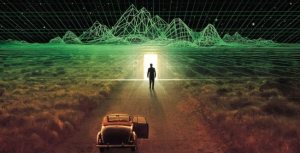 (Laughs) Not entirely. It’s also the sort of thing that is, in many ways, unfalsifiable. One thing that struck me, and I hadn’t considered it until I started talking to these people and working on the film, is that in many ways it comes down to an idea of faith. It’s almost a religious question. I suppose at a certain point science could prove or disprove it though once physicists start talking about it, I lose my ability to understand pretty quickly, as they’re describing Planck’s constant or quantum physics. If they were able to prove or debunk it categorically, that would change a lot of things but I think that’s the same as a lot of paranormal topics.
It’s certainly the case with religion isn’t it? Without faith, religion is nothing. Had you got an idea in your mind how you were going to structure the final piece when you were doing the interviews? Or did you get the interviews and then go right, this is this huge jigsaw that I’ve got, how am I going to present it?
 I started being naïve enough to think that I knew what the film was going to be and how it was going to come together. I had expected that it would be the story of say, six people, who all believed that we were living in the Matrix and that intercutting the moments where they first became convinced about it and how it changed their lives would be a fairly straightforward checkerboard. I had read a lot of stories particularly on Reddit boards of people who’ve experienced bizarre coincidences and seemingly impossible misadventures that made me think I was doing something that would be a non fiction Twilight Zone. But it very quickly morphed into something hopelessly complicated.
Rachel Tejada, my co-editor, and I worked for a long time building up scene upon scene upon scene as little three minute sketches, trying to find the way to sequence them. It looked like any of those images of a mad conspiracy theorist with thousands of newspaper clippings and threads connecting them all. I was living that nightmare for maybe six months, to find this structure.
Did you have a Eureka moment with it then in terms of how you were going to do it or was it one of those, almost subconscious realisations?
 Well, it was all about shuffling the scenes together. Each little three minute thought sequence would get a different colour Post-it Note and then we would arrange those into chapters, and those chapters into the entire thing. Along the way we’d often have to lose scenes that I very much loved but got in the way of the larger story or shifted the focus in the wrong way.
It’s the kind of thing where, because this movie is so re-enactment heavy, so animation heavy, you make it twice. We do the interviews and we cut it together in rough form and then we go to the trouble of actually animating all of those sequences – and of course as you do that, things continue to change as you do it. The filmmaker Lucy Walker had a great quote that editing a non fiction film, editing a documentary, is less like editing a scripted film than it is like writing one.
Did you get to the point where you animated sequences that still haven’t made the final cut or bearing in mind presumably there was quite a cost involved, you only did what had to be done?
 I think there’s probably less than two minutes of animation that was created that’s not in the film. The cement was mostly hardened by the time animation started to happen because that’s such an expensive and complicated process and it was a fairly small team with the principals of Syd Garon, Lorenzo Fonda and Davy Force, but my gosh, they moved mountains. If this movie was made 20 years ago, it would have been a $20 million production! There’s no way we could have done something that looks like this on an indie doc budget.
Even three years ago, a lot of the animation, especially the stuff that Lorenzo was doing with the avatars speaking on the Skype calls and even in their sequences, a lot of that animation was done with motion capture. You put on that scuba suit like they do for Lord of the Rings and act it out with gestures. It was only this past year or two where that technology was available on a indie doc budget, where one guy can have the suit and plus it into a laptop and do it in his apartment.
With using the avatars and everything like that, obviously the animation is presenting a new version of what’s being said.
It’s a simulation, you might say! (laughs)
Well exactly. Presumably the animations and simulations are as close to how the original talking head was acting as possible, but presumably you could do exactly the reverse? You could have an animation that’s reacting against what’s being said.
True.
How did you get the tone of the particular avatars and animation that you were using?
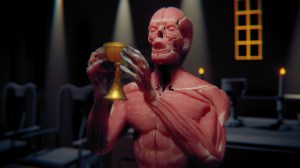 That was largely due to Lorenzo’s work. He was so good at doing those expressions of both honouring the original interviews but also adding layers to what people are saying, being really expressive in how he talks.
You’re talking about the danger of it not representing the meaning or the tone of what people say and that’s a danger in any documentary, how accurate you are to these people’s original stories.
One thing I try to do is be very upfront about my manipulations. You’ll notice that even within the avatar interviews, there are jump cuts from when I had to edit their conversation, whether I was just removing an ‘um’ or ‘like’ or a longer digression to get back to the original point.
It’s much more trouble to put the jump cuts into the animation, instead of making it look like it’s all smooth but I thought it was kind of funny but also an important way of addressing the fact that as hard as I’m trying to reflect the intent of what people said, there’s a fair amount of manipulation goes into any of these things. So, take that under advisement.
In my side of things we’d put an ellipsis in to indicate that we’re jumping, even if it’s taking out a swear word. You’re doing the visual equivalent of that.
Exactly. I always figure that being upfront about the artifice is a way of being more honest.
 You’ve got the clips of Elon Musk, Philip. K Dick and various people; did you have problems finding the clips that you wanted or was it more that you had far more of that sort of thing than you could deal with?
Oh, far more. I had a gigantic hard drive full of possible things to dip into now and again. There is more on this topic out there than you would imagine.
Is it the sort of thing that you could revisit or do you feel that you’ve visited it as far as you’re comfortable with?
I don’t know that I see a follow-up up here, maybe a short one.
One thing that happened, we finished filming largely before the pandemic but then while we’ve been in the midst of it, more than one person has mentioned that the pandemic has changed their thinking about the subject.
I did a round of follow ups with most of the principal people to see how it had affected their thinking and there were some interesting things there. I don’t know that there’s a feature but there could be a half hour return.
A Blu-ray extra, maybe
Yes. If it wasn’t so much trouble to animate them all, it would be a great half hour follow up.
With the interviews, what was the thing that you found most surprising that you were told or found out?
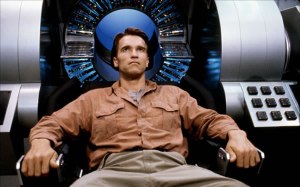 Again, it was how quickly this idea which I always thought was more or less scientific turned to not just a matter of faith and religion and religious metaphors, when we’re talking about inhabiting the avatars of Minecraft characters, but also to ideas of ethics. When you start talking about the world being a simulation, for me, the first fork in the road is what that means about the other people in the world, whether they are all, say like in The Matrix, if everyone like you is the avatar of a real person in a pod someplace, or if everybody is a shadowy A.I computer creation, and how to navigate that question and what that means about your relationship to other people.
I think almost everyone I spoke to had thought long and hard about what this meant about your daily interactions with other human beings. I didn’t necessarily go into this thinking, this was going to have so much about morality and ethics in the course of it but it ended up being inescapable.
Something that intrigued me, which I only learned quite recently, is that some people don’t have an internal monologue and a couple of very creative writer friends of mine don’t and they’re always amazed when people do. I just wondered if there’s any connection with people who do or don’t with people who sense a simulation.
That wasn’t a question I thought to ask but it certainly provokes questions. Whenever you talk about other people’s experiences, or you’re trying to model other people’s behaviours or thoughts, that’s always the big question, right? Is everybody like me or am I some strange exception? And how difficult a question that is to answer.
What was the biggest challenge you had to overcome with making this documentary?
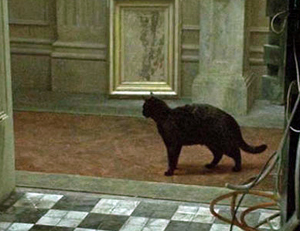 You were hitting upon it earlier on. It was to make one sensible path or story out of many hours and hours of people telling stories and reflecting on a metaphysical idea, to try to beat it into the shape of a story or at least one coherent production.
That’s also the fun, the challenge. What’s satisfying is when you can move both from the detail of a particular shot, scene, moment, visual, zoom in and back out to see a path that makes sense and is satisfying.
A Glitch in the Matrix has been released by Dogwoof on VOD platforms and Dogwoof On Demand https://watch.dogwoof.com followed by aDVD released on 4 May 2021.
 Doctor Who News Star Trek News
 Sci-Fi Bulletin: Exploring the Universes of SF, Fantasy, Horror and Spy-fi!