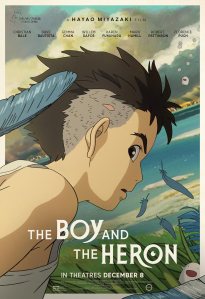
 Starring: Soma Santoki, Masaki Suda, Aimyon, Yoshino Kimura, Shōhei Hino, Ko Shibasaki, Takuya Kimura (original); Christian Bale, Dave Bautista, Gemma Chan, Willem Dafoe, Karen Fukuhara, Mark Hamill, Robert Pattinson, Florence Pugh and Luca Padovan (English dub)
Written and directed by Hayao Miyazaki
Studio Ghibli, out now
Mahito Maki loses his mother in a hospital fire, and finds an unlikely companion…
I couldn’t talk about this film when I came out because each time I tried I burst into tears. Make no mistake – this film is a masterpiece but like many true works of art it is not necessarily easily understood or even going to work for everyone.
It worked for me and I think I can articulate the exact reasons. This is a film that could only be made by someone at the end of a long life and, in many ways, the messages layered into this narrative are those that concern legacy and loss and grief and hope.
There are many films out there about grief but nearly all of them are about those left behind, not those going beyond and the grief they face. The Boy and the Heron is about grief from all angles – the grief of the boy Mahito, the processing of this by his father, the rebuilding after the loss but, rising above all this, it is about the end of the world for Mahito’s grand-Uncle.
This is a film that’s concerned with how we leave the world behind, with the truth that the world doesn’t see us at all, that it doesn’t realise we’re leaving and that, no matter what we build, it will in the end crumble away. It’s about the realisation that this is the truth of our experience, that this is the end for all of us.
Do we see that truth and struggle to ensure the next generation takes up what we’ve laboured for or so we send them out into the world to ‘build their own world free of malice’? The film has two answers to this question and leaves us, the audience, to ponder where we land for ourselves.
it is, undoubtedly, about building and rebuilding, about the different stages of our lives. If a man’s life is a stool with three legs – birth, life and death – then The Boy and the Heron tackles each of those stages and asks us if we are the kind of people who will build our worlds without malice? Beyond this it asks us whether we will accept our exit without trying to make other people take on what we believe is valuable and essential.
I’ve said all the above without talking about the story and that’s partly because explaining the story is almost impossible. Ostensibly it’s about a young boy who loses his mother during the fire bombing of Tokyo during World War II. She dies in a fire and he never sees her body – there is no funeral in which he can mourn and, a year later, what remains of his family moves to the countryside where his father had made a new love match and he’s to live out the rest of the war.
Except Mahito has not recovered from the loss of his mother and doesn’t, quite, know what he’s supposed to do with himself.
It soon becomes apparent that there are strange goings on at the new home and Mahito discovers that his mother may not be dead but rather in need of his help. it features talking Herons, parakeet armies, angry stone, wateru wateru and all kinds of other wonders who together paint a story about the strange and oblique ways in which grief becomes the lens through which we see the world until, suddenly, it no longer is.
As a father whose children are on the precipice of leaving me behind, the sense that at some point (and soon) I will have given them what I can and they will be gone hits me during this film like a ten ton truck. I love them and worry for them and am proud of them and will miss them. The idea that they will live lives I cannot see or be a part of, that they will build their own towers is central to this film – the grief of losing that shared life but the wonder that they will build their own lives. Humbling and terrifying and aw(e)ful all at the same time. There will come a line beyond which I will see no more of their choices and those of the people who come after them and it fills me with the greatest sadness and I can feel the director, Miyazaki, looking over both his and my shoulder and nodding his understanding of what it means to reach this stage and know there will be a moment where we go no further.
There is joy in this film but there is little nostalgia, little cosyness and precious little triumphalism. In that it will alienate audiences who have grown used to comfort food that tells them the myth that everything will work out in the end, as if we might never die, as if we might see all things and be a part of them too.
Miyazaki tells a story here with a clear eye on his and our own exit and asks this question: will you let those who come after you choose their own path? Can you accept that whatever you build it will crumble and be forgotten in the end?
He’s not trying to judge – it is elegiac and this truly comes through in the framing of the animation and the glorious score that never lets us wallow in sorrow and loss but holds a fine line of tension between joy, hope and departure.
I think all this means that it’s a work of art with a specific message – it’s not broad but it is extremely layered and thoughtful. I think this means it will find its true status as a classic only later, in the future because I can see how many, especially those who’ve not yet had to contemplate these concepts, will emerge from watching it without a sense of what the film was about.
Verdict: It’s wondrous but it’s not a film that tells its story in a straight line and I can see that children will go to see it with parents and neither will really pick up on what it’s trying to do. I don’t regard this as a problem in any way. I only hope as many people reading this as possible come out of the film with as much of a world turned upside down for them as I did.
Stewart Hotston




 Sci-Fi Bulletin: Exploring the Universes of SF, Fantasy, Horror and Spy-fi!