Review: Doctor Who: Books: The Black Archive 23: The Curse of Fenric
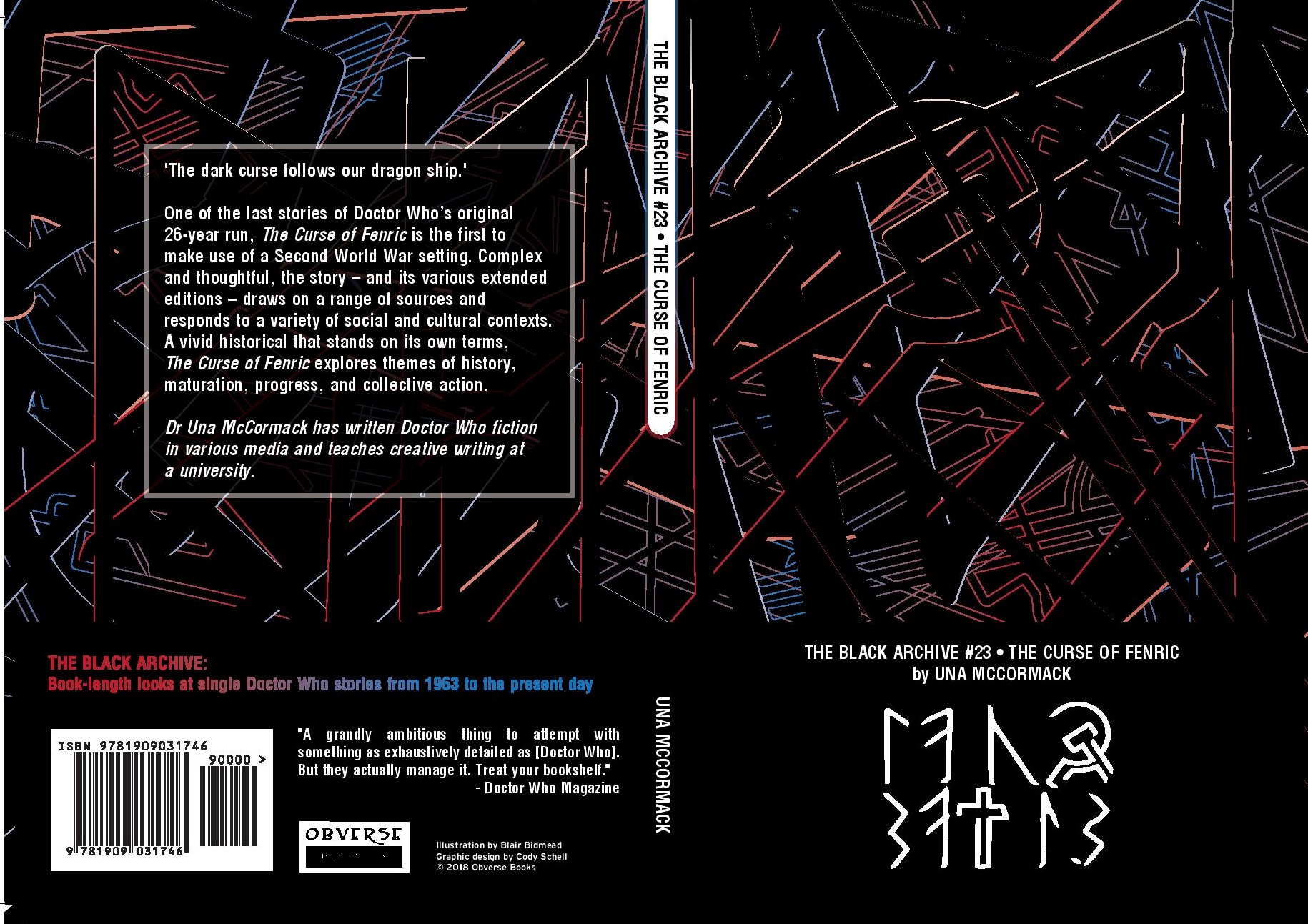
By Una McCormack Obverse Books, out now The Seventh Doctor’s battle with Fenric is analysed through a political lens. Doctor Who has often been at its best when it reflects […]



By Una McCormack Obverse Books, out now The Seventh Doctor’s battle with Fenric is analysed through a political lens. Doctor Who has often been at its best when it reflects […]
 By Una McCormack
Obverse Books, out now
The Seventh Doctor’s battle with Fenric is analysed through a political lens.
Doctor Who has often been at its best when it reflects the cultural and political moment in which it is produced – that was the underlying premise of my own history of the show, Timeless Adventures. It is also the approach taken by author Una McCormack to the story her entry in the Black Archive series of studies is devoted to, the much-acclaimed 1989 tale The Curse of Fenric. That much is clear when in the introduction she points out the fact that Episode 3 (with one of the original series best ever cliffhangers) aired the day before the Berlin Wall was breached and Francis Fukuyama notoriously declared it to be ‘the end of history’ (an argument McCormack calls – from a 2018 perspective – ‘woefully naïve’).
This is McCormack’s favourite story, and she uses it (in its various forms and media) to look at both the history of the show itself and the historical moment (and all that flowed from it) in which it was first broadcast. It’s an interesting approach, going beyond the merely textual to bring in the larger world of cultural and political influence and effect.
One of the reasons McCormack loves this particular story is due to the psychological depths afforded the then-current companion, Sophie Aldred’s Ace. This had been part of a project initiated by script editor Andrew Cartmel to position Ace and her development at the centre of the series, much as Russell T Davies would later do with Billie Piper’s Rose in the modern relaunch of the show (this is very different to Steven Moffat’s penchant for ‘impossible girls’ and people as puzzles that need solving, his default approach to companions). There is much in the final seasons of the original run of Doctor Who that informed the 21st century revamp, when a new emotional intelligence rarely seen in the show in the past (although glimpsed occasionally) became the central focus.
The Curse of Fenric can also be viewed as a locus point in what McCormack calls ‘transmedia storytelling’, something that Doctor Who pioneered. As she notes the essentially ‘unstable text’ of the unfinished story is ‘enlarged and expanded by ancillary material’, including the novelisation, various ‘making of’ accounts, and the variant edits of the transmitted version, the VHS release, and the DVD ‘movie’ cut.
The author also discusses Cartmel’s self-declared war on Thatcherism (through the programme) and that political ideology’s impact on the BBC itself; compares Fenric – the only screen story in the original run set during the Second World War – with the modern series episodes that take place in the same period (‘Doctor Who in an Exciting Adventure With Nazis’), an odd lacuna given how many other BBC programmes of the time explored the war; and examines the character of Ace in comparison with other female characters in science fiction at the time. She concludes with a look at the increasingly mythic stature of McCoy’s manipulative Doctor, positioning his conflict with Fenric as part of a never-ending battle across time and space, one that continues to this day.
Verdict: Like all the Black Archive volumes, it’s a swift read, but a notably thoughtful one, 9/10
Brian J. Robb
 Doctor Who News Star Trek News
 Sci-Fi Bulletin: Exploring the Universes of SF, Fantasy, Horror and Spy-fi!