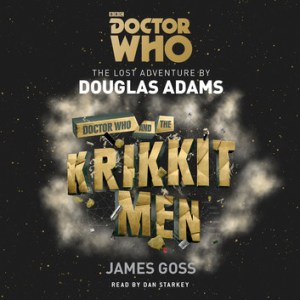
 by Douglas Adams and James Goss
Read by Dan Starkey
In which catastrophic events at Lord’s Cricket Ground signal the impending end of life, the universe, and everything…
Since Nick Joy has already done a sterling review of this book’s physical edition, I’ll do my best to restrict this review to notable aspects of the audiobook itself. Firstly, this incarnation lacks the introductory essay by Douglas Adams and the appendices by James Goss which chronicle the novel’s convoluted genesis. Sad but understandable deletions, these absences could be considered added incentive to purchase/download the full text itself. ***
Initially, Dan Starkey seems like an odd choice for narrator – previous recent Adams novelizations have been handled by Lalla Ward or Tom Baker soundalike Jon Culshaw – but Starkey’s voice work for Big Finish has shown he’s capable of far more than Strax the Sontaran. He gives a winning rendition of the Fourth Doctor here, emulating Baker’s rich, brown timbre without ever dropping into pastiche. The velvety tones boom insouciantly in marked contrast to Starkey’s calmer, quieter Romana and his clipped, pompous K-9. He voices other guest characters of all genders (including a certain controversial Prime Minister) with aplomb; these include outraged cricket officials; bloodthirsty Elders and uncertain rebels of Krikkit; squidgy aliens; wheedling Time Lords; and a cosmos-weary supercomputer named Hactar (sound familiar?). And special mention should be made of how Starkey conjures a perfect combination of unctuousness and relentlessness for two characters that pop up in a second-act subplot which would’ve left Mary Whitehouse apoplectic (and most everyone else convulsed with laughter).
Yes, Doctor Who and the Krikkitmen flags and meanders at times, but this is no way due to Starkey or his narration; it’s a natural consequence of taking so many disparate elements and diverse drafts of the material and unifying them into a whole that’s honestly more cohesive than it has any right to be. Like most of Season 17, it’s hugely witty, overflows with staggering concepts, and abounds with character moments that teeter on the fine line between profoundness and sophomoric silliness that raised so many humourless hackles back in the day.
Verdict: A rollicking return to the excesses of teatime 1979, with James Goss successfully channeling Douglas Adams’ many strengths and deficiencies in equal measure. 9/10
John S. Hall
*** Editor’s note: The appendices are included on the discs in pdf form.




 Sci-Fi Bulletin: Exploring the Universes of SF, Fantasy, Horror and Spy-fi!