Feature: Bigger on the Inside
Stephen Baxter’s latest novel Xeelee: Redemption is out from Gollancz now, and here the veteran SF author talks about the scientific realities behind the Big Dumb Object at the heart […]



Stephen Baxter’s latest novel Xeelee: Redemption is out from Gollancz now, and here the veteran SF author talks about the scientific realities behind the Big Dumb Object at the heart […]
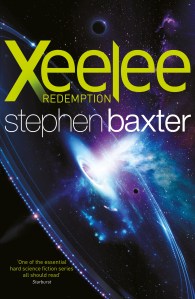 Stephen Baxter’s latest novel Xeelee: Redemption is out from Gollancz now, and here the veteran SF author talks about the scientific realities behind the Big Dumb Object at the heart of the story…
Redemption features a Big Dumb Object, as giant engineering artefacts are fondly known in SF – and it’s not my first BDO, not the first in the Xeelee universe, and not even the biggest in that universe. But it has one unique feature: it illustrates the only way I can think of to build an object that, like the TARDIS of Doctor Who, is bigger on the inside than the outside.
Like many Who fans, as a kid watching the show – and, confession time, I’m old enough to remember Hartnell and Troughton – I think I was more entranced by the inner bigness of the TARDIS than its time-travelling capabilities. A thing the size of a wardrobe through which you could access what looked like a roomy cruise liner – it was like a scientific Narnia. Except that in the show there wasn’t much actual science justification for the inner bigness save for vague talk of dimensions of space and time.
Which is why I was fairly electrified when, as a swotty teenager trying to figure out Einstein’s relativity when I should have been revising for my physics A-level, I thought I could see a glimmer of a way to build my own TARDIS.
Despite common conceptions, Einstein’s work can be surprisingly accessible, if taught well – as I tried to do later as a maths teacher myself – even, in fact, Einstein’s own writings. He seems to me to have had more of a visual imagination than a mathematical one – he had to train himself up on advanced math to handle general relativity – and some of his insights came from dreamlike visions rather than mathematical logic. What if, he wondered, you could travel on a light beam? How would the universe look to you?
The key insight in special relativity is that all observers, no matter how they are travelling, if they measure the speed of a given photon of light – so long as they aren’t accelerating in that direction – have to come out with the same answer. That’s because lightspeed is a number embedded in the laws of physics, and physics itself doesn’t change just because you take a walk. Try to overtake a photon and it will recede from you just as fast as when you stood still.
And for that to happen, Einstein saw (dreaming of clocks and flashlights on moving trains and so forth), your measuring equipment has to adjust. You measure speed with a ruler and a clock; if you are moving past me, said Einstein, your rulers look shorter, your clocks seem to run slower – but always in such a way that measuring lightspeed comes out with the same answer. For example if you are moving at around ninety per cent of lightspeed compared to me, your rulers shrink by a factor of two.
(And that’s how, in Redemption, Michael Poole travels to the centre of the Galaxy in an outside time of around twenty-five thousand years, but a subjective time of only a few decades.)
 Now, my big artefact is a kind of giant ringworld, a wheel spinning very fast – close to lightspeed. So what happens with the clocks and measuring rods then? It’s a good question, and Einstein used spinning rings and discs as a thought experiment to help him figure out relativity in the first place. (This is the so-called ‘Ehrenfest Paradox’, and if you don’t like the logic below – and plenty don’t, which is why it is still called a paradox! – follow it up through for example G. Rizzi et al., Relativity in Rotating Frames (Kluwer, 2004), or follow the Google trail.)
Suppose the diameter of your ringworld is a couple of kilometres. The circumference is pi times the diameter, or just over six kilometres – as you see it from outside. And if you put a surveyor with a measuring rod a metre long, say, down on the wheel, and they paced out that circumference, they would measure that value of six kilometres and a bit, just by laying down that rod over and over.
But suppose the wheel is spinning at ninety per cent lightspeed. Look down on the wheel from above. At any instant the surveyor moves past you at that huge speed, so you observe their measuring rod as half its stationary length. But from your point of view the surveyor has to plod around that distance of what is still, evidently, six kilometres and a bit, as you can see. So they, with a rod apparently shrunken by half in the direction of motion, would measure twice that distance. You could watch them do it!
The paradox is experienced by the surveyor. If they tried to estimate pi on their spinning home, by dividing measured circumference by measured diameter, they would get the wrong answer. Einstein saw this clearly. Our surveyor down on the wheel is in a spacetime distorted by the wheel’s motion. They can measure that distortion, directly. Just by counting the number of times they lay down that measuring stick.
Such an object would be tricky to build, by the way. If you put together the wheel, made it just long enough to close the six-kilometres-circumference loop, and then spun it up, the fabric would stretch, crack, snap, as space distorted. Conversely, once built, if somehow the wheel slowed down, it could crumple, fold up. Not enough space to fit in its length. Einstein thought of that, in fact. He said that you’d have to build a spinning object of some kind of liquid – mercury, maybe – that would flow to fill the space as it distorts.
And that, as I tried to figure back at school, is one way you can have an object which is bigger on the inside – that is, bigger for its occupants than the space it occupies as seen by outside observers. Granted this is a long way from a luxuriously appointed TARDIS, which of course is not visibly spinning at lightspeed – but as long as the principle isn’t ruled out by the laws of physics, the rest is just detail, to be left for the engineers of Gallifrey.
Xeelee Redemption is out now from Gollancz; click here to order from Amazon.co.uk
 Doctor Who News Star Trek News
 Sci-Fi Bulletin: Exploring the Universes of SF, Fantasy, Horror and Spy-fi!