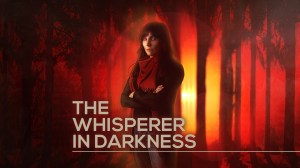
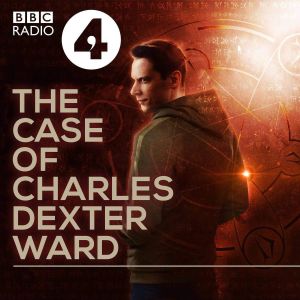
 The Whisperer in Darkness continues the investigations of Matthew Heawood and Kennedy Fisher following their debut in last year’s The Case of Charles Dexter Ward. This time they’re looking into the disappearance of Henry Akeley who lived near Rendlesham Forest – the site of a famous UFO encounter nearly forty years ago. The podcast series, commissioned by BBC Radio 4 from Sweet Talk Productions, heads into arcane territory and Paul Simpson caught up with its creator, Julian Simpson midway through the episodes’ release…
NB There are spoilers in here for both The Case of Charles Dexter Ward and The Whisperer in Darkness
We were going to chat last year about Mythos but things never came together…
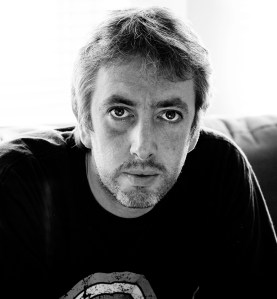 Well you’re going to be rewarded because in the middle batch of uploads, you’re going to start to see some Mythos tie-ins. The Whisperer in Darkness is kind of a second act. I did a radio play called Fugue State which is getting referenced in this, one called Bad Memories which is getting referenced, and Mythos is getting referenced in a big way. We’re tying the worlds together.
It’s only there for people like you who are going to spot it – it’s not required listening to understand what’s happening in The Whisperer in Darkness by any means, but because we throw in a lot of supposedly factual stuff, I’ve dropped in events from Fugue State and Bad Memories as other supposedly factual things. If you’ve listened to those you’ll know they’re made up but it all sounds alright.
I noticed that in episode 2 with the Rendlesham Forest incident – something I covered in my conspiracy theory book, That’s What They Want You to Think, about a decade ago. I walked the trail in the forest to be able to communicate the sense of it in the text.
 I did it in the summer. Originally we had planned to record up there as well – we record all our stuff on location – but I think we dodged a bullet. I was really pushing but it’s a difficult place to get access to because it’s a public transport nightmare. The budget wouldn’t really stretch to it.
I went up there about a week before we did record to go over everything again and be in all the places – and there was building work, which would have totally destroyed it if we’d tried to [record there]. The church that I had in mind for Wilmarth’s church – it’s right near Rendlesham Forest, and the UFO trail, a beautiful old thatched-roof church. It was amazing when I first saw it. When I went back there, it was covered in scaffolding because they were reroofing the whole thing. It would have been terrible.
The mix of the reality of the incident and your own mythos for this added to it worked well. Did you know about the Rendlesham Forest Incident before working on this?
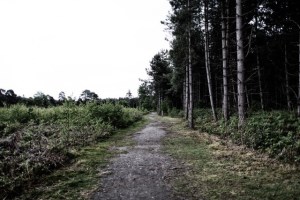 Yes. I had written an episode of New Tricks, the first one I ever did, and they wanted something different, so I said I wanted to do a UFO thing. I did some reading on Rendlesham Forest prior to that, so I based that New Tricks episode on Rendlesham Forest – US Air Force witnesses but not named [as such]. So yes, I did know about it.
When I landed on The Whisperer in Darkness as the next Lovecraft story to do after Charles Dexter Ward and re-read it, I thought, “Henry Akeley lives in a forest and strange alien creatures are attacking… this is Rendlesham.”
Then I started looking around on Ordnance Survey maps at that area of Suffolk and saw it’s only a few miles down from Dunwich which gave its name to The Dunwich Horror. You start to realise Lovecraft gained a lot of the names for his mythical New England area out of our south east coast, via Arthur Machin etc. There is a big tie in here.
Even weirder than that, [add in] the notion that there are all those mermaid myths around the area of Rendlesham, Orford and Woodbridge that go back to the Middle Ages, and it starts to really feel like Lovecraft country. A really great tie in…
And then you throw in a numbers station.
Always throw in a numbers station! A numbers station can get you out of all sorts of problems. They can basically be anything. The Conet Project, which collects all those things, I’ve got their CDs [of recordings of numbers stations]. You sit and listen to them and they are just spooky. With no context whatsoever they’re just spooky.
Some real audio recordings people would say are unbelievable if you put them in a play as fiction…
 Yes – with the Rendlesham Incident, as you’ll have noticed, the Holt recording we’re using is the real one. I was always nervous as to how that would mesh in, and then also worried that people wouldn’t realise that it was real – we’re already making stuff up so why would that be a real thing? We can’t within the context of the podcast flag it as being real because we’re pretending everything is real. We can’t say, “this is a genuine recording” because they’re all meant to be genuine recordings, so you just have to hope. I’ve had a few people say that was really well done, the acting on that US Air Force recording was really good. Damn… it’s the real thing and no one knows.
Did you have any issues getting the rights to use it?
You’re asking the wrong person because it wasn’t my job, but I don’t believe so.
Presumably they’d have told you that you couldn’t have it if that was the case…
(laughs) Exactly. No one told me that. I basically flagged it really early. “I want to use the Holt recording, here it is, this is the transcript of the bits that I want to use, and if we can’t clear it, I’m not faking it so I will change the story to dodge around it rather than fake it up with actors. If we can’t use the real thing, then I won’t use it.” Karen [Rose], our producer, came back and said we could. That was brilliant because it meant there was a whole chunk of episode 2 I didn’t have to write or record. We have edited it – it doesn’t play out exactly. It’s all the bits in the same order but we’ve cut out a lot of silences.
Stepping back, where did the idea of the whole Lovecraft serial podcast come from?
 I have a big interest in Lovecraft stories and the kind of places that they’ve led through the genre – Stephen King, Joe Hill, Guillermo del Toro – and I knew I wanted to do something in that world.
I don’t know if you know the Dark Adventure Radio Theatre, part of the HP Lovecraft Historical Society – they do amazing audio versions of Lovecraft stories that are super faithful, and done in a really great pulpy 1930s style. There’s no point in aping that because they do it so well, and what’s the point in retreading that ground? Then Serial came out and I thought: most Lovecraft stories are investigations, so you could do a modern day fake Serial thing with a story. What you need is a hook that has the same hook as Serial or any true crime podcast – here’s a mystery [to solve]. Ideally you want a locked room mystery, you want “how did this person vanish or get killed?” I started flicking through [Lovecraft stories] and realised, “Oh it’s Charles Dexter Ward. It gives us that [hook] – this guy disappears” and instantly that’s your platform.
A lot of Lovecraft’s The Whisperer in Darkness is based around an exchange of letters between the narrator and Akeley, so it’s easy to go, “we’ll do Akeley as audio”. He’s recording his experience and they’ve found the tapes. It really lends itself to podcasting and serialisation.
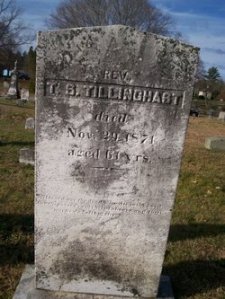 Once I got into the flow of Charles Dexter Ward and started writing that, and started to riff around bits of folklore and other conspiracy theories, a whole bunch of stuff fell into place that was fascinating. In the first series one of the bad guys is called Godfrey Tillinghast and that was a name that just kept cropping up while I was doing historical research. It’s a great name and there were Tillinghasts in Rhode Island and Tillinghasts in England – I don’t know if it is the same family but they crop up all through history. I just like the name.
By the time I got to Whisperer in Darkness, there’s a scene where Heawood goes to the London Library and has been told to look up an article from The Times. The article he reads out is real – and I found it because I was on the London Library website and I did a Google Search of their newspaper archive for the name Tillinghast just to see what happened. I found a coaching accident by Niagara Falls that involved someone called Tillinghast who was one of the guys who started up Providence, Rhode Island, and a woman called Mrs Fisher. They were in this carriage together in Niagara Falls in 1869 and they were the only survivors where a bunch of people died.
A lot of things slotted in like that, and throughout Charles Dexter Ward and The Whisperer in Darkness, the research let itself be joined up. You start with the Rendlesham Incident in The Whisperer in Darkness because that makes sense with Henry Akeley’s situation and you look across the map, and Orford Ness is right there. That’s where they invented radar, that’s where my numbers station is coming from. Up the coast is Dunwich and Dunwich was largely destroyed by storms in the 12- and 1300s, so you go, “How does that work? Why did that happen?” And there’s all this mythology that ties into Lovecraft.
It almost gets to the point where you’re midway through these series as a writer that it starts to feel like it’s writing itself – you’ve got all these loose ends and they start tying themselves up, which is a very strange feeling and quite rewarding.
Somewhere between serendipity and automatic writing!
 It kind of is! That’s what happened with Charles Dexter Ward.
Even leading in from the end of Charles Dexter Ward into The Whisperer in Darkness: whether Kennedy’s coming back, how she’s coming back, that felt like the biggest problem I was going to have – what to do about that cliffhanger ending at the end of the first series. I fixed it in a way that was intended to be temporary – “oh she got hit by a scooter, she’s been in hospital and missed everything that happened. We’ll just carry on and then I can go back and fix that later, once I’ve got the script set up, and make that a real thing.”
What happened was I kept her being hit by a scooter because it turns out that that thread goes through this series and becomes a major factor and a much more interesting idea than if I had just covered what happened to her at the start of the series.
Not having heard the first series when I heard that, I found it interesting – was it the equivalent of ‘with one bound she was free’? I thought, “no there’s got to be more to it than that.”
If I was listening to this cold, I would be on the edge there – “if this is going to pay off then I’m interested. If they honestly think this is the way, the old Flash Gordon cliffhanger where he wasn’t falling into the volcano after all, then that’s a terrible cheat and I’ve wasted my time.” No one’s wasted their time – it’s fine. But I like the idea you could go, “this is the world’s cheapest way out of a problem.”
There’s a very strong cast for this as you have for all your plays – and you’ve got quite a large repertory company effectively. Are you now writing the parts knowing you’re going to have Jana Carpenter, Nicola Walker or whoever, and Tim McInerny’s up your sleeve…
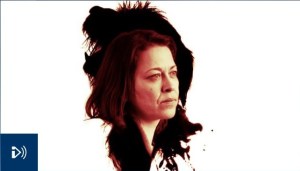 Yes. It’s an interesting thing doing audio because it’s not a particularly well paid gig for an actor. Most actors are used to saying they’ll do a radio play and pop into the studio for an hour. We don’t do that, we say, “you’ve got to come away for a week to Brighton or wherever, live in a house, record every day and it’ll be a week”. For a lot of people, they either don’t get it or it doesn’t fit their schedule.
We’ve built up this rep company and I love that they don’t need to read scripts, which is a joy – we say, “we’re doing another one, who’s in?” Everyone just says yes without having seen it. We do have the same people coming back over and over again – we gather new people each time too. There’s an actor called Ben Crowe who did bits and pieces in Mythos and Charles Dexter Ward, and I wrote the character of Ben for him, the guy in the club who’s the defence expert. I write with Nicola Walker in mind. Obviously with Jana and Barney [Kay – playing Kennedy and Matthew] that’s set for this. There are a few actors where I always want them – Steven Mackintosh wasn’t available this time to do the week but he recorded something. We figured a way for him to do a smaller part but a good part. It’s really nice to have a rep company and not start from scratch with your casting.
What’s been the biggest challenge of writing this as a sequel? Take time and money as a given!
 It was a challenge that I don’t know and may never know if it paid off or not. I didn’t finish the story in Charles Dexter Ward, but I did finish it in a slightly Lovecraftian fashion. You kind of knew what was going on, everyone went a bit mad at the end but no one was caught or put behind bars. No one could stamp this thing “solved”, but they figured it out.
That led into The Whisperer in Darkness and I knew from the get-go that I didn’t want to end the story at the end of this series. “There we are, there’s the bad guy in jail, done.” These stories are more esoteric than that. You never get justice in an HP Lovecraft story – all you get is a glimpse of the awful horror of the world and then you go mad.
So the challenge was how to keep that going. The thing I had to hold my nerve for in this series was I didn’t end the story. It’s very much the second act, and in keeping with the notion of UFO encounters and abductions I didn’t want what had happened to be very clear.
There is an encounter in the last episode of The Whisperer in Darkness. I know what happened. It’s recorded via Kennedy Fisher’s phone and the audio is deliberately not that clear and there’s no explanation of what happens. They’re left basically going “what the hell just happened?” Which feels correct to me for every UFO abduction story you’ve ever heard and also for Lovecraft.
But [my challenge was] to hold my nerve and go, “I know at the end of episode 8 of this show there’s going to be a lot of people going, ‘oh no I’ve been cheated, that didn’t finish’.” I think that’s how it should be and it will go hopefully into season 3 and we will do something of a wrap up at the end of season 3.
It felt like what it needs to be. I can’t solve the mystery, find anyone who’s missing. These things happen in the Lovecraft universe and specifically when you’re melding it with UFO encounters, there’s just got to be a degree of confusion.
You have to have the ‘seen through a glass darkly’ element.
Precisely. That was the biggest challenge – not to wrap it all up with a bow knowing that that would make people happier, but to stay true to what we’re trying to do, and getting the story right.
Did the cast ask what was going on?
It was probably clearer on the page than it will be in the audio because the cast need to know they’re running from here to there, so it’s a little bit more explicit for them. It’s really Jana and Barney who were involved and they don’t mind that lack of definition partly because it plays into what they’re doing. Matthew and Kennedy’s narration, their summing up at the end is, “we don’t know what that was”. They have to play that and it’s even easier to play that if you don’t know!
 There were no problems in that sense – I guess they figured it was my funeral not theirs. “We’ll say the words – it’s your problem.”
You’ll end up doing a Philip Martin appearance as The Writer in the middle of the third series, a la Gangsters.
(laughs) I think it’s right. Don’t get me wrong – it’s not the most horribly oblique thing you’ve ever heard. It’s not difficult, it’s just per Lovecraft.
People listen to a series hoping for a resolution and I got this note on Charles Dexter Ward – “it didn’t wrap up”. It did wrap up; they didn’t catch the bad guy because that’s not how these stories work. They found out what was going on. All the way through season 2, they find out what is going on, there are reveals and there are twists, but what we don’t get to do is put handcuffs on anybody in the last episode.
The Case of Charles Dexter Ward and The Whisperer in Darkness are available on BBC Sounds; they are Sweet Talk productions for BBC Radio 4.
Thanks to Sean Harwood for his help in arranging this interview. Read our review of The Whisperer in Darkness here




 Sci-Fi Bulletin: Exploring the Universes of SF, Fantasy, Horror and Spy-fi!