Westworld: Interview: Jonathan Carlos
Jonathan Carlos was production designer on the final two episodes of Westworld’s third season, having worked as supervising art director on the earlier part of the year. With the show […]



Jonathan Carlos was production designer on the final two episodes of Westworld’s third season, having worked as supervising art director on the earlier part of the year. With the show […]
 Jonathan Carlos was production designer on the final two episodes of Westworld’s third season, having worked as supervising art director on the earlier part of the year. With the show now available on digital download (with a physical release following later this summer), Carlos chatted with Paul Simpson about the challenges and joys of the HBO series. NB SOME SPOILERS FOR SERIES 3
Another intriguing season of Westworld: it’s a show where I think if anybody says they know what’s coming they’re lying, unless they’re actually working on it and seeing all the scripts. What was the biggest challenge of those final two episodes?
The range of and variety of design that we’re tasked to create is always really a joy but it’s also a challenge. Our biggest enemy is always time, I would say, and then obviously budgetary restraint.
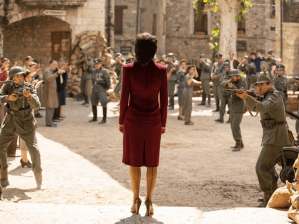
We were trying to design such a huge range over the course of the season. The different aesthetics range from futuristic brutalist architecture in the corporate campuses to the romantic European cityscapes, as well as technological bionics and art deco environment with detail. We’re also trying to do justice to the character development and bringing the arc to a close from the storytelling as well as from a design standpoint.
 As with anything in television things alter as you go along. Were there things that when you came to the end you went, “Oh I wish we did that slightly differently when we were doing 301 and 302?” Or were those decisions made early on enough in pre production that you didn’t hit that sort of snag?
I think it’s fair to say, with any artist, if you give somebody a week they will create something that they’re happy with but they’ll still see flaws or they’ll have things that they wish they’d done differently. You give that artist the same exact assignment and give him 100 weeks, they will still produce something that they love but that they still see flaws with. I think, just naturally, as an artist you’re always going to have things you wish you’d done differently but your perspective, looking back on something, is always relative to the present. That’s constantly a variable, so of course you’ll always have things to look back on.
We had discussions early on about how we wanted to use colour palette, how texture or architectural composition changed throughout the season based on storyline or character development. So things had a very sound foundation from the beginning that we established and stuck to.
That’s the same from season one to season two to season three – there’s overall design arcs that encapsulate all three seasons, as well as each episode, as well as scene by scene. So I think we have really strong foundations from the writers room and from the previous seasons that we build upon and I think we were very successful.
How much have the aesthetics changed over the seasons?
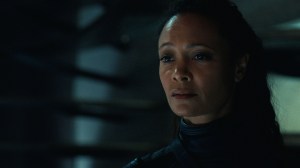 In the earlier seasons we established different colour palettes because in season one we were really only either in the park or within the underground corporation running the park. To establish the difference in world there, we had a more natural based colour palette when you’re in the park with browns and beiges and greens, but once you were into the labs or the Delos resort, the colour palettes were very restricted and muted. Specifically, any times it was Delos, the colour palettes were generally black, white, grey, red, very restricted.
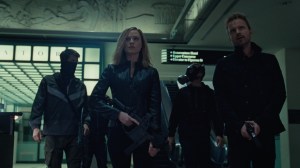
If you flash forward to season three there’s actually some similarities in that in the real world. There’s still a restricted colour palette in these futuristic cities, with the people dressed in clothing that’s also very restricted to dark blues, blacks, greys. same thing with a lot of the buildings. The lighting, the linear lighting was always very white. There was the introduction of greens and foliage and lushness on the buildings but overall there was a controlled colour palette. I think this shows the difference in the free will of each person living in the city being able to express themselves.
As we move through the season, there was more of a consciousness of one’s own freewill or lack thereof which is when we started introducing a bit more colour and explosions of colour. I think we did stay true to the rules from the early seasons and utilized them to our benefit to the storyline for season three.
So if you go back and look at the earlier episodes of season three now, you get some foreshadowing through the use of the palettes in terms of who and what the characters are.
Yeah I think so.
 In terms of the tech that we saw, were you working from what we have now and extrapolating forward or were you going, “Right, this is what it needs to do within the fiction therefore this is how we’ll make it?” Things like the drones I’m thinking of.
I think it’s a healthy combination of both. Jonathan Nolan and Lisa Joy are very adept with the current and the future development of technology and bionics – where we are now and where it’s going. They also have access to some pretty unbelievable resources and colleagues who are friends of theirs. There’s a lot of research that is done about the current movement in technical advances, a research and understanding of where we are today, where they’re moving toward. Then we kind of fill in the blanks of where that might be in 20 years. Luckily we’re in a day and an age where people are constantly evolving to the now and for the 20 years from now so there already is a road map of where it’s going.
Then like you said, it’s kind of transformed to fit the narrative and used in our storyline but it’s always based in a foundation of the possibility of the future. I think that’s why there’s such a relatability and a comforting nature for the viewer of how this could get to there because it seems feasible.
I’m of an age where I saw Blade Runner as a teenager in the cinema and was blown away by the tech that was created for 2019 Los Angeles then. Is there a concern about going almost too dystopian with some of the stuff and it’s going to go too downbeat or is it just given that with Delos, that’s just the way things are.
 Blade Runner has a really dear place in my heart as well and I think it’s a huge foundation for any futuristic sci fi property.
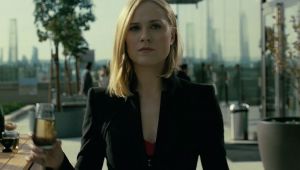
That being said there was a conscious decision to make sure that we did not follow a dystopian version of the future. Jonathan and Lisa wanted to create something that was more optimistic, so we did a Los Angeles that was reduced carbon dioxide emission and pollution, increased foliage and greenery on the elevated pedestrian walkways, reduced personally driven vehicles and an increase in automated electric vehicles. These are all things that would take down the pollution and smog that you usually see in Los Angeles. There was a more idyllic version of what the future could look like; people seem happier, people seem less crime driven, so there is a hope for where the future is going.
Now of course, we learn as the season goes on that the reason it is that way is because they’re controlling AI. We’ll see where this future goes from there now that that’s been destroyed, but there was a hope that we can change our ways as we are currently going in order to create something that is more normal and sustainable environment for us.
Are there things like the use of the foliage that people wouldn’t necessarily spot, things that you did to create the world that we wouldn’t notice unless we actually went and looked for them?
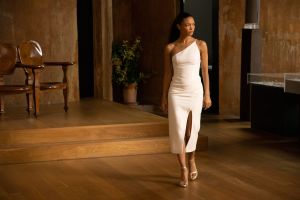 Absolutely. We are always littering the screen with very subconscious and subtle textures and colours, shapes and pieces of art. Early in the design process we discussed how to take one character and move them forward over the season or accompany our storyline and there’s a very conscious decision about the colours, the art, the sculptures, the decoration that infiltrate a set that work to shape that particular storyline or development.
I think it’s important that they aren’t right there and forward in your face. We wouldn’t be doing our job correctly if you noticed every single thing. It’s something that has to affect you subconsciously or subliminally.
A lot of thought goes into what works for the show for visual effects post production.
Is there one particular piece of design or the production that you are particularly proud of that you’ll look back on in 20 years and go, “That was Westworld for me”?
(laughs) I think any answer I give now will be different from what I say 20 years from now
Alright, if for some reason the show didn’t return what would be your answer?
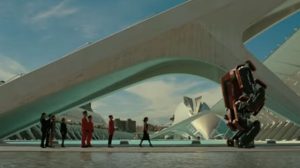 I’m particularly fond of the Delos corporate spaces, Hale’s office, the boardroom. Those stemmed from the design of Santiago Calatrava’s City of Arts and Sciences in Valencia Spain which we used for Delos campuses.
Santiago Calatrava is an unbelievable architect who has influenced me immensely and that particular campus is decades old and still, to us, resonates with a sense of futurism and bold architecture. It’s very vivid and to think that we could use something that is decades old to represent the future is a huge source of inspiration for me. Looking to that to build and design those interior spaces on a soundstage that complement the exterior location was a huge challenge and a huge joy. The concrete brutalism style of architecture always holds a strong place in my heart.
I think those in particular I look back on with fondness, in addition to the art deco hotel room in episode 3. I loved loved loved that set.
 Westworld III is available now on digital download across all major platforms.
Thanks to Jason Woodley at Premier Comms for assistance in arranging this interview.
 Doctor Who News Star Trek News
 Sci-Fi Bulletin: Exploring the Universes of SF, Fantasy, Horror and Spy-fi!