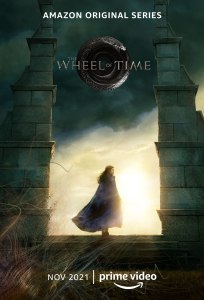
 The Wheel begins to turn…
Robert Jordan’s epic fourteen book series was originally supposed to be a trilogy. I remember talking to a sales person when I worked at Waterstones when book three came out and they were rolling their eyes and saying it was now going to be a six book series but no one knew if Robert had an ending in mind so who knew how long it might end up being.
That didn’t seem to matter because at the time the market was starved of these kinds of epic doorstopper fantasies in the vein of The Lord of the Rings. The Wheel of Time had deep lore, ridiculous histories, all kinds of repurposed races (trollocs and ogrin anyone?), magic, powerful women (more on that later) and a shadowy mishmash of Christianity and Daoism. In other words, it was a fantasy fan’s delight when it arrived in 1990.
Now, 8 years after the last book was finally published (completed by Brandon Sanderson after the late Jordan’s passing) Amazon bring the series to our screens. The list of those involved is obviously as long as the books but it’s worth noting that the entire mountain which is the adaptation was masterminded by Rafe Judkins and produced by David Brown. There are many screenwriters involved but I’d also note that Rosamund Pike is noted as a producer and the list of talent is pretty well balanced across gender and ethnicities.
Adding to that, the showrunners took a really simple decision to make our protagonists diverse. It’s a great decision as the communities they live in and encounter are equally diverse – giving us a sense right from the beginning that the world we’re encountering is one whose conflicts are based on something other than slavery and imperialism. This is a refreshing outlook.
Having said that, The Wheel of Time’s morality is a simple one – that there is a Dark One who needs defeating before they bring about the apocalypse. In that sense, it’s not going to get down into the weeds of the personal morality of war, although it does better on this front than it has any right to do in the very first episode.
The show itself was faced with the monumental task of how to introduce the world built by Jordan without it seeming shonky as all hell. It largely manages that across the first two episodes although I did find myself leaning over to my companion and muttering ‘this is lifted right out of Lord of the Rings’ a couple of times.
It’s been more than twenty years since I read The Eye of the World (the first book in the series) so I can’t say whether it’s the source material or the adaptation which has kept this similarity, but I suspect it’s very much the book because to say the first couple of episodes were an homage to Tolkien is akin saying margarine is inspired by butter – it’s so obvious it sounds daft actually saying it.
I do remember that once Jordan got his initial introduction of the world out of the way and grew in confidence he took the story in a very different direction to The Lord of the Rings and so this is the last comparison I’ll make with Tolkien’s work.
The show takes what could have been painfully awkward dialogue and gives its four main characters a chance to do something a little deeper. Whether it’s a marriage that’s full of love that doesn’t need saying or a family where it’s the children who are the parents or a boy who lives outside the community and has fallen in love with someone who’s destined to leave him behind? It’s all there on the screen with more depth than I expected and the leads deliver their pieces with lovely touches which had me bought into their lives and what they were trying to do.
The design work actually reminded me of Willow – which was both a positive and a negative. The colours were bright, the dirt layered onto perfect construction and the sewing determinedly straight stitched. Nevertheless, I can see this being inspiration for thousands of cosplayers and LARPers in the years to come and that can only be a good thing in my mind.
One thing which remains is biological essentialism. I’m not sure how I feel about it (other than to say it’s nonsense, but does it work as a story telling device? I’m still not sure). It’s there in the books, indeed it’s in the westernised interpretation of Daoism right at the heart of the story. I’d like them to do more than homemade apple pie relationships as well. I think the latter is more likely than the former as I can’t see how you deviate from a concept so central to the books which, in themselves, don’t explore the political dimensions of these issues at all.
Verdict: This is a solid start that left me wanting to see how things turned out for our heroes. In a day and age where I have more shows than I can ever watch that’s a strong recommendation. 7/10
Stewart Hotston




 Sci-Fi Bulletin: Exploring the Universes of SF, Fantasy, Horror and Spy-fi!