The Watch: Review: Series 1 Episode 2: Ook
How has Carcer Dunn survived? Episode 2 picks up right after episode 1. There’s a crossbow bolt heading for Vimes and we understand why he’s stood before DEATH discussing how […]



How has Carcer Dunn survived? Episode 2 picks up right after episode 1. There’s a crossbow bolt heading for Vimes and we understand why he’s stood before DEATH discussing how […]
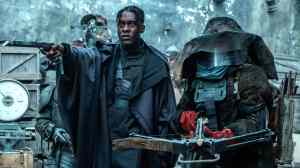 How has Carcer Dunn survived?
Episode 2 picks up right after episode 1. There’s a crossbow bolt heading for Vimes and we understand why he’s stood before DEATH discussing how he got to this point. Then something shocking happens which I won’t detail here but it’s completely unexpected and left me gasping.
For a moment I didn’t believe it would stick – this decision they made. I thought they’d roll it back. I actually talked to my screen saying ‘you can’t do that’. Yet they did and they stuck with it and once again the show left me not knowing what to think or how to feel. From there the dregs of episode 1 were swept away and suddenly I was watching a show which had found its feet, which had gotten out of its own way and, perhaps, might become really good.
There is, again, a lot happening here and one of the things I love about Pratchett’s world is here on the screen – it feels alive, in a way episode 1 didn’t manage – we get a sense of the vitality of the city, of the inner lives of passers-by and people not directly connected to the Watch.
There are a series of wonderful gags with a gang of goblins and, to be honest, I would watch an entire show about them and their tragic aspirations.
There continue to be changes from the books – but I’m beginning to trust the showrunners now. There’s still no Fred Colon or Nobby but I didn’t miss them this time. I would still love to see them but somehow it’s not quite so important – their loss and the dialling down of Pratchett’s homosocial elements (although you could argue this is exactly the experience of most police officers at the time he was writing) is not necessarily a bad thing.
Additionally, I think it’s worth talking about Vetinari. Many people believed the casting was wrong. I didn’t know because I hadn’t ever, really, thought about Vetinari as more than a cipher for the idea of the benign tyrant and, honestly, who cares what an autocrat looks like? It was one of Pratchett’s masterstrokes to make Vetinari ambiguous in almost all ways because that is, in the end, the nature of bureaucratic power. Yet the showrunner cast a woman and certain sections were outraged. Some of those concerns I could understand and sympathise with – one discussion pointed out that Vetinari’s ambiguity was a really strong role model for Aro/Ace people and were upset this appeared to have been done away with.
However, Vetinari may be played by an actor who identifies as female, but the script genders Vetinari as male (just as the books do) and they studiously play with that ambiguity. It’s a small point for most people and certainly not a major element of the story but it’s precisely this attention to detail which has won me over.
The episode also shows us Unseen University for the first time and we start to the see the story itself unfold. It’s still too early to say whether the changes they’ve made will add or detract from the main plotline, which is the same as that from Guards! Guards! but, and it was as much to my surprise as anyone’s, I laughed out loud.
Then, just as I was getting over the shock of being made to laugh out loud while watching a show on my own, I laughed a second time and then a third. I do not laugh out loud when watching shows on my own. I can name only a couple of others ever to have done that (the witch’s hat episode of What We Do in the Shadows being the only one in recent memory).
It’s still bombing along slightly too fast to get the depth you can see lurking beneath the surface but, crucially, it’s there and I cared about these characters and want to see episode 3 now.
Verdict: So, after two episodes I have some bold statements to make.
I like this show.
It loves its source material.
It feels like Pratchett.
It’s worth your time.
Rating? 8 librarians out of 10
Stewart Hotston
 Doctor Who News Star Trek News
 Sci-Fi Bulletin: Exploring the Universes of SF, Fantasy, Horror and Spy-fi!