The Watch: Interview: Simon Allen
Simon Allen is the creator and executive producer of The Watch, BBC America’s series inspired by characters and situations created by Sir Terry Pratchett which comes to BBC Two next […]



Simon Allen is the creator and executive producer of The Watch, BBC America’s series inspired by characters and situations created by Sir Terry Pratchett which comes to BBC Two next […]
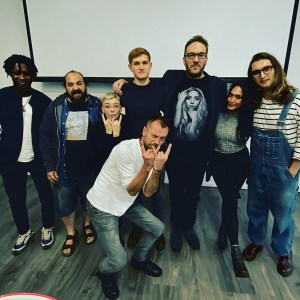 Simon Allen is the creator and executive producer of The Watch, BBC America’s series inspired by characters and situations created by Sir Terry Pratchett which comes to BBC Two next month after a successful rollout around the world. In a wide-ranging interview, he chatted with Paul Simpson about the genesis of the project, and its many challenges…
Richard Stokes told me that the original script that he saw for The Watch’s opening episode was very different from the one that we saw, in which we come in and find out about the world through Carrot’s eyes. How did you get involved? And what was your original approach?
I got involved because I was working at BBC Studios. I was one of the two showrunners on the last series of The Musketeers for them. We’d been promoted out of the second series after Adrian Hodges decided not to do it.
That was an amazing formative experience. They weren’t going to green light a third series so we took it and did quite a lot of work on it in the hinterland between series, to pitch and convince them to do one more. We spoke to Ben Stephenson and the guys at BBC Worldwide who distributed it, and managed to get a third series. We felt like that was very much ours because we had won it. The numbers hadn’t been great but it sold everywhere all over the world.
That was a real gruelling baptism of fire in terms of show running because it was ten episodes, lots of moving parts, quite limited resources. We pulled it off and made it work. It was a good series, it went pretty well and they were very happy with it.
 BBC Drama Productions, who’d now become BBC Studios, had a relationship with Narrativia, who are the company that owns the rights to the books, and they had been working for a long time, initially right at the start with Sir Terry Pratchett.
Quite late in 2015, they had written lots of scripts, they had lots of pitch documents – none of which I saw and all lost in the mists of time! I think it had been a prospect for BBC One on Saturday nights (in the old Doctor Who slot) and then it wasn’t and it seemed to be that they were sort of at the end of the road, in terms of the development hell of that particular project.
The feeling I got from the executives who were there at the time was they were struggling with the brilliant but challenging literary nature of the books. What’s so wonderful about the books is that Pratchett, as an author, is present in them, there’s a self reflexivity to it all, and they were struggling to translate that into television. They felt that when you take that meta commentary and that self awareness out, you lose what’s special about it. When you put it back in, you have something that’s driven by voice overs or narrators and that didn’t feel compatible with the demands of linear television at that time. This is pre-Good Omens, pre-Amazon, pre-all the biggest streaming sites being as big as they are now and able to do things differently, and they just didn’t feel it was working.
 They were looking for a different approach and everyone was on board with that. Simon J. Ashford was involved initially – he was the other showrunner on The Musketeers – but we parted company and he went on to do other things.
So I went in there thinking, ‘I think you need to build something that exists in its own right but has the tone and the feel of the books. One way of doing that is to try and do in the medium of television what the books do in the medium of literature. Let’s use television grammar – subtitles, music that seems to be self aware and so on.’
If you watch episode 5 we drop Crockett’s Theme over a Vimes montage, and you’ll hear the music lose confidence in Vimes when he falls over. And then Matt Berry becomes this meta aware commentator on the action, giving him advice on how to montage and so on. It was that kind of thing. I said, ‘I think that is using television the same way that Sir Terry Pratchett used literature.’
Then there were the sort of general ideas of samples and remixing – the fact that these books are so extraordinarily iconic but the first one Guards! Guards! was written in 1988, Night Watch was written in the early 2000s. I feel if you do just one, you miss all the special things that came with the later books. You want a blend of the darkness and the depth of characterisation and the comedy and the satire, so you need to borrow from across the spectrum.
 Then, more fundamentally, there’s a lot of things in the books that are wonderful but I feel like the socio-cultural vernacular that is used to talk about those subjects has evolved quite considerably, particularly when it comes to queerness. The character of Cheery is widely regarded as a queer allegory and functions as a kind of inkblot in which lots of different people see different things. We felt it was important. If we wanted to make a show with queerness at its heart as a sensibility, as an aesthetic, as subject matter, firstly, we wanted to normalize it – we didn’t want to comment on it, we just wanted to centralise it and normalise it which is why we do Cheery the way we do – and secondly we wanted to reflect where things are in terms of the discourse around non binary identity and so on.
So to go back to your original question – all of that fed the first version of that script Richard was talking about. Lots of people got very very excited because they’d never read anything like it! It was a script that was like a conversation. It was a script that tried to trick you and checked that you’d read something on page four and it was a script that told you to look over your shoulder. It was probably a little too literary – it was a script that knew it was a script, if you like?
Lots of big buyers came in but AMC and BBC America, who have always been very left field and tonally risky and ambitious and innovative, read it and were very excited about the creativity of it and, in particular, the queerness. I don’t think they were overly familiar with the source material at that point – they were more focussed on the show as a thing in its own right which, of course, is what our pitch was when we started. So Richard read that script. He’s a television stalwart and a brilliant brilliant storyteller himself, and his reaction was ‘How the hell are you ever going to make this?’
 At that point I was trying to be as disruptive and as radical as I could be because that’s what I’d been encouraged to do, and obviously who wouldn’t take that opportunity?
I would make great declarative statements like ‘We’re not going to do a new guys story! we’re not going to hold your hand through this world!’ but of course you end up going back to convention because there is some wisdom in it. There was an executive at AMC, a brilliant guy called David Madden who said ‘This is too out there, too bewildering’ (and I think it still is, by the way!). He said, ‘You need to just help people out a little here’ and so then we went, OK we’ll do Carrot arriving in the city and becoming an entry point.
If you watch the first episode, I’m not sure if we got the balance entirely right but try and imagine it if you didn’t have that! Try and imagine it like you’ve just been plunged in completely and that’s what it would have been! Anyway, once the rewrite had happened, Richard Stokes read it and comprehended what it was trying to do. Then we started developing it and moving it into 2019 and the looming reality of making this thing!
Various cast members have said that scripts were being written while you were in production but you presumably had the beats of everything for all eight episodes before production began. How fluid was it?
 The dream scenario is that you write all your scripts before you start but nine times out of ten that just doesn’t happen because of the decision making – decisions about what you’re going to do and what you’re not going to do because of the realities of production. Locations fall through, budgets drop out, all kinds of things. You’re constantly having to adjust!
I think that’s actually something for new writers to think about. If you’re lucky enough to be in a situation where somebody’s got the finances to say, ‘We’re going to buy your time for a year just to write this script and then we’ll green light it afterwards’… if you’re in that position, you’re incredibly fortunate. Most people aren’t, that’s reality.
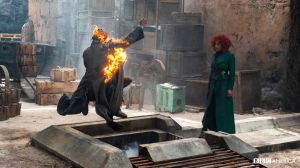 Your skill as a screenwriter is as much about how you deal with those challenges. It’s not about how good you are over six months or twelve months, it’s about how good and responsive you are in two minutes! The Watch was not quite like that – the first two scripts were locked; we didn’t really change them very much – but the later blocks definitely changed as we went along. We weren’t changing story, we always had a plan for the story, but we were having to deal with practical realities. It was a good budget for the show but it wasn’t the biggest in the world and we had to continually adjust and be quite physically and tangibly inventive about how to execute things. I don’t think we had the CG budget of Doctor Who for example, I think we were less than that so we had to be pragmatic. A classic example would be the Assassins’ Guild in episode three where I was taken to that building and I was just like, ‘This is the Assassins’ Guild! This would be amazing and we could shoot the whole thing here!’
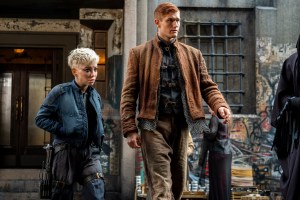 I think one of the reasons why I can cope with working that way, is because of The Musketeers. It was a big ten episode series – there wouldn’t have been time to write them all before we got greenlit and we were always having to make adjustments on that. Also I’ve made short films on micro budgets so I’m very accustomed to practical realities and marrying creativity to the facts. It’s a skill that takes a long time to develop. Actually I don’t know if it’s a skill or just an ability to cope with stress!
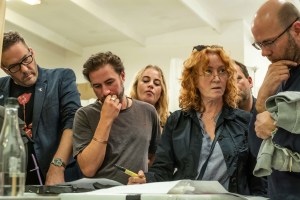 Things like that are skills that are caught not taught.
Yes, I agree. I’ve been doing some stuff with new screenwriters and supporting specifically writers from different backgrounds like mine and looking at the various obstacles that exist – which are actually, I think, worse now than they were when I started, particularly in terms of socioeconomic background and access and geography.
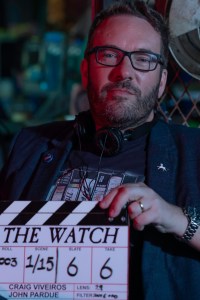 But for all the things you can do to tell people what it’s like to work in the industry I don’t know that you can adequately convey the sheer chaos of production! It’s something you’ll either go with when you’re dropped into it if you’re lucky enough to experience it or you’ll wilt. It can be very overwhelming and a lot of it depends on who’s around you and how they support you. In my case, I’ve been very fortunate to have amazing producers and particularly on this show, I had Richard Stokes and I had Johann Knobel.
Johann knew South Africa inside out. He was somebody that just had access to everything in the city of Cape Town and if one thing fell apart he’d have twenty different solutions. A lot of it is about the support network around you, I think.
How much did the scripts change once you actually got casting?
Another skill I think you develop after you’ve done a few things is that when you get rushes back at the end of every shooting day, you see what people are accentuating, what’s registering and what isn’t. So for example, with Adam [Hugill as Carrot], we noticed he’s actually quite funny! Originally the character wasn’t that funny so we wrote scenes for him – for example there’s a scene where he’s in front of the magic mirror. He’s performing at being a cop in front of the mirror and finds out that the mirror saw it all and made a comment about his arse. We wrote that in block three or four but it’s in episode one because we could see what Adam was doing.
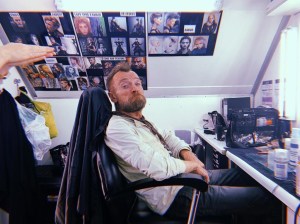 Richard Dormer is just a centre of gravity, he’s extraordinary, and you could see that he was holding the screen in ways that perhaps we hadn’t anticipated. We knew what he could do, we’d worked with him on The Musketeers and seen him in so many different things, but you start realising ‘Oh God, we’ve got to give him more of this!’
Lara’s audition was so extraordinary and I hope people can see it one day because she brought in a little dragon tooth and it was the most wonderful thing! She literally commanded your attention in so many ways. Lara’s talked a lot about the importance of that role to her and how as a Black actor she’s never been offered a Black character that has pomposity and is messy and flawed and entitled. Those characteristics aren’t usually given to characters like that and she loved that and the more she reacted to that and talked to us about it, we thought, ‘Well we’ll give her more of that! We’ll give her blind spots’. [Sybil] has this huge sense of decency about her but because of her privilege and because of the fact she inherited wealth and opportunity, she makes mistakes, she overlooks things. Which is why she has this great plan in episode one to dispatch the ne’er-do-wells in Throat’s Yard and it goes wrong, she messes up.
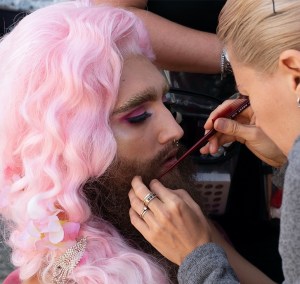 And then Cheery. I think Cheery is one of the characters we’re most proud of. That really came from the fact I met a writer called Amrou Al-Kadhi who was one of the first writers we interviewed for our room. Amrou just talked about quantum physics, gender fluidity, deconstructing constructs and conventions and perceptions and gazes, particularly the male gaze and heteronormative gaze and so on. That had such a massive influence on me and I was so excited by its possibilities. A lot of the people who like the show like the fact that it’s effortlessly queer in the way it looks and feels and the way it normalises queerness – and that came from Amrou. Amrou’s contribution to the show wasn’t just in co-writing episode six or the Cheery character arc, it was everything, the way it looks, the way it feels.
Particularly in terms of stories like the Lara story, the Cheery story, those have resonated with people. I’ve had some lovely messages. I know it’s really important to Lara and Jo and that alone made it worthwhile. If just one person reacted and saw themselves in this story somehow that would be worth it but it seems like a lot have and that’s made it all worthwhile for us.
I think the worst thing you can do is be safe and go through the middle. I was agonising over the cuts for such a long time thinking ‘Is this too straight? Is it too normal and boring?’ There’s a fantastic director who I won’t name that my producer works with who makes wonderful science fiction shorts. He’s now doing big shows and his shorts are really out there. Johan said ‘I’ll send it to him and he’ll tell you if it’s boring and straight.’ And what we got back was ‘This is really ****ing out there!!!’ And I thought ‘If he’s saying it’s out there, then it really is out there’ And that’s a good thing!
Sounds like you all collaborated on being ‘out there’?
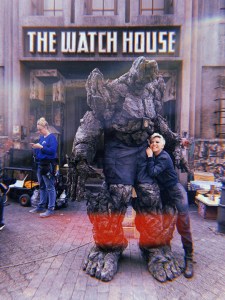 Something I’ve learned over the years and the shows I’ve worked on is to be collaborative. When you hear something that excites you, to just go with it and encourage it. It was a collaborative environment and that’s the thing that I love about it most really. I think that in every atom of it, you can see the fingerprints of somebody that worked on it, who put their heart and soul into it.
It’s not just the actors, it’s not just the score from Russ Davies, it’s not just the directors who are all wonderful. It’s the craft, it’s the costumes, it’s the makeup, it’s the set design. I would have people come to me and give me concepts and ideas and I’d say, ‘If you think you’ve gone too far you haven’t gone far enough!’ and they would come back with really mad things! I wanted it to feel contrary and upside down and counterintuitive.
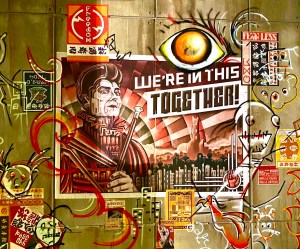
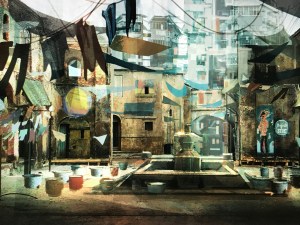 We had so much fun with the posters. We made thousands of posters…there are even little Easter eggs in there. You’d have to really look, I won’t tell you where they are but there’s little score settlers in there as well. There’s people who wanted to get back at ex boyfriends and stuff so there’s little messages in the background. It’s a real collective expression of creativity, particularly from the South African crew who are amazing, just incredible…world class.
Although they quite often have big movie productions in South Africa, television production seems quite new. Because they were less used to it, were they coming up with ideas that were more left field?
I’m very good friends with all the crew and cast, we’re a very close company and whether it’s The Watch or something else, we will all work together again. In fact, I’m hopefully working with the fulfilment company out there again on something else.
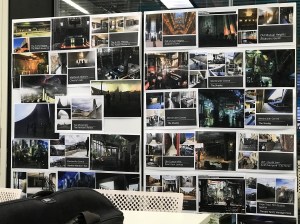 The impression I got the first day when I walked into the production office and I just saw this explosion of ideas and suggestions… I think they would all say that this is the first time where they’ve been totally empowered and encouraged to think outside the box, to be lateral, to be bold and brave.
I think quite often British productions have gone out there and it’s been driven by the tax break or this or that, but I genuinely think The Watch is one of several shows – Raised by Wolves is another, by the way, the Ridley Scott show – where you can see that creativity. There’s a far better reason for going to South Africa to shoot.
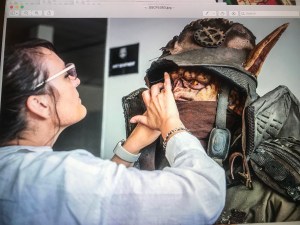
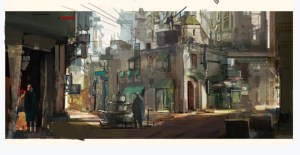 The quality of the talent out there is unparalleled and amazing and underused. You can see it: Shane Bunce who’s our art director, Tessa Wessels who’s our concept designer: these are people that everyone should know about because they’re unique. Amanda Ross-McDonald who does the makeup, Dihantus Engelbrecht, the costume designer – they are geniuses. Dihantus said to me he’d never worked on anything where he got the opportunity to be this expressive and this emphatic with his talent.
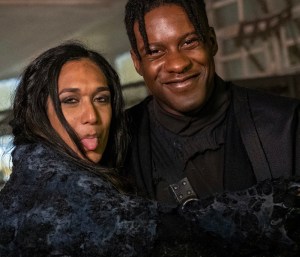 That’s another thing that made it worthwhile alone, another wonderful thing. What a privilege to be a part of that and what a privilege to get to work with those people!
It’s probably a difficult question to answer but what did you personally find to be the hardest challenge of the whole project?
Once we’d agreed that this show was going to be its own thing, I think there was a great clarity about what we were doing so I don’t think it was a creative thing.
I think with something like that, because it wasn’t a Netflix show or a show with $100 million behind it or even $50 million, it did remind me a lot of The Musketeers. That had quite a good budget but at the same time it was Holby City plus probably, and that’s quite difficult to do when you’ve got horses and stunts and action set pieces and so on. You do aggregate that down to ‘We can have two mini fights, one big set piece and one mini set piece’.
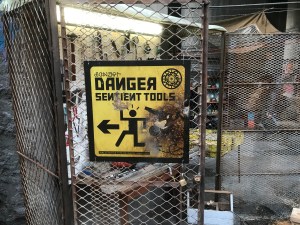
 I think the biggest challenge for me, on something that’s so sprawling and creatively ambitious and wants to go in so many different directions, was having to reconcile with the realities of the resources we had. Then coming up with a tool kit, which was the producer part of me kicking in. You’re being told at the start ‘We’re probably not going to be able to do all of this’ so that’s why when you find a place like Werdmuller, which is abandoned 80s shopping centre in the heart of the city and you see all the concrete structures and so on, you say ‘Can we reskin this? Can we go to this place and dress it?’ And if you watch the show very carefully, that thought process of draping sails along the background and putting posters up and trying to get the feel that way, that was a methodology that I wrote in the bible because I knew we wouldn’t have the resources to do big builds.
That was actually inspired by Thor Ragnarok, which I love! Obviously there are all the big CG vistas but then there’s lots of closer work where it’s nothing more than Bruce Banner and Thor having a conversation. The only thing that gives it visual depth and complexity is coloured powder and some sails and some drapes. I was like, ‘Well, we’ll do that!’
But even though we thought we were being clever sustaining that for so many episodes was very very difficult! So again, reconciling creative ambition with practical reality is always the greatest challenge for me, I think.
The South African locations – particularly the Atlantis dunes – are just gorgeous.
 Absolutely, it’s amazing! It’s basically a beach but you think you’re in a desert and it’s quite a beautiful place to go. And of course we knew we’d have to use that at some point – originally it was going to be DEATH’s domain but I couldn’t get the costume out there so I had to think of a different solution for that.
It’s a magical place, it really is. I was there the whole time looking for Great White Sharks because I’m obsessed with sharks! I’m actually writing three shows involving sharks in different ways at the moment. Ever since I saw Jaws when I was about eight or nine, I’ve been convinced that the way I’ll go out of this world is to get killed by a Great White Shark so I was thinking ‘It’ll happen here!’ But I was very disappointed, I saw Orcas but I didn’t see any Great Whites while I was out there.
The aesthetic, you were very clear about what you wanted it to be. To what extent were you saying that in the script or was that coming from production meetings?
 I wrote a 150 page bible that was full of visual references.
One of the things we encountered in pitching the show was that – and this is not a criticism of the books or anything, it’s just the reaction we were getting and it’s the way that television executives sometimes work – there were a lot of shows out there with the Victorian steampunk city aesthetic or even a Victorian fantasy city. There was Carnival Row, The Irregulars was coming, there were multiple shows and it became a point at which people were saying ‘Well if the world is going to look like that, how is it distinctive?’
You think, ‘Come on guys, it’s distinctive in all these other ways but visually yes it will look like a Victorian city’ or it will look like Georgian city or whatever. And that became a problem so that’s where we came up with the idea that this is a multiverse. This is a backwater of Pratchett’s wonderful multiverse so it can look different, it can have more modernity, it can be more advanced. That’s where we went in terms of the concrete understructure and the blend of new and old and so on.
I knew we had to do that partly for practical reasons, if I’m being perfectly honest, partly for the fact that we weren’t getting a positive reaction to a Victorian city but also because we have seen a lot of Victorian fantasy cities. When a new audience who doesn’t know anything about the world sees that for the first time, they make a set of assumptions about it and it informs their relationship to the show in, I think, not a particularly positive or helpful way.
 What we wanted to do was create something that actually is new. You’ve never seen a place like this before! You’ve never seen an upside down place with new and old colliding where it’s inflected with the 80s, and we tried to have fun with that. There’s ideas in the show that explain or account for why it looks the way it looks but I wonder if they register as strongly as we intended! For example in the second episode there’s a tracking shot in James Fleet’s office, the Arch Chancellor’s office, from a dish with a globe in it and he says ‘It’s Round World, it’s where I get all my best ideas from’. The idea of that is that all of the technology and advancement comes from the Unseen University and the Arch Chancellor who’s been stealing it from ‘Round World’ but nothing really works or adds up. It all backfires!
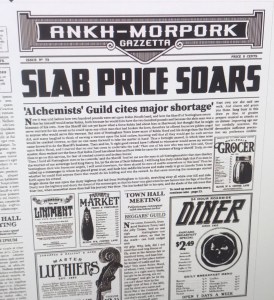 I thought that was quite a fun concept and quite consistent with the contrariness and absurdity of the books, and that was something that infused the aesthetic quite a lot. I don’t think you can find another show that looks this way. I don’t think there is anything that has a world that looks like this one, so again it has a distinctiveness which I think is a positive and good thing!
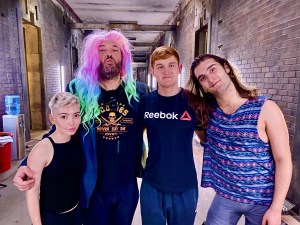
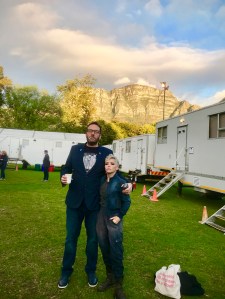
Thanks to Simon Allen for the behind the scenes shots from the series.
The Watch is available now on BBC iPlayer and will launch on BBC Two on Thursday 12 August at 9 p.m.
 Doctor Who News Star Trek News
 Sci-Fi Bulletin: Exploring the Universes of SF, Fantasy, Horror and Spy-fi!