The Watch: Interview: Richard Stokes
Richard Stokes is a familiar name to readers of Sci-Fi Bulletin, as the producer on Doctor Who spin-off Torchwood. His latest genre project is the BBC America series The Watch, […]



Richard Stokes is a familiar name to readers of Sci-Fi Bulletin, as the producer on Doctor Who spin-off Torchwood. His latest genre project is the BBC America series The Watch, […]
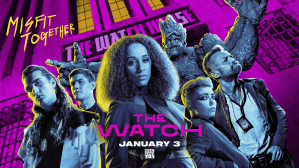 Richard Stokes is a familiar name to readers of Sci-Fi Bulletin, as the producer on Doctor Who spin-off Torchwood. His latest genre project is the BBC America series The Watch, inspired by the characters created by Sir Terry Pratchett (you can read our reviews of it here). In the first of our series of interviews with the cast and crew, Paul Simpson chatted with Stokes about creating a world somewhere in a distant secondhand set of dimensions…
NB This interview is spoiler-free for specific events during The Watch, and will be updated once episodes have aired worldwide.
How did you get involved with The Watch? Were you a Terry Pratchett fan before you got involved with this?
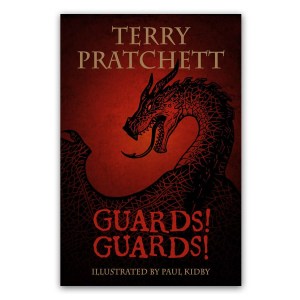 Like a lot of people, I’d read Pratchett as a teenager and am a huge fan of the genre, as you know from talking to me when I was doing Torchwood.
Hilary Salmon, who was running the drama department at the time, showed me Simon Allen’s first script. I’ve said this to him: I read it and enjoyed it but I wasn’t quite sure what it was really about or which character I was meant to be rooting for or caring about.
That was about three and a bit years ago. Then, a year later almost to the day I was looking for a big project to do. I was about to enter my third year of exec-ing Silent Witness, I’d got a lot of stuff in development but I wanted to spread my wings a little bit. Hilary said, “Simon’s done an amazing re-write on this in order to bring a new audience into the world rather than starting from the expectation that you already know it. Please give it another read.”
I read it and I loved it. Simon had done a fantastic job of rewriting it so that an audience that didn’t necessarily know Discworld could enter the world and enjoy it. That’s what really appealed, not because I felt it was necessary to divorce the project from Discworld but we were making it for BBC America. Pratchett is a massive name in a lot of places around the world but not so much in America. BBC America were very much looking for a show that could stand on its own and I felt Simon had done a really good script for that.
So I came on board about two years ago; sometime in February it’ll be the second anniversary. There was a first script, no cast, no HODs [Heads of Departments] no real sense of where we were going to shoot. We’d started very preliminary reccys in South Africa but that was it and so I took it from there.
That first version, was it still using Carrot to introduce us to the world, or was it much more of a “This is it, it’s all here, we’re going into join something sort of in media res”?
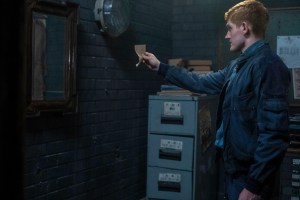 One of the things Simon did in his big rewrite was introduce what you’d call the “rookie cop trope” from crime series. This allows the audience to be handheld into the world. It meant we could see everything through Carrot’s eyes, the absurdity of the world, the wrongness of the world, how the laws of the world made no sense and needed to be changed. So yes, that was absolutely in the new script that I read.
The decision to go to South Africa: obviously Chris Chibnall had taken the Doctor Who production team there for series 11, but did that have any bearing on it?
Not directly. Actually I filmed in South Africa about five years ago. I did a show called Undercover which was meant to have a two week shoot in Louisiana. For various logistical reasons that became impossible and so relatively late on we shot the American bits just outside Johannesburg. We were only over there for seven or eight days but what struck me was how brilliant, adaptive and slick the crew were. I came away thinking, “If I ever get the chance to shoot in South Africa again, I want to.”
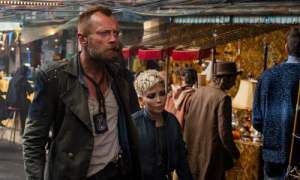 Our first choice producer, Johann Knobel, had just come off a big shoot in South Africa for Noughts and Crosses and knew the crews and the team out there. BBC Studios had just filmed not only Doctor Who but also Our Girl out there as well, so knew a lot of the companies that run the infrastructure of filming out there. It was a very easy group of people to talk to and work with.
You get a completely different sense of light and world and locations out there – and there’s no time difference which is fantastic. Even though it’s a long flight, you come out the other side and it’s pretty much the same time of day so there’s no real jetlag. That was a bonus: it meant actors and HODs that went over there – there weren’t that many, most of our crew is South African – could just get straight on with working pretty much as soon as they arrived.
 It also gave us a very different feel. There’s been a lot of talk about the visuals of the Discworld novels and what we wanted was not to deliberately subvert that, but we did want to make it feel contemporary. Again, we wanted to make it work for a new audience who didn’t necessarily know the books. If you read the books there’s a lot of different styles meshed together. There’s Victorian, there’s Gothic, medieval armour and sandals…. so if you put that out there, it could look like a bit of a mess. It could look like a designer wasn’t quite sure what direction to go in. So we very deliberately said, “Let’s go in one cohesive different direction.”
 We talked a lot about the original Star Wars and how it would feel if you could walk through the streets in Mos Eisley – you can kick the dirt and pick up the props. We wanted to lean very much into that rather than relying a lot on CG. Cape Town gave us that. You can build big sets for a lot less money than you can in the UK, or even in Europe these days.
The light is extraordinary, the crews are fantastic. It gave us everything we wanted so it was the first and obvious choice to go and shoot the whole show – and I’m very glad that we did.
How much did COVID affect you?
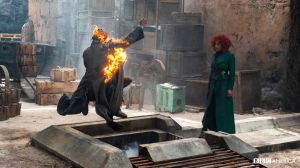 It affected us quite a lot but we were lucky. We had been shooting in Cape Town for five months when we got to about the 4th or 5th of March last year and we could tell there was going to be a lockdown. All the news was that there were lockdowns across most of Europe and we could feel it coming in the UK. South Africa were starting to talk about there having to be restrictions on movement. We had ten days left to shoot, so we had to get through those next two weeks.
That was on the Monday. We had a big conference call between the UK and South Africa about what we were going to do and what we were going to try to achieve and when we were going to wrap and get everyone home. So we said, “OK, let’s try and get through to Friday and that will leave us a neat five day block to have to film and we can come back in three or four months to complete.” Or so we thought, naively.
 As we all thought.
Exactly. “We’ll come back and finish it off, it’ll be fine.” That Monday evening our assistant producer rang me and said, “My flight has just been cancelled and BA aren’t offering an alternative.” So on the Tuesday we had another call and we said, “OK, we wrap tonight, let’s just get everybody home.” We finished on the Tuesday, we got everyone home by that Thursday or Friday I think. We had about eight days worth of material left to shoot.
We had loads of post production to do so we were kept very busy the whole of last year. Editors, our composer and VFX teams were able to work from home so that was absolutely fine, but we still had these eight days left to shoot.
We went through the material, stripped out what we felt we didn’t need, which left us with about six and a half days’ worth. As well as that, we had some second unit stuff to shoot. We were able to shoot two days of pickups remotely in Cape Town, literally closeups on tables and cutaways of stuff, once South Africa had their COVID filming protocols in place. I was sat at my desk in my house with my computer on, my iPad open with the screen directly connected to the camera monitor in Cape Town via an app. Simon Allen was able to watch it from where he was, the director Craig Viveiros was in Portugal and we were all watching the camera monitor in Cape Town live.
That’s a hell of a video village.
 It was extraordinary; the technology has really saved us over the last nine months. We’ve been able to achieve a huge amount.
That left us with six days left to shoot and we ummed and ahhed about whether we could get back to Cape Town, all the way across July and August last year. Eventually I had to make the tough decision and say, “Look, we’re not going to be able to get back out there. We need to finish it so let’s ship costume, props and set dressing over and we’ll shoot it in London.”
So we went to a place called Millennium Mills in East London which has been used as a backdrop for a lot of locations. Our designer, Simon Rogers, who did an amazing job in Cape Town, was able to basically rebuild a whole section of street. We can spot the differences but actually I don’t think the audience will.
Going back to the aesthetic of it… Pratchett created the parts of the society he needed for the story he was telling at the time. Your vibe is steampunk but it’s more punk than steam. What was the reason for the choice of that? Because that’s not what I’d call a 2021 vibe. It’s almost, when we were kids in the 70s and 80s…
 Well, yes very much so. If you look at Simon Allen’s influences that pretty much answers the question and you’re absolutely right. The feel of it was to be very contemporary but if you look at all our references, they are things like the original Star Wars and Time Bandits. In terms of its tone, we wanted to do something visually that Pratchett did with the books, which is constantly question the form. He would do footnotes and be present as a narrator and he would introduce obstructions and obstacles to literary form in order to help the satire and comedy. We wanted to do the same thing visually but of course you can’t do footnotes. So we had to reinvent what he was doing in a literary way for a television audience.
One of the references we actually used quite a lot was [the BBC series] The Young Ones and the fact that you would always feel there was a slightly edgy element to the comedy. We talked about a sequence in the series where someone picks up a brick and chucks it at the camera, and the camera wobbles and shakes as if it’s been hit. It was that genuinely visceral feeling that as an audience you feel you’re in the room, you’re in that space as a part of it and it’s not very formal or very slick.
 Also, to be honest, everyone has seen those slick shows. Everyone’s watched Game of Thrones, everyone’s watched the latest Star Trek, everyone knows what you can achieve on TV if you have $8-10 million an episode. We didn’t have $8-10 million an episode so there’s no point trying to match that. You have to think about it in a different way and that’s what we did.
The idea was to make it feel vibrant and alive and visceral, and like you could reach into the screen and touch it. I think part of the problem with some fantasy and science fiction is it still feels at arm’s length for a lot of people and we were trying to appeal to a bigger audience than just your usual science fiction or fantasy fans.
You want the people who went to see Conan because it was Schwarzenegger not because it was Conan the Barbarian.
It’s exactly that. It’s interesting: the positive reviews we have had divide into two groups. There have been some who like Pratchett and like the books but have said ‘Oh this is something different and I like it’ and there have been quite a few who have said, ‘I don’t really know the books but taking this as it is, I’m really enjoying it’.
I think it’s worked; we’ve found that balance of trying to do something that stands alone, absolutely respects the source material because the source material is the thing that inspired everyone to make it, but also is able to stand up for itself to a new audience.
 When you were talking about doing the footnotes it reminded me of the Hitchhiker’s TV show that went back and tried to replicate what Douglas Adams had done with the book and the radio series by having all the inserts. Was there ever any contemplation of on screen joke captions, stuff like that?
You know, there were actually, and in fact and there’s still a couple..
Well, there’s obviously the first one, the scene setter.
Yes, and in episode 1 when you cut to Vimes in the present day for the first time there’s the little caption about 20 years and the number of bottles and number of brain cells. There were a few more of those but what we found was they slightly got in the way, they slowed the scene down or they weren’t as funny on screen as they were when you were reading them in the script.
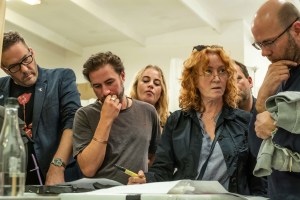 It was very interesting and you’ll know this from critiquing TV for many years: you see a script and although it’s trying to be a blueprint for something visual, it’s still a literary form, you’re still reading a script. You read these comedy lines that come in just at the right time and they make you laugh so you think, “That’s great, we’ll put that on the screen”. Then when you’re watching, it felt like sometimes we were going, “We’ve shown you the gag visually and now we’re putting up a note as well”. It’s like we don’t trust you to get the gag so we’re showing you and telling you that there’s something funny going on here. Not many of them worked in the end; the ones that stayed there are there because they did.
What was great was that there was a proper collaborative creative team between Simon and the writing team, myself and Johann on the production side and Craig Viveiros and the other two directors, Brian Kelly and Emma Sullivan. It was always that core group of people riffing off each other and making decisions, which is great.
And captions and everything like that are automatically appealing to a different part of the brain anyway. You’re analyzing rather than just absorbing, I suppose when you read it aren’t you?
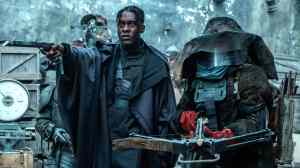 Exactly, the closest we got it to was the Goblin subtitles
The Goblins had a whole different story, originally, and we went through two or three iterations of what that story might be. It was going to be a love story then it was going to be a Marxist uprising, and then it was going to be a mixture of the two which is where we ended up.
Simon had written the subtitles and then they’re put on the screen as almost the very last thing in post production. I would go in with Johann and we’d watch it and sign off on it. Every single time a title came up, we’d watch it and we’d have to be doing that quite difficult thing as producers, where you’re reading it pretending you don’t know what it says and then asking, “Is that up for long enough? Are people going to be able to read that?” We were constantly shortening and tightening the lines to make them easier to read so that nobody missed the gags.
You could have rewritten the whole subplot at that stage.
 We did several times. Simon had some great ideas about the Goblins. The Goblins initially started out as the redshirts from Star Trek. The story he would tell is when he was making Musketeers and there would always be that group of henchmen of the big bad that would get killed by the Musketeers in sword fights but no one ever knew their name or cared about the fact they’d left a family behind. He thought we could do something that nods to that and say these henchmen, that constantly get taken away like cattle fodder, are actually quite important, they have lives of their own.
We really liked that, so he set up this, almost a Remains of the Day unrequited love story between two of the Goblins. Then we thought it would be really funny if we leaned a little bit more into it and there’s a couple of homages to Monty Python in there with the oppressed workers’ uprising. Partly because of our limitations in terms of prosthetics and makeup, there were two that go through pretty much the whole series, so we set up the uprising through which these two Goblins fall in love.
I think it ended up being a successful hybrid of the two stories but yes, it went through two or three versions across the writing.
Was the intention always to cast female for Vetinari? Because it’s written as it could be male.
Yes.
There doesn’t seem to be one line so far that Anna Chancellor says that couldn’t have been said by… I don’t know. Richard E. Grant.
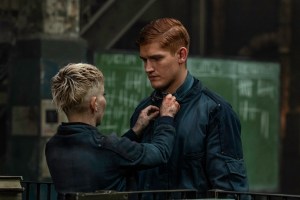
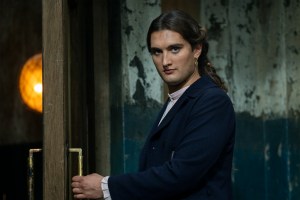 Absolutely. We had a list of both male and female actors for that role and we narrowed it down and down. One of the things we talked about, and again it’s a sense of making a 21st century show with a modern sensibility, there is a lot of queerness and gender fluidity in the show. We deliberately cast Jo Eaton-Kent in the role of Cheery and made quite a strong non binary statement about that role and that character. There’s a big story for Cheery coming up which is absolutely inspired by the Cheery story within the books.
And we asked what if we had a female actor playing Vetinari – like Anna Chancellor who rapidly rose to the top of our favourites list. We discussed that in The Princess Bride, the Dread Pirate Roberts isn’t actually the real Dread Pirate Roberts. The real Dread Pirate Roberts is retired and gave the current Roberts the title. And so it goes back in history. The original Dread Pirate Roberts is actually about five people ago.
 We thought that would be quite interesting if Lord Vetinari is simply a symbol for the city. The position of Lord Vetinari is this symbolic leader; you have to believe they are an ongoing benign dictator, whoever it is that fits the role. Therefore Anna Chancellor is Lord Vetinari and all the pronouns are he. We simply left it as that, completely without comment and it’s only now that we’re talking about it with other people as they’ve had chance to see it on screen.
We were lucky that I can genuinely hand on heart look at all those actors and say they’re all first choices. We auditioned a lot, we saw a lot, Richard Dormer rose quite quickly to the top of the hit list for Vimes but all of them were first choice cast. All of their auditions were the best that we saw for each role, which was great.
Did you do chemistry auditions for them?
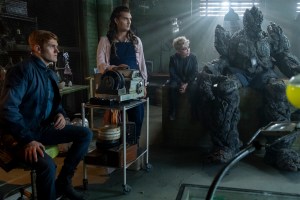 We didn’t. It’s something we try to do more and more in television – put characters together and see how well they fit. I suppose in some ways the director Craig did, not by having two actors in together but by having them one after the other. We’d watch the tapes together and we’d put faces of the team together that we thought would work. There were a few different options and then, ultimately, we all decided on the ones that we went for.
Lara, Marama, Adam, Sam, Jo … All first choices. I auditioned Richard (Craig was already in Cape Town) because BBC America only knew him from Game of Thrones and Fortitude. Doing a comedy lead was a very different move for him so they wanted to know that he could do it.
We haven’t got all of The Watch from the books; have we met all the Watch that we’re going to meet?
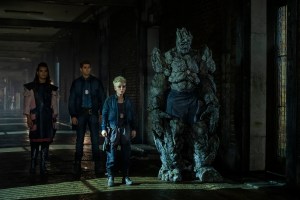
 Pretty much yes. My ‘pretty much’ is specifically about a reveal that comes in a later episode I don’t want to give away. There were a couple of characters that we deliberately excluded for no other reason than there would have been too many. If you’ve got eight or nine regulars it’s harder to give them all an arc, it’s harder to give them enough real estate on screen. Particularly as we were trying to do a much bigger character arc with Carcer Dun than is in the books and also build the subsidiary characters like Vetinari, Death and Throat. It was a very deliberate decision to say, “OK let’s try to make it a gang of five” because that does seem to work in TV and so that’s the gang we ended up with.
What are the odds of going again?
Well, we’ll wait and see. It’s opened well on BBC America; they seem very pleased with the opening episodes and the figures.
 As a producer it’s something I’m incredibly proud of and we’ve all put a lot of creative energy into it, so fingers crossed it seems to be connecting with the audience we wanted, which is those who didn’t necessarily know Discworld and have come to it new, and those who knew Discworld but were willing to see it have a slightly left field twist. It’s successfully pulled in that audience and fingers crossed they’ll stick with it.
The Watch airs on BBC America on Sundays at 8,
 Doctor Who News Star Trek News
 Sci-Fi Bulletin: Exploring the Universes of SF, Fantasy, Horror and Spy-fi!