The Watch: Interview: Marama Corlett and Lara Rossi
In BBC America’s The Watch, inspired by characters created by Sir Terry Pratchett, Lara Rossi plays Lady Sybil Ramkin and Marama Corlett plays Officer Angua. Shortly after episode 4 aired […]



In BBC America’s The Watch, inspired by characters created by Sir Terry Pratchett, Lara Rossi plays Lady Sybil Ramkin and Marama Corlett plays Officer Angua. Shortly after episode 4 aired […]
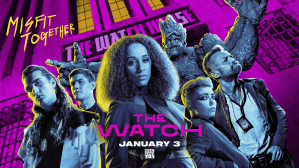 In BBC America’s The Watch, inspired by characters created by Sir Terry Pratchett, Lara Rossi plays Lady Sybil Ramkin and Marama Corlett plays Officer Angua. Shortly after episode 4 aired in the US, Paul Simpson chatted with them about creating a noble vigilante and a werewolf for the series, written by Simon Allen…
How much did either of you know about Discworld and Terry Pratchett before you got involved in the project?
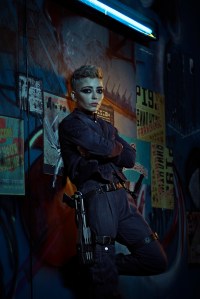 Marama: For me Simon’s scripts were the first introduction to Sir Terry Pratchett’s work, and I was shocked that I hadn’t come across his work because it’s obviously fantastic. There’s so many books, it’s so exciting and since then I have huge respect for him and what he’s brought to life. So yes, my first introduction to his work, personally.
Lara: Same. I was raised in Italy and then we came over in the 90s so I missed it while I was growing up. When I first read Simon’s script I thought, ‘What is this, I’ve missed out on something big here’. So, I’m the same as Marama, I have huge respect for Terry Pratchett – it’s a really amazing, weird and wonderful world that he’s created.
When you read the scripts, what did you think of your characters
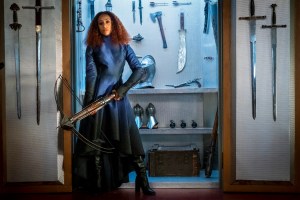 Lara: When I first read Lady Sybil I completely fell in love with her and it was like a dream come true to even have that kind of work come on my computer (laughs). Everything about her, even down to her wigs falling off and plonking them back on, the nonchalant aspect of her and the fact that she’s this noble woman and a vigilante, I just completely fell in love with immediately and I felt incredibly grateful when it came my way.
Marama: For me it was the same, and I think what I love about women in this story is that they have equal rights to men, equal power if not more. We’re not playing victims, we’re powerful and we’re also leaders in many ways which is exciting.
Lara: And unusual.
 Marama: Yes and unusual.
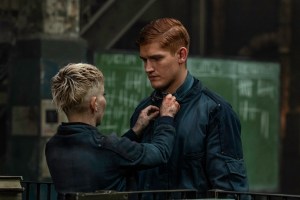
Both of you are paired off with a male character – Sam or Carrot – and you’re very definitely, at least from the first four episodes, very much the senior. Lara, you’re dragging Sam back into what he could be and Marama, you’re hopefully moulding Carrot into something decent as a Watch Officer.
Marama: I think the exciting thing as well is that we’re all moulding each other. They’re all seeking some sort of love in many ways, not only love for each other but also for themselves, which I really loved about these characters. It doesn’t shy away from showing their flaws – we see their flaws constantly throughout the series – but they’re learning how to be OK with that, how to love themselves as well.
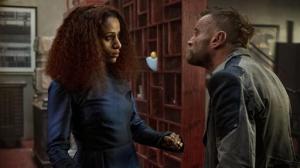 Lara: Yes, they find themselves through each other which is through the space they make for each other, so it’s really beautiful, in terms of them being lost. Each character in their own way, they’re all very autonomous, [but] eventually they all come together in this family unit somewhat, like a dysfunctional family. It begins like that and then through the spaces they make for each other there’s hope there and they all believe in that hope. It keeps growing, which is kind of what we need right now. A really beautiful quite grandiose theme that we try to investigate.
By the end of the first episode, they feel like a group, albeit one with a hell of a lot of rough edges that are going to be smoothed as the series goes. Did you have that cohesion as actors? I know you met for the table read over here but did you have that connection between you before you even got out to South Africa?
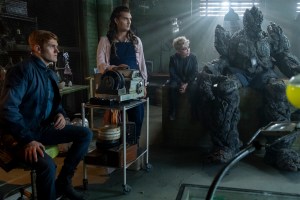 Marama: Before we got out to South Africa, it was a very short time wasn’t it? Like you say we had the read through. Did we meet at any other time? No, I don’t think we did.
Lara: No.
Marama: We literally met properly in South Africa, actually yes Lara came out…
Lara: I was late.
Marama: A couple of weeks later, she was shooting something else, and so we met out there. We were out there for seven months and you become like a family. You laugh together, you quarrel together, you see each other, you don’t want to see each other, then you see each other too much and then you don’t see each other enough.
That’s what happens when you’re working on set for a very long time. Not only us but also the crew, they’re with some of us at 3am in the morning, 4 am – we start very early. It’s a wonderful dynamic, it’s great that we’re all so different from each other as well. On screen we are very different but we came together.
Lara: Yes, we did. It was a lot of time together figuring out how to get these characters going and we were all living in the same building. In some ways it felt like my only experience of what being in dorms would be like (laughs).
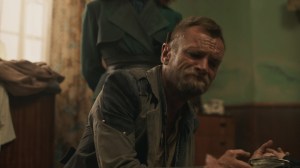 Marama: Lara, Richard [Dormer] and I were literally on top of one another – they were on the floors above. Richard was above me and you could always hear him playing ukulele or guitar, so when we had to have band practice, it’s the real deal. The whole of Cape Town was hearing Richard. (laughs) It really was a lot of fun.
Lara: He played a lot of electric guitar with this tiny little amp, and especially with an electric guitar it’s so tinny. Richard and I shared a two way trailer, so it was constant but I love him so much so it was fine (laughs). But at times testing, when I wanted to sleep!
Did you find it difficult to get back into character after that break from March to the autumn?
 Lara: I didn’t particularly. What I found hard… well, not hard but just disorienting, was the fact that it was weirdly sunny in London, so I just kept forgetting where we were. We had some of the crew from South Africa but there was also some crew that I’d worked with before on other shows, so I just kept being so confused. It was the same costume and it was weirdly hot in the same way. We were at the Millennium Mills and so everything was quite flat and I just kept forgetting where we were.
Apart from that, there weren’t that many distractions in between, because we were in lockdown, so it just felt like we were literally put on pause and then play was pressed again. So apart from the fact we were in London, I was just like, ‘Yes Sybil, I didn’t get to finish you, here we go! Let’s finish this.’
Marama: I think we were very lucky: our production designer Simon Rogers built this incredible set in South Africa and he was available at the time. He had to recreate a lot of the set, bits of it anyway. It was so similar, wasn’t it?
Lara: It was amazing, it was exactly the same – just incredible, he’s a genius.
Marama: And so you just felt you were in South Africa again, just a little bit colder, I guess.
Obviously both of you have quite a bit of fighting/stunt work; how was it for you to work on those?
Marama: Do you want to…?
Lara: Who should go first?
Whichever, werewolf or vigilante…
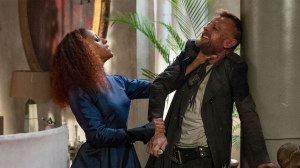 Lara: (Laughs) We had an amazing stunt coordinator and we worked a lot together. He’s got a really good technique, he was really professional and a perfectionist. So [the way] we work on the fight sequences: he films them and he puts them on a screen and you watch them, and you get to understand how the camera might move, and what’s important and what isn’t. Then he puts sound on it – sometimes when you’re fighting, obviously a lot of it is pretend so he adds these sounds so you can see the richness of the fights come to life and you go ‘Ahhh OK’. You start to have more trust in what you’re doing and you don’t feel as awkward. It doesn’t feel like you’ve got egg on your face.
He was incredibly helpful. I’ve done a little bit of fighting before but he really took it to the next level. He was very hands on and really encouraging, always there working with you, so I was eternally grateful. We were really looked after.
 Marama: Yes, like Lara was saying, our stunt coordinator Darrell Mclean, he really was incredible and most of his team were actually playing different characters within the show, they were Goblins and Detritus as well. Craig Macrae played Detritus, in real life let’s say, as Ralph Ineson does the voice. They were there the whole time and they gave us so much support – they made you feel like you could do it.
I didn’t have as much as Lara had, Lara was literally fighting with all sorts of swords and axes and everything, which was really exciting.
Somebody sounds a little jealous at not getting the sword fights
Marama: (Laughs)
Lara: Angua wanted a sword.
What was the most challenging aspect for you of playing the parts?
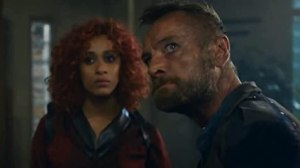 Lara: I would say, to always make sure that Sybil didn’t become lost in the comedy. Not that it was necessarily in the scripts but it’s very easy as an actor to attach yourself to those anchors. I just wanted to make sure there was always a soft centre and those anchors of truth. It’s a comedy, it’s a funny show, but I always worked hard to try and make sure there was a balance. And that at times was challenging because all I wanted to do was mess around with Richard all the time and try and find the funnies in the scene. I had to be disciplined. (laughs)
 Marama: That’s the thing because it’s all fantasy and they are such fantastical characters, it’s so easy to just go into this world of anything can happen – dragons and trolls and all sorts – but the most important thing was to root them in human stories. At the end of the day, that’s what you want to come across to the people watching, to have a connection with these characters.
And like Lara was saying, to have that fine line with the comedy, it’s very tricky to get that right. I just think the balance is perfect for me. When I watched the episodes, it was so exciting. It is funny but it’s serious. They’ve been through a lot. There’s the sadness that’s really there in their eyes and so you feel there’s a connection there, which I love. That was important.
Sybil in the books is quite different physically.
 Lara: I think all of us were cast in the right way and the casting process seemed to go more along the way of the essence of the characters rather than the aesthetic. I think that by doing that, you inevitably end up with a cast which is more representative of our century, of 2021. So, I guess in terms of my being a black woman it’s important, it’s timely and important for Sybil to be of colour and it gave me a lot of freedom as an actor.
In what way?
Lara: I guess I would say it was really fun and new to be able to engage with themes, with characteristics like entitlement and privilege. It’s usually ‘strong black woman’, and there’s nothing wrong with that…
But it’s almost an archetype, isn’t it?
 Lara: It’s an archetype that’s been played out quite a lot. I guess it’s just been freeing and fun to be able to engage with those characteristics.
Cheery’s supposed to be a dwarf and Jo is not., and Angua’s supposed to be ginormous and Marama’s not so I felt really proud to be part of a show that’s brave enough to do that.
Marama, did you go back and look at any other portrayals of werewolves or did you just go purely from what Simon gave you in the script?
Marama: I think a lot of people were like, ‘How exciting, do we get to see you as a werewolf? Do we get to see you in full form?’ For me, that was really special and what was different was that we were going to work more on Angua’s transformation from werewolf back to human, the aftermath. As an actor that’s a lot more exciting because there’s something deeper going on and to bring across the implications it has on her emotional and mental state and physical state as well I was excited about.
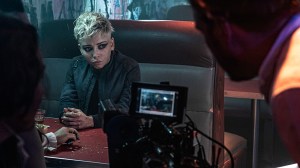 Obviously hearing that I’m going to be playing a werewolf, I thought, “How the heck am I going to make this something substantial? How am I going to make it mean something?”
I talked with Simon and our first director, Craig Viveiros, who were both there for us from the start, and had a huge impact in where we were going to take these characters. What made it exciting was they allowed us to have some freedom, like Lara was saying. It was essentially: ‘These are the characters. Now go! They’re yours, this is happening now, so do it.’
Of course it was a lot of fun to get prosthetics on and go into a little bit more of Angua’s backstory, which is very exciting. The prosthetics are a lot of fun and I love it but it was great to have both.
What part of each other’s character did you find most appealing?
Lara: I personally loved the notion of Angua having this darkness that she’s still battling. I feel like I’m speaking for Marama, but it’s so representative or metaphoric, this monster inside you that but at the same time it’s maybe also where you are your most true. It’s having to find space for both of those and I thought that that challenge as an actor would be quite amazing. I think what Marama did very well was finding a way to live both in Angua and as a werewolf.
Marama: Yes. We all have some sort of monster inside us and I think it comes from our past or something that we struggle with, a trauma that we’ve been through. These characters have that.
 What I love is that although Sybil’s been through so much trauma, she still manages to bring that softness and it comes out with Vimes and it’s beautiful. I just love the way you guys look at each other in the episodes, it’s really special and very human. You can be so strong and so powerful, the way you speak and everything about you, but she knows how to come down to people’s levels and really speak truth. We listen to you basically, which I love.
She’s using her privilege – and a sword!
Marama: Yes, exactly.
When you look back on this what particular memory do you think you’ll say ‘Yes, that’s The Watch, for me’?
 Lara: I really loved filming the last bit. We were all together. There’s something about it that really tugs at my heartstrings – we were all together on this plinth doing this scene and especially because it was a night shoot and we were all tired, your emotions are a little bit more on your sleeve and it really felt like the end. I guess it’s cheesy to think of the end as the last memory but it really was.
Also, we were home, well I was home anyway because we were in London, and I remember going, ‘This is good, I really enjoyed this and I’m so happy to be with these people, saying goodbye.’ It’s very unusual to wrap on a scene where you’re all together so that’s really special and at night, and tired and with loud music. It was just amazing.
Marama: Gosh, there are so many but I definitely have two that I can say. The first one would be the first day on set outside the Watch house. I looked back and I see Detritus walking towards me and he is huge. I’m tiny but this guy is huge, on stilts. There is no CGI on this guy, it’s real. And I thought, “This is the magnitude of this world, this is how real is it” and it was such a beautiful moment. I actually got shivers when I saw him walking towards me.
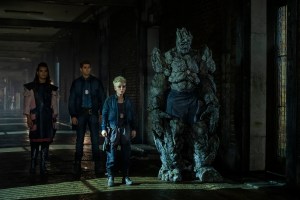 I wish you could have met Craig, inside the costume, I wish you could have met Detritus – he was Detritus, his face was so beautiful and I just miss seeing him. So that’s one.
Another time that I just think “fun job” was we were all together somewhere in Ankh-Morpork. Lara had Goodboy but obviously Goodboy is this little [puppet] hiding in her pocket. I don’t know what happened but you kept trying to take him out or something…
Lara: He kept getting stuck.
Marama: It was just hilarious, you stop and you think she’s got a little tiny dragon there.
Lara: There was a lot of corpsing that day!
Marama: You can’t stop laughing and it’s really difficult to stop all of us!
It was so much fun. It’s such a crazy fun show and I feel so lucky to have had the opportunity to play one of Sir Terry Pratchett’s characters from his books, it’s incredible.
Lara: I second that
The Watch continues on BBC America on Sundays at 8 p.m.
Click here to read our other coverage of the show
 Doctor Who News Star Trek News
 Sci-Fi Bulletin: Exploring the Universes of SF, Fantasy, Horror and Spy-fi!