The Underground Railroad: Review: Chapter 8: Indiana Autumn
Spoilers Cora at the Valentine’s Farm… The episode starts with a reading of the declaration of independence by a child. Something we’ve all seen or heard on TV and in […]



Spoilers Cora at the Valentine’s Farm… The episode starts with a reading of the declaration of independence by a child. Something we’ve all seen or heard on TV and in […]
 Spoilers
Cora at the Valentine’s Farm…
The episode starts with a reading of the declaration of independence by a child. Something we’ve all seen or heard on TV and in the real world. Except here the comment lingers on all men created equal (setting aside the gender bias of the founding fathers for a moment) as spoken by a young Black girl in a Black community. There are no White faces and it feels strange that after so, so much these folks are sitting peacefully, free and able to do as they wish.
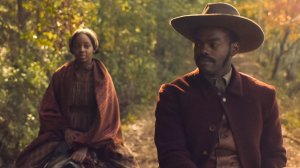
We come back to Cora, a member of this community sometime after she was rescued by Royal in Tennessee. She is struggling – with her community, her freedom, her place, her shape.
We see a community dinner – outside with Black men playing fiddles and the contrast with the scene in episode 1 at the Randalls’ where a runaway slave is immolated alive couldn’t be starker. These people are free.
There’s a deep discussion to be had about the role of Christianity in these people’s lives – not just the White supremacists who see Jesus as somehow authorising the murder and subjugation of others as some kind of Deus Vult but in how (at least for me) a more authentic vision of Christianity comes through in the community at Valentine’s Farm. One focussed on freedom, compassion, survival in a hostile world and on providing for those in need. If these sound like weaknesses and fools’ errands granted to the undeserving, perhaps remember that the meek shall inherit the earth as far as the Gospels are concerned. The show’s comment on Christianity is that it was ubiquitous, both the religion of slaves and their masters but in reality two separate expressions of very different drives. There’s a more modern urge to deny that Christianity played any meaningful positive role in the lives of the oppressed but history really tells a different story. Certainly that story is a complex and nuanced one – early freed or successfully liberated communities remembered the religions of their forebears to a much greater extent, but the presence of a Christianity which fit those seeking freedom shouldn’t be underestimated even if its legacy is not simple.
Indeed, the name Valentine’s Farm comes directly from the martyr, the bishop who ministered to the persecuted and was executed for refusing to stay quiet about what he believed. Whether it’s a message about the community at the farm’s future or not, the sense it is a sanctuary for those who’ve lived under persecution is written through the episode like DNA.
Yet far more important than the role of religion in the lives of our characters is something I’ve not seen any other show talking about in the context of this period (or the subsequent lived experience of racism in more contemporary periods).
What then for freedom when it is finally attained?
The fear of building – especially when your neighbours hate you. The challenge to move beyond your identity as a slave, as someone oppressed and abused to the idea of being free, of being defined not by your relationship to someone else but on your own terms. We have seen this exploration in microcosm through Cora as the series has progressed and once again her tiny frame carries the weight of this idea – how does one become free?
Inevitably newly found freedom brings with it conflict – for how do we protect and nurture this baby of hope when it is so fragile and liable to be stolen from our hands before it has a chance to grow into what it is supposed to be?
As one of the characters asks, is it arrogant to live and prosper? If it is, what does that say about those who judge it to be this way? Who gives them the right to make such judgements, let alone act upon them.
Whether it’s the woman who’s somehow shrill rather than the man who’s assertive or the Black person being uppity for demanding the same pay as their White counterpart – the gaze of power reflects the values of those to whom it belongs.
Calls for compromise and understanding can’t come at the cost of the victims of hatred. Where there is power asymmetry, the cost must be paid by those with more or, really, they are bad faith actors demanding others pay what they aren’t willing to commit themselves.
This is the misunderstood point about restorative justice – it isn’t for the perpetrator to decide upon their own fate, for how does that mend relationship? No, restorative justice has at its heart the idea that the broken relationship can be made whole again but the impetus for restoring that relationship and making reparations (the bit most often forgotten by those who wish only for restorative justice to be ‘I decide what I experience as a consequence of my wrong doing’) that are acceptable to the one who suffered from the broken relationship and the actions which caused it. It is in accepting the repentance of the one who did wrong that the sufferer takes control, and in the perpetrator allowing them to do so we see restoration begin.
Safety comes layered through with fear and trauma and, somewhere within, the hope for recovery. Yet to recover one must also learn to defend who one is, to set that boundary and say no more shall others cross this without my permission. For the abused, for the slave, this is a deeply challenging journey because, for those fleeing into freedom, it is a journey of exile not immediate salvation.
Cora says that there may be no safe places, only places to run from – to continue that exile, to never again find home even if the home left behind was one made from flame and ruin.
It’s what those who haven’t come from that country can’t see, that the exile of freedom is part of your identity. There is no moving past it, no setting it aside. Freedom can only ever be a victory partially won because it’s grown in the soil of trauma and harm and its fruits, while sweet, can never be those of people born free, with privilege.
It’s why the privileged moan and grow angry because they recognise the world cannot be reconciled, not properly, not here. This failure, this flaw in our common experience underscores the differences between us and shouts out that it’s because some have power at the expense of others and what could harm the myth of equality and meritocracy more than the truth of this? Better to burn the world, just as Ridgeway suggested.
Cora is also unwilling to become something she’s not – now she has the chance to make her own shape. No Black saviour, no Black role model of the slave become free. She rejects the idea of it as others try to make her into that. Instead, she slowly finds her own path to the person she wants to be and it is a journey fraught with the literal ghosts of her past, swirling around her and unwilling to let her go.
As she descends once again into the deep underground, perhaps the one place she can be Cora, she comes across a grand terminal full of the escaped looking for their next place to call home. Wild and disorienting, this huge underground world is like something out of the dreams of the survivors of H G Wells’ The War of the Worlds. A place where Black folk exist as themselves but only because it’s entirely hidden from the White gaze.
Here she is challenged about what story she is telling. In naming herself Cora Randall is she saying anything more than where she came from? What is this freedom she is seeking? What does it mean? The show asks Cora to think about who she is and where she belongs. It asks us to reflect on why that is so hard for her and what we do to continue to make those declarations so challenging for the people around us.
In this underground city, whose edges are fuzzy, hard to see, Cora wants to know the boundaries but is denied because the very act of seeing would collapse everything of this carefully constructed fantasy. Once again, Jenkins reminds us, while there are those who hate you outside the door, your existence is tenebrous, hard to understand and difficult to truly define.
The episode is careful to leave us unsure about the nature of what Cora experiences. Is it real? Is it nothing more than a fever dream? In any way that matters the answers to these questions are irrelevant because the world of the Underground Railroad is demanding Cora speak her history, her truth, her experience because to bear witness is the most important thing she can do. In this we see an echo of Grace’s journey from the last episode.
Yet is it fair? Is Cora’s reticence to speak a sign of failure or of strength? Again, there is no answer except to remind us that trauma does not always easily speak its name. You could argue that Cora is experiencing a kind of waiting room to Heaven but if so, Heaven is telling her she’s not ready for what it has to offer.
At the very end, Cora understands what she wants but it’s too late. The shape she wanted to take is no longer there to be taken and once again she’s left wondering at a world which seems to have no room for her because she couldn’t be what it wanted when it wanted. The tragedy of the last few scenes is heart breaking because instead of accommodating her, Cora is once again left alone.
Freedom is exile. There is no going home.
Verdict: This episode is dense with questions about what comes after slavery and persecution. It doesn’t offer easy answers and is, I think, the most special entry yet in this series. 10/10
Stewart Hotston
 Doctor Who News Star Trek News
 Sci-Fi Bulletin: Exploring the Universes of SF, Fantasy, Horror and Spy-fi!