The Underground Railroad: Review: Chapter 3: North Carolina
Spoilers Cora arrives at a closed station on the Underground Railroad. Cora is all alone. Stumbling through the tunnels of the underground railroad in search of hope, in search of […]



Spoilers Cora arrives at a closed station on the Underground Railroad. Cora is all alone. Stumbling through the tunnels of the underground railroad in search of hope, in search of […]
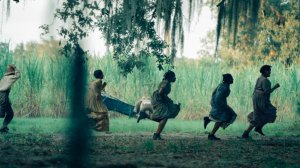 Spoilers
Cora arrives at a closed station on the Underground Railroad.
Cora is all alone. Stumbling through the tunnels of the underground railroad in search of hope, in search of somewhere new to call home.
Cora persists, for what else can she do? There is no option for her to come to the surface wherever she likes – out of necessity the hiding place she has chosen only comes to the surface in rare spots likely to offer sanctuary.
When Cora finds a closed station she also stumbles upon its station keeper. The keeper, a frightened man called Martin, tells her the place is closed, that the train doesn’t stop there anymore. It is clear the only reason a station would close is if it was too dangerous for a runaway slave to surface there and the immediate question I wanted to know was what kind of place could be so bad she didn’t dare risk coming up?
Again, what is Cora to do? When pressed, Martin offers to keep her fed and watered until another train comes along but what the show tells us is this: there is no schedule to the trains bearing runaways to freedom, no way of predicting if and when they may come.
This in itself is devastating because it speaks not just to racism but the experience of all the abused. How do we exist when to surface, to show our faces, may well result in our destruction? How long must we live underground?
Cora decides she cannot live like this and forces the station keeper to bring her up onto the surface. The first thing they see is a long road of corpses, presented as decoration and warning because the place she’s emerged has literally outlawed Black people. When Cora asks if that means there are slaves she is told, no, there are no Black people because they left or were killed. Martin also lets her know that if he’s found harbouring her his whole family will be murdered alongside them.
In many ways this metaphor serves the whole episode by playing out on screen the playbook of those who think they get to control others. They start with declaring there are none except them and they enforce this through the law and through violence when and if the law does not prove enough. In their most powerful incarnations they deploy the law to justify their violence – as seen here in this small town where to be Black is to be murdered, where to have been an ally is to be guilty of a crime punishable by death.
The message is ‘be us or do not exist.’ The real horror of it is these people believe they are righteous, and I found myself reflecting on their modern day counterparts who surely think the very same thing.
It is the heart of the matter, it is the thrust of the culture wars everyone is so engaged by these days because, as it always has every time it is required to come together and make its case, one side is saying ‘we get to decide who is fully human, we get to decide who is worthy of life and care and love’. It is not a difference of opinions, a squabble over the centre ground because the current iteration of our ‘culture wars’ stretch back to the Southern States of the USA and their cultural traditions of White Supremacy. It is too easy to forget that, when everyone is slinging mud at everyone they disagree with – these arguments began life in slavery and those traumas (for both the owned and the owners) have yet to run their course in our societies.
The leader of this small town is shown utilising every possible propaganda tool to indoctrinate their people – they co-opt religion, using its messages to justify their slaughter. They revise history, deleting and denying the bits they don’t like. They burn texts and messages which disagree with the world they want to see, as if by literally burning them they can unmake parts of the world which challenge their view of how things should be. Furthermore, this leader incorporates the law into their running of the town. We should always remember one big difference between US policing and the rest of the world – in the USA Southern police forces grew out of slave patrols (for the most part) and so, from their very beginning, have been structured to regard those not in power as potentially the wayward property of others. In this episode we see a new member of a slave patrol being inducted through ritualised murder of a Black person while the community looks on.
Finally, the leader of this small town has ensured that anyone who would help the persecuted will be treated as the persecuted. Many people might be sympathetic to Cora but how many of those will run the risk of their own death to help the helpless?
These factors intersect to create a pit of grim destruction for any who will not, or worse still, cannot, conform. Cora cannot conform to what is required because she is alive.
The show brings us a town that is uniform, the streets demarked, the trees highlighted, the people indistinguishable.
Into this comes Cora who has no choice but to swap one hiding place for another. Except by surfacing, by choosing a hiding place among those who would kill her as soon as look at her, being discovered becomes inevitable.
The pressure on all the conspirators is immense and no strategy based purely on defence can last forever – it’s why in any kind of martial arts we teach people that defensive moves do not exist in isolation but exist to create opportunities to attack because this is how to end a fight. Cora cannot attack, she can only wait to be found.
That the show packs in such a complete depiction of the tools of oppression is breath-taking and I was frantically scribbling notes as I watched. In the end I needed to go back several times and rewatch scenes again because in the layers of political and social comment I was losing the drama of what Cora was going through.
In comparison with the previous episode, which demanded Cora fit a specific shape if she was to be allowed to prosper, this new town dialled the approach right back and simply says – there is no shape which you can find which is acceptable to us. To be a Person of Colour is not treatable; there is no contortion you can make which will result in you being acceptable to us.
It is the roots and foundation of systemic racism, in many ways the attitude which is left behind when the law and sanctioned violence are denied to oppressors. In other words, the shape oppressors take on doesn’t change just because their tools get taken away. Like anyone seeking to live a certain kind of life, they search out new tools and begin all over again. Consider post-apartheid South Africa where die-hard racists have established towns in which Black people are not just unwelcome but denied access, kept out. Towns for Whites only who justify their existence just like those in this episode – by reference to culture and religion and purity and self-determination. These are not the fantasies of leftist minorities; they are the realities of the real world.
There’s one other really notable point from Cora’s experience here. She shares the hiding space with another young Black woman, Grace. That woman has been there long enough to realise the truth of their likely death at the hands of their persecutors in a different way to Cora.
Cora is still coming to terms with the world, still working out her own shape and how it tessellates with reality. Her fellow fugitive, Grace, sees the end of the road more clearly and hates those who force her to walk that path.
We often ask ourselves why the oppressed resort to violence, especially violence which can only result in their own deaths. Yet what is Grace to do? If she was suddenly let out and told she could live among these people who previously would have hung her from a tree and celebrated doing so, should she forgive them? Should she simply accept this one act of humanity among the grim inhumanity which precedes it? Should she be grateful to her abusers for, at last, being allowed to live?
Or would she be justified in exacting revenge? Grace has no illusions – she would enact revenge on those who have persecuted her. I don’t want to sympathise with someone driven to violence and hatred but how can I not? Grace and Cora are in an impossible situation, put there by others who show no humanity or sense of the evil they’re perpetrating. There is no negotiation, no middle ground. There’s only one side to the discussion in this episode because the power of White Supremacy in the town means they shape and define everything. If there is no room for debate what is left for the oppressed?
At the end of the episode Cora is taken away after being discovered by a bounty hunter. I found myself breathing a sigh of relief at this new horror despite the fact she’ll now be returned to face her own torture and execution. At least there’s time for her to escape again, I thought.
Verdict: What is this kind of ordeal where one acknowledges death is coming and so, rather than seek to escape it, accepts deferment as a balm? The threat of what is to come when it is all you can see could not be more harrowing. 9/10
Stewart Hotston
 Doctor Who News Star Trek News
 Sci-Fi Bulletin: Exploring the Universes of SF, Fantasy, Horror and Spy-fi!