The Terror: Interview: Infamy: George Takei
The Terror: Infamy arrives on AMC UK on October 7, set during the Japanese internment in the United States in the Second World War. Star Trek star George Takei lived […]



The Terror: Infamy arrives on AMC UK on October 7, set during the Japanese internment in the United States in the Second World War. Star Trek star George Takei lived […]
 The Terror: Infamy arrives on AMC UK on October 7, set during the Japanese internment in the United States in the Second World War. Star Trek star George Takei lived through this period and features in the series – as well as consulting to ensure the real-world element is accurate. Prior to the show starting in the US, Takei talked with the world’s press about his experiences…
How personal is this TV show? Did it bring back a lot of memories for you?
Well, on April 20th 1942, I turned five years old. And it was a few weeks after that, that soldiers came to our home and took us away. So, we were in three different camps. The camps were being built and not completed. We were taken to Santa Anita Racetrack, which was a glamorous racetrack where movie stars used to go and ladies wore fancy hats. But when we were taken there, initially, there was a chain link fence around this once glamorous racetrack, concertina wires over it, and it was guarded by soldiers with rifles and bayonets on them.
We were offloaded from the trucks and herded over to the stable areas. We were a family of five; I was five years old, my brother was four years old, my baby sister wasn’t even one, she was an infant, and my parents. All five of us were assigned one horse stall still pungent with the stink of horse manure. For my parents, going from a two bedroom house on Garnet Street in Los Angeles into this horse stall, it was a degrading, dehumanizing painful experience. And they impoverished us.
They took everything. First, they came down with a curfew: we had to be home by eight o’clock and stay home until six o’clock, imprisoned in our homes at night, which made no difference to us because we were put to bed. But other people, young people who wanted to go out, couldn’t. People that worked at night, they couldn’t work. They were being imprisoned at night.
 Then when we went to the bank, we discovered that our bank accounts were frozen. Our life savings were taken away. Why? We’re innocent. My mother was born in Sacramento, California. My father was a San Franciscan. They met and married in Los Angeles. We’re American citizens. And we’re being subjected to all this abuse, simply because we looked like the people at Pearl Harbor. And then the soldiers came to take us away and imprison us.
We were in the horse stables. Our shower was where the horses were washed down outside. The men went first, showered, and we went with our father, my brother and I, and then the women, they had their turn, outdoors. I mean, how – particularly for the women, how humiliating that was, degrading. When the construction was finished, we were put on a train with armed soldiers at both ends of each car as if we were criminals. And we could take only what we could carry.
We were transported two thirds of the way across the country to the swamps of Arkansas. For me as a kid, it was an exotic place. I mean, I’m a Southern Californian. It was an adventure [full of] learning, discovery. Trees grew out of the water on the bayou. And the roots went in and out of the water. And near the edges, there were little tiny black wiggly fish swimming. And so I got a jar and caught them and put them in the jar and watched them every day. And they start springing legs out, fish with legs. Then every day it got stronger, and then the tail fell off, and it hopped out of my jar. Magic.
For my parents, it was harrowing. When it rained, it’s a swamp; they cleared it off but it turned into a swamp. We had to make that trip to the mess hall three times a day. Old people couldn’t make it because their feet would sink in and they didn’t have the strength to pull their feet out of the muck. So, young men had to carry them on their backs.
My father spoke both English and Japanese fluently, and he was able to talk to the immigrant generation as well as the American born generation. So, he was asked to be the block manager, the connection between the camp command and the people in the block, and resolve any problems in the block. He organized a group of young men to build a boardwalk connecting all the barracks to the mess hall and to the latrine, and other central places that they had to go to.
Everybody’s daddies were with them. But my father was always dealing with some uproar, some problem, so Daddy couldn’t be with us. And what I remember were the Arkansas storms, which would terrify me. Here we are in these flimsy tar paper barracks. And the thunder sounded like the sky was being torn apart and the whole barrack would [shake] – so we all hovered together with my mother. And so, after all the problems had been dealt with, my father would come stomping in with these muddy galoshes.
How much do you think the show reflects the history that you personally lived?
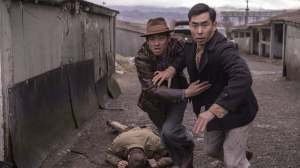 This show is groundbreaking. There have been a few movies about the internment, a few TV episodes. But they were just background for a love story. With this, we have ten episodes. That means ten hours, spread over a ten-week period to tell this story. We can go into detail.
Right after Pearl Harbor, young Japanese Americans, like all young Americans, rushed to the recruitment centres to volunteer to serve in the US military. This act of patriotism was answered with a denial. They were denied military service and categorized as enemy aliens, which was crazy. And then we were imprisoned.
After a year of imprisonment, the government realized there’s a wartime manpower shortage. And here are all these young people they could have had, but we categorized them as enemies. How do we justify drafting them out of a barbed wire prison camp? Their solution was a loyalty questionnaire.
Can you imagine, after impoverishing you and imprisoning you for a year, they demanded loyalty, very sloppily put together. And obviously ignorant people were writing the questions. Two became controversy. People got outraged. All ten camps were in an uproar. Everyone over the age of 17 had to respond to the loyalty questionnaire, 17 or 87, man or woman.
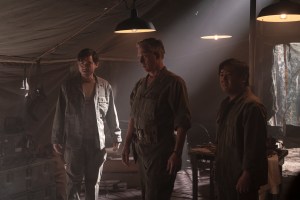 Question 27 asked, “Will you bear arms to defend the United States of America?” That being asked of my mother – I was by then six years old, my brother was five years old, my baby sister was a toddler. She was being asked to abandon us, to bear arms to defend the nation that’s imprisoning her family. It was crazy.
Question 28 was even crazier. It was one sentence with two conflicting ideas. It asked, “Will you swear your loyalty to the United States of America and forswear your loyalty to the Emperor of Japan?” We’re Americans. We never even thought of the Emperor. And for the government to assume that we have an inborn racial loyalty, a genetic loyalty to the Emperor was insulting, was ignorance.
A crazy level of racism.
It was, and ignorance. And if you answered “no”, meaning “I don’t have a loyalty to the Emperor to forswear”, that no applied to the first part of the very same sentence. If you answered “yes”, meaning “I do swear my loyalty to the United States”, then that yes applied to the second part, meaning that you were confessing that you had been loyal to the Emperor, and were now prepared to forswear it, and repledge your loyalty to the United States. My parents answered no to both of them and we were transferred to what they call a segregation camp for disloyals. It was not just another concentration camp. It had three layers of barbed wire fence. And, I mean, to really illustrate the overreaction, half a dozen tanks rolling around the perimeter to terrify us. They belonged on a battlefield.
 That’s a real terror.
Exactly. I mean, and our story goes into that as well. I mean, the stupidity of the government, and the cruelty of the government, and this show being aired now has an even more powerfully chilling ramification, a resonance to our times. At least we were together with our parents. The kids were together.
The Terror: Infamy begins on AMC UK on October 7 at 9 pm. Read our review of the first episode here
 Doctor Who News Star Trek News
 Sci-Fi Bulletin: Exploring the Universes of SF, Fantasy, Horror and Spy-fi!