The Singing Ringing Tree: Review
Network, out now A spoilt and capricious princess, a malevolent dwarf, a handsome prince transformed into a bear and a giant fish stuck in a frozen lake. If you’re already […]



Network, out now A spoilt and capricious princess, a malevolent dwarf, a handsome prince transformed into a bear and a giant fish stuck in a frozen lake. If you’re already […]
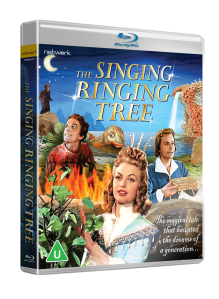 Network, out now
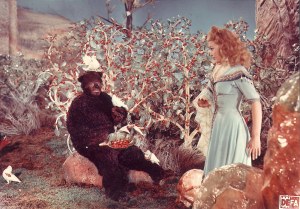
A spoilt and capricious princess, a malevolent dwarf, a handsome prince transformed into a bear and a giant fish stuck in a frozen lake. If you’re already breaking out into a cold sweat then prepare to hide behind The Iron Curtain and relive your childhood trauma…
Readers of a certain age will recognise some of the elements above from numerous BBC screenings between 1964 and 1980. I saw it a couple of times, 1976 at seven years old would have been my first, and much of it was burned into that part of my brain reserved for “things off the telly I’d rather forget”. The aforementioned fish is possibly the source of a phobia I still carry with me. A quick delve into various internet comments sections shows I’m not alone in considering this one of the classic “scarred for life” slices of telly.
What’s fascinating is that this doesn’t seem to be the case for those who saw it as intended. Here in the UK it was a three part series, originally shown under the banner Tales from Europe. These foreign films were often presented with their original soundtrack intact but with English-language narration overlaid. These were written by Peggy Miller and, in this case, read by Tony Bilbow, a very familiar BBC face in the ’60s and ’70s. Being split into three parts of course gave us two cliffhangers, and a whole week to process the very vivid and occasionally scary imagery. It also must be said that having the spoken German underscoring the narration adds an ethereal quality to the piece, as a young child unfamiliar with the language it would have seemed very strange, and bolstered its dreamlike nature.
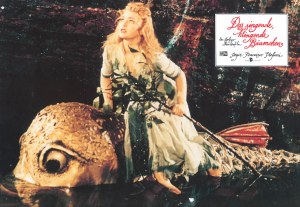 As intended it works a little differently. It was a proper motion picture, a huge East German hit, selling almost 6 million tickets in a population of 17 million (who admittedly probably didn’t have an awful lot on at the weekend once they’d finished controlling the means of production for the week). Inspired by the folktale Hurleburlebutz, collected by the Brothers Grimm, it can be seen as a simple prince meets princess meets evil dwarf story with a clear moral message about being kind. Or if you prefer a barely disguised depiction of the fall of the Third Reich (the princess at the start) to Communism (the bear) who together go on to thwart the wicked forces of decadent Western Capitalism (the dwarf). It doesn’t really hit you over the head with a hammer and sickle but it’s there if you want it – this is Eastern Bloc Cold War era material after all, albeit for kids.
This Blu-ray presents the film only as a whole, and I have to say although I recognised the moments that upset me when I was little, seeing it in one go would have lessened its long-term impact. All is made right at the end unsurprisingly. It seems like such viewers recall it as enchanting and magical rather than haunting and disturbing. I’d be fascinated to know what modern day youngsters would make of this, and if you have little ones I recommend showing it to them. Just make sure to be there for them afterwards just in case…
As mentioned the film is presented as a single piece, running at about 74 minutes. You have the choice of widescreen or fullscreen (i.e. 1.33:1). Most sources I’ve found suggest it was shown in the latter format, the widescreen version seems to have been prepared especially for this release – it’s not on either of Network’s earlier DVD issues. There are a variety of sound options with a choice between the original German or the narrated version in English (the default option), French or Spanish. Subtitles are available although these are for a translation of the spoken dialogue, no subtitles for the narration are provided. Incidentally it is worth giving this a watch with those subtitles, it’s interesting to see what the characters are more-or-less actually saying compared to how that’s conveyed as reported speech. The picture is nice and crisp for material of this type, the strong colours particularly bold and pleasing. I only noticed one brief moment where the picture seems to distort slightly, likely a bit of warped film, but it’s only momentary. The sound (in mono) is a little worse for wear in places with some noticeable distortion most apparent in some of the music cues and the occasional crackle, although the latter seems to be specific to the English dub not the film itself. Again considering the age and provenance of the source materials it’s not a huge issue and didn’t spoil my enjoyment at all.
 The package includes a booklet by Tim Worthington and the disc also includes a pair of extras previously included on the DVD – a selection of photographs accompanied by a lengthy suite of music from the film plus a 2003 interview with the Princess herself, Christel Bodenstein. She obviously has very fond memories of making this, and it’s lovely to see her all these years later. Incidentally her co-star, Eckart Dux as the Prince, now 94 years old, seems to still be a working actor in Germany and an in-demand dubbing artiste – he has voice credits as far back as Gunsmoke, via Norman Bates in Psycho, up to Gandalf in The Hobbit and LEGO movies.
I was a little worried that this would be one of those well-loved/feared childhood experiences that wouldn’t turn out to be interesting decades later. I’m happy to report that I really enjoyed seeing this again, it was clearly made with a lot of care and inventiveness and as a grown-up I was able to spot the influences of German Expressionism and other film techniques from the era which little me wouldn’t have had a clue about. This and other series like it (Heidi, Robinson Crusoe and Belle & Sebastian come to mind) were really a generation’s first exposure to European cinema, and it’s a pleasure to experience it now a little closer to how it was intended to be seen.
I’m still not keen on fish out of water though…
Verdict: Not just a nostalgia-fest for the over 50s, this is also a fascinating example of popular film from a culture not usually associated with such magical and colourful delights. 8/10
Andy Smith
 Doctor Who News Star Trek News
 Sci-Fi Bulletin: Exploring the Universes of SF, Fantasy, Horror and Spy-fi!