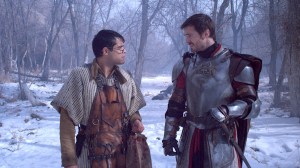
 Talon learns the full implication of Gwynn’s actions in saving her. Spears enlists some unusual help in trying to determine more about the cause of whatever turns people into Plaguelings. Withers has another investigation on his hands, and matters escalate between Elinor and The Worm.
I’m aware I’ve been really quite hard on The Outpost so far, so I went in this week with the most open mind possible. After all, just because a show is obviously cheap and more than a little tropey doesn’t mean that it can’t be fun. I decided to give the show the benefit of the doubt, and see if it would maybe lean into its shortcomings and let us know that it’s in on the joke.
But the thing is, I really can’t see that it is. One minute, during an examination of dead bodies, onlooking Munt opines to Spears about how ‘some women have desires for other women’. It comes almost from nowhere (there’s a kind of narrative justification, but it’s flimsy at best), and then in the very next scene, you have two women demanding that a third strip down and have a bath in front of them because ‘we’re all women here’, as the show’s writers artlessly elbow you in the ribs and theatrically wink (or at least that’s how it feels).
My main issue with the show (and there are many) is how disjointed proceeding feel. Take Janzo – the character is obviously supposed to be creepy, though I suspect he’s a lot creepier in actuality than the series is showing at the moment. He’s some kind of genius level alchemist who’s using his talents for brewing ale. Why this might be (or indeed why he walks permanently hunched over, as if auditioning for a role as Igor in some cheap Hammer Horror-wannabe version of Frankenstein), is never explained, or especially clear. Why he gets asked by Spears to help him in an important investigation, and indeed what Spears expects to be able to find that nobody else has before, is equally unclear.
But that’s OK because there’s a dozen other plot points, most of which feel as if they are each drawn from different shows, demanding your attention. There’s the odd fascination of Gwynn with Talon, which we assume isn’t sexual despite the show’s desperate mugging to camera, but which doesn’t actually seem to have any rational explanation. Then there’s the subplot involving The Worm and Elinor and the supply by one of some drug called Calypsum to the other. There’s a battle of wills going on here, but it’s between a man who alternates between being pathetic and dangerously scary depending on what scene he’s in, and a woman who looks like a panto dame fallen down into a midden. Tonally it shifts from oddball comedy to brutal nastiness and back again without so much as a pause for breath and it jars.
And then there’s the Blacksmith. The entire exchange between him and Talon in this episode just doesn’t make any sense, as he goes from refusing to explain anything to her ‘because she knows all that she needs to know’ to literally laying everything out for her thirty seconds later. How he came upon all this knowledge is just another mystery that the writers aren’t all that interested in, and it is a mystery, given that it ties intimately into knowledge of Talon’s own people, al of whom are dead but for her.
Oh, and the bad CGI demon thing is still wandering around town causing mischief – as little as possible and mostly in the dark, but still enough to show just how lacking the budget and imagination behind it both are. Between Talon’s search for her people’s killers, Plaguelings, the intrigue of the Calypsum trade, whatever secret Gwynn absolutely has but doesn’t want to say, the Prime Order, Withers, Demons running about the place and everything else, it’s difficult to care. All of it just feels ephemeral, like a hundred ideas were thrown at the board, and whatever stuck went in, regardless of whether it fit together or made sense.
Verdict: All over the place, from cheap innuendo and poor dialogue to sets which all look like sets rather than the locations they represent. I’m trying to find something in here to like, some quality to champion, even if it’s that it’s so bad it’s good. Thus far, it eludes me. 1/10
Greg D. Smith




 Sci-Fi Bulletin: Exploring the Universes of SF, Fantasy, Horror and Spy-fi!